In 2017, Armando Babaioff was performing in a production of Michel Marc Bouchard’s “Tom at the Farm” in Rio de Janeiro, and was looking forward to having Bouchard see the new staging. But when Bouchard, a Quebecois playwright, arrived, he thought he was in the wrong place.
Originally written in French, the play is set on a Canadian dairy farm. In Rio, Bouchard “saw buckets, a plastic tarp, a microphone, a pair of boots, and he went, ‘No, it’s not here,’ and left,” said Babaioff, who translated the play into Portuguese and led the Rio cast. (Someone from the production grabbed Bouchard and he saw the show. And liked it.)
Those spare elements provide the aesthetic and ambience of the director Rodrigo Portella’s production. They have also made it easy to move it around: Babaioff has performed “Tom at the Farm” around 600 times, all over the world, and now he’ll do so at NYU Skirball from Thursday through Saturday. It then travels to the Barbican in London, where it’ll run Oct. 13-17.
“I was 36 years old, and now I am 45,” Babaioff said. “My body is changing, and the world has changed a lot, but the play didn’t age one second. Here, in Edinburgh, in Paris, in Belgium, in Korea, the stories of the people are the same.”
Babaioff plays Tom, a graphic designer who is visiting the farm of Agatha (Denise Del Vecchio, the respected Brazilian stage veteran) and Francis (Iano Salomão). The occasion is the funeral for Tom’s lover — their son and brother. Agatha seems to ignore the fact her son had been gay, while Francis clearly despises it. The story unfurls in a tense atmosphere of secrecy and lies in which violence is always bubbling under the surface, and sometimes spills over.
Tom kicks off the show, presented with English supertitles, by describing the family house he’s discovering. “A wood stove with a chimney. Balcony. And a microwave. Rug. Table,” he says, in part.
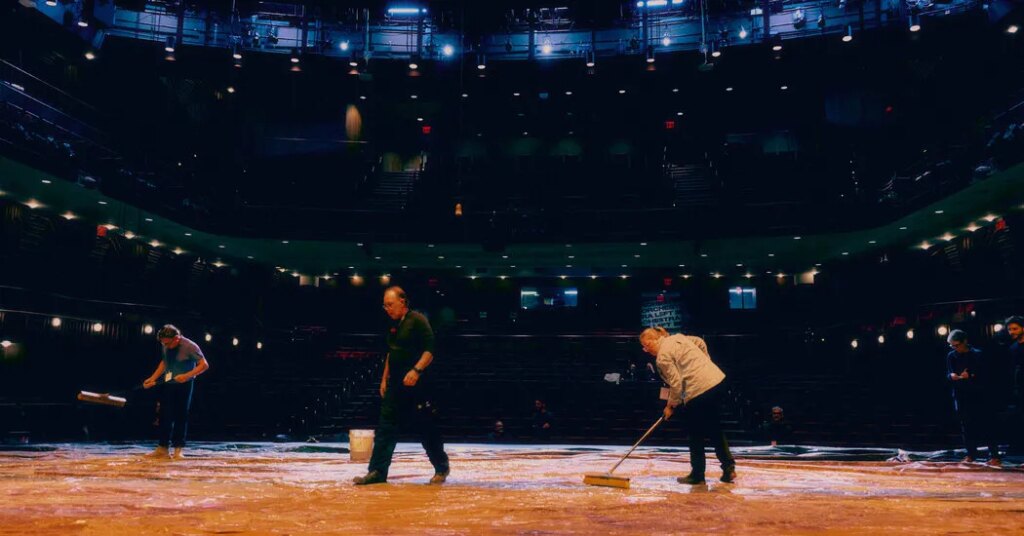
All we get from the set designer Aurora dos Campos, however, are a single bulb hanging from the ceiling and pails dotting an otherwise empty stage that’s entirely covered with a dark tarp speckled with dried reddish clay. “It is the color of Brazil,” Babaioff said, rubbing some of it on his fingers in a conversation backstage. “The color of the countryside, of the farms.”
Babaioff discovered Bouchard’s play in 2014, when a friend asked if he wanted to see the Xavier Dolan film adaptation in Rio. A dedicated theater actor, he decided to read the source material instead.
“Homosexuals learn to lie before they learn to love,” Babaioff said, quoting a line from Bouchard’s preface to the script. “I understood in that moment in my bed, reading the play, that I was in front of something powerful.”
From then on he was on a quest. He wrote Bouchard’s agent about the rights, laying out “the problematic situation that we’re living in Brazil.” (In addition to endemic issues, a presidential campaign had stirred up debates about corruption and government policies.) The plea was effective: “I bought the rights for less than — I don’t know, but it’s like minus, minus, minus, minus, minus, minus,” Babaioff said, laughing.
The rural setting was moved to Brazil, and Portella came up with the idea of mud, which carries a lot of symbolic meanings — creation, farm animals, a swamp.
About 30 pounds of stage clay adds mystery and even an inherent dramatic tension: The tarp can be slippery, and it bunches when stepped on, which requires the actors to be a little cautious when they move about. “The absence of stability is the base of our work,” Babaioff said.
As it becomes splashed with water, the coating on the tarp gets stickier, spattering the actors and eventually covering Babaioff in a thin film (“it’s good for the skin,” he joked).
The metaphorical is personal, too. Asked about the character of Agatha, who is a lot more complicated than first assumed, Babaioff simply said, “She’s my mother. I had to do the play to create a new relationship with my mother.” And that involved coming out to her. But, he said, “it was easy.” He mentioned that his mother, a seamstress, used to instruct him to “speak tough” when he was a kid. In retrospect he understood she had been afraid for him and was trying to protect him.
Babaioff has a host of plans these days, including directing, but his belief in the importance of “Tom at the Farm” has not faded. “It’s an honor to keep doing this,” he said.
The post Mud (Lots of It) Makes the Play appeared first on New York Times.