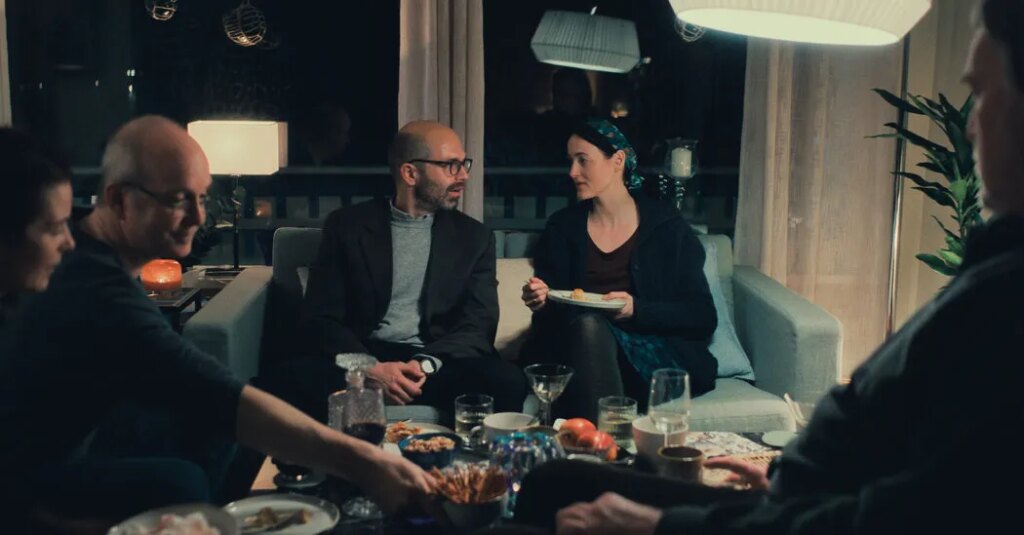
The sly provocation, “Fjord” largely takes place in a Norwegian hamlet nestled in what looks like heaven on earth. The setting is a small, thinly populated waterside town tucked in a valley and surrounded by sloping mountains. It’s an extravagantly, hypnotically beautiful place, the kind that sets hearts to thumping, adventurers to dreaming and Instagrammers to posting. On certain days, when the sea turns glassy, an inverse reflection of the mountains appears on the water’s mirrored surface — as if the world itself has flipped upside down.
This is the paradise that the Romanian writer-director Cristian Mungiu’s “Fjord” drops a family of devout Christians into, and where life soon goes askew. The Romanian father, Mihai (a very fine Sebastian Stan), and Norwegian mother, Lisbet (a muted Renate Reinsve), have five children and have moved to the town so her family can help out. The couple met, he explains to a colleague, when Lisbet was on a mission in Romania to support children in need. Mihai leaves it at that, but his words are haunted by the specter of the children who languished in the country’s orphanages during the Ceausescu dictatorship.
Mihai’s comment about needy children sounds almost like a throwaway, especially given that in the same conversation, it emerges that he’s an aeronautical engineer. For his new job, though, he will be running an local I.T. department, where he has a desk in a cramped, shared office. His professional trajectory seems the more relevant bit of character-revealing information than Lisbet’s former mission. Nothing, though, is incidental in Mungiu’s filmmaking, including in this exactingly constructed movie. Each word and shot, every glance and gesture — Mihai’s sober mien, Lisbet’s yielding smiles, the looming mountains, all the enormous picture windows — serve as revelatory pieces in the complicated whole.
One of the most acclaimed and prominent filmmakers to emerge out of the Romanian New Wave, Mungiu is perhaps best known to American audiences for “4 Months, 3 Weeks and 2 Days” (2008). Set in the late 1980s and before the fall of the dictatorship, it is a tough drama about two university roommates. One woman needs an abortion, and the other helps her procure it. It’s a place in which grim rooms suggests greater existential decay, and each face tells a story, despairing or resilient. The fulsomeness of Mungiu’s realism is intoxicating, especially in how it visually expresses the specific textures of every day life. He can be incredibly convincing, even when he pushes narrative ambiguity to opaque extremes.
The complications in “Fjord” emerge steadily and rapidly, and what soon seems like blunt inevitability. One day in gym class, a teacher notices a red mark on the face of the family’s eldest girl, the teenage Elia (Vanessa Ceban). The teacher then notices a larger blotch on Elia’s shoulder. Elia shakes off the teacher without a word, but the marks prompt the school to open an investigation with child protection services. It’s an outwardly casual process, at least at first, with Elia and her teenage brother, Emmanuel (Jonathan Ciprian Breazu), called in for a meeting at school without their parents. There, as the principal, Mats (Markus Scarth Tonseth), hovers, two women ask the teens about their lives, routines and faith.
In this first meeting, set in a brightly lit school office with a mountain view, Mungiu demonstrates his storytelling prowess and effectively announces the overall narrative arc with just a few pointed questions and a bombshell of an answer. The inquiry opens with one offscreen woman asking what seems like a curiously off-point question (“How often do you go to church?”), only to discreetly shift focus (“And what happens if you don’t do your prayers?”). As the women continue their gentle prodding, Elia, thoughtful and calm, mentions some kind of punishment involving a point system. The interlocutors again shift emphasis, with one woman asking if there’s physical punishment. “Define ‘physical,’” Elia responds.
Everything soon shifts for the family, and with escalating intensity. To Mihai and Lisbet’s shock, child protection services arranges the removal of the kids, who are placed in foster homes. With degrees of support from family and others, Mihai and Lisbet struggle to get their children back, which finds them navigating a bureaucratic system that seems, for all Norwegian smiles and indoor voices, hostile to their faith. Even the family’s first lawyer — a woman whose short bob and smart pantsuit contrasts sharply with Lisbet’s modest skirts and kerchiefs — doesn’t seem on their side. “What did you mean by ‘their culture’ and ‘our legislation,’” Mihai asks the lawyer, who promptly dumps them as clients.
Mihai’s confrontation with the lawyer is representative of the family’s conflict with child protection services that, by extension, pits faith against the state, religious traditionalism against progressive liberalism. It’s a juicy subject that Mungiu takes on dryly, at times clinically and with punctuating dark comedy. Sometimes that humor has an uneasy sting, as when Mihai, who’s been chopping wood, argues with Lisbet. “You did your best,” he says. “Now I take over,” he adds, forcefully swinging the ax down on the chopping block, and ever so briefly, summoning up a leeringly deranged Jack Nicholson in “The Shining.”
It’s a characteristically rich, resonant moment in a movie that is easier to admire visually than anything else. That Mungiu’s sympathies lie with the family is obvious from the start; when two agents tell Lisbet they’re also removing her baby from the home, they announce it while flanking her, a setup that’s the cinematic equivalent of a military pincer movement. Again and again, Mungiu teasingly pushes the viewer toward the obvious even as he withholds information, including about the severity of the apparent abuse. It’s only on those all-too brief occasions when Elia and Emmanuel sneak out to be with a friend does Mungiu suggest another possible world, one with the freedom no one else here seems interested in.
Fjord Not Rated. Running time: 2 hours 26 minutes. In theaters.
The post ‘Fjord’ Review: A Moral Rorschach Test appeared first on New York Times.