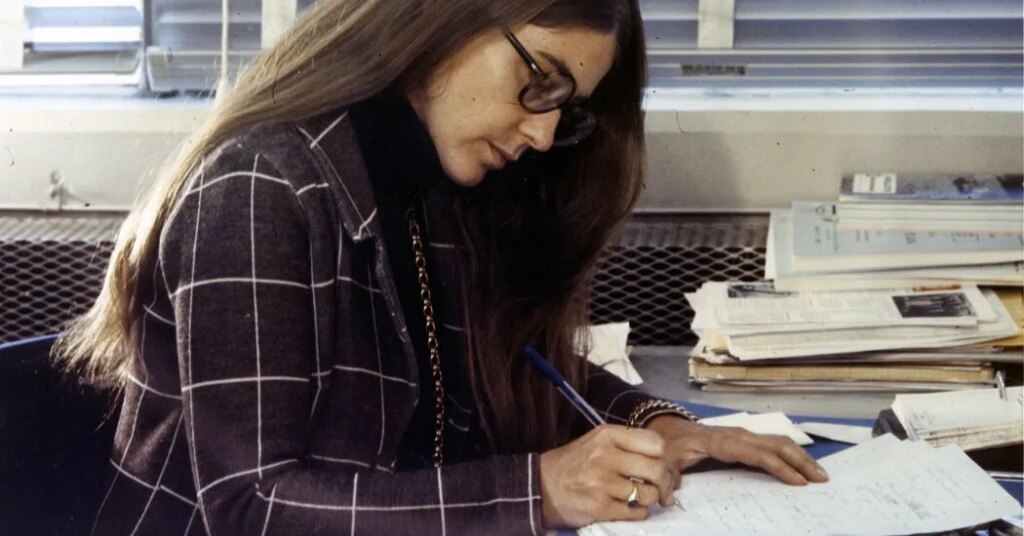
Long before software engineering became a boys’ club — the exclusive domain of tech bros and a mythical force that threatens to either transform the world or snuff it out — it was just Margaret’s thing.
“There goes Margaret with her software engineering,” Margaret Hamilton recalled being ribbed by her colleagues in the 1960s at Massachusetts Institute of Technology’s Instrumentation Laboratory. Ms. Hamilton led the software engineering division there, programming the on-board computers that guided the Apollo spacecraft to the moon, and argued that software ought to be on the same plane as the then-more-glamorous endeavor of building hardware.
But her insight wasn’t seen as visionary at the time; it was more like a quirky inside joke.
Ms. Hamilton, who died last week at the age of 90, is a classic “hidden figure” in science history — a trailblazing woman who played a crucial, largely unseen role in a field where the protagonists were mostly men.
Her overlooked contributions were catapulted into the spotlight in recent years, propelled forward by a charismatic photo. Ms. Hamilton, 5-foot-4, stands, grinning, next to an equally tall pile of printed-out software code. In 2017, the tableau was recreated by Lego, as part of a “women of NASA” set.
Today, the business of software mints billionaires and is dominated by men.
That was not always true.
Ms. Hamilton fit into a lineage of female pioneers in computer science, before the field was considered prestigious or lucrative.
In the 1840s, Ada Lovelace wrote the first computer program long before the first computer. She devised an algorithm that was intended to run on the steam-powered “analytical engine” that Charles Babbage had proposed.
During World War II, the Eniac Six were six women who programmed the first general-purpose, electronic digital computer to calculate ballistic trajectories. Men built the computer, but programming was considered tedious and so was left to female mathematicians to handle.
In the 1950s, Grace Hopper invented the computer compiler, translating English-like programming language into instructions that a computer could understand and execute.
In the space program’s earliest days, women, including Black women, worked as “human computers,” carrying out essential calculations by hand.
When Ms. Hamilton began her career in the late 1950s, her programming peers were overwhelmingly men, she recalled in interviews. This was the decade when women flowed into the work force, and even professions like medicine and law were opening up to them.
“Then you were sort of like just an exception because you just sort of were doing a good job so they decided to give you more,” she recalled in a 2017 oral history for the Computer History Museum.
For the Apollo program, she led the software engineering division at the M.I.T. lab, which had won the contract to program the spacecraft computers. The monumental task before her team was to make sure the software was safe for people, or “man rated,” in the parlance of the day.
“If it didn’t work, a person’s life was at stake — if not over,” she said. “That was always uppermost in my mind and probably many others as well. It had to be man rated, and it had to work the first time.”
Ms. Hamilton’s conviction that computer science was a form of engineering would augur the field’s future. As computing left the rarefied world of the cosmos and came down to earth, the cachet, status and salaries of the people who did it rose.
But while Ms. Hamilton is credited with popularizing the term “software engineering,” it seemed to her that it was only when a man — a “hardware guru” — argued in a meeting that “You know, Margaret’s right,” that people began to listen.
There were the hardware engineers, Ms. Hamilton recalled in the oral history. And the aeronautical engineers. “But we were the programmers, and we were kind of like second-class citizens,” she said. “I mean, you know, we’d take the stuff and we’d ‘make it run,’ right?”
Maria Zuber, a geophysicist at M.I.T. who led the NASA GRAIL mission to map the moon’s gravity, said that she never met Ms. Hamilton, who was a generation ahead of her in science, but that she admired her “extraordinary technical and leadership talents.”
“When you see someone like her who went for it and lived her dream it makes it a little easier for the rest of us to dare to reach for the moon as well,” Dr. Zuber said in an email.
As Ms. Hamilton reached icon status in recent years, she was frequently asked to reflect on what it was like to be a female engineer in the “Mad Men” days of the 1960s.
At one job, she recalled, a colleague asked her: “‘How can you do this? How can you work here when you have a baby at home?’ And I remember, I’d not been asked that before. I said, ‘Well, you know, you have to do what’s right for you and I have to do what’s right for me.’”
During her work on the Apollo software, she brought her daughter, Lauren, to work on nights and weekends. Lauren would pretend to be an astronaut, pressing various buttons on the module — and once caused a simulation to crash. This revealed “the Lauren bug.” Her bosses said it did not need to be fixed, because astronauts were better trained.
“I said, but what if it does happen?” she recalled in an interview in 2019 as part of the 50th anniversary of Apollo 11. “My whole emphasis was always ‘What if?’”
During Apollo 8, she said, an astronaut did press the button during flight when he was not supposed to.
“Right after that flight I was allowed to put that fix in there,” Ms. Hamilton recalled.
That caution — prepare for the unexpected — proved crucial as Neil Armstrong was flying the Apollo 11 lunar lander. Ms. Hamilton and her engineering team had anticipated that the tiny computer might become overwhelmed by the deluge of data during descent.
Because of an unfortunate confluence of events, that is exactly what happened. A series of foreboding alarms sounded. By design, the computer jettisoned its nonessential tasks without crashing, and the landing succeeded.
After the moon landings, Ms. Hamilton went on to found companies and continued to work in software engineering.
But for decades, almost no one had heard of her or known her role in Apollo. In The New York Times archives, there is no mention of her until 2005, and that article described her, in passing, only as “one of the hundreds of programmers who worked on the software.”
The number of women majoring in computer science rose through the 1970s and peaked in 1984 at 37 percent. That was a few points lower than the percentage of women in law school but higher than medical school and physical science majors.
But the rise of personal computers turned the field into something more like tinkering with automobiles, and the culture shifted. During the 1990s, a photo of a Playboy centerfold became one of the standard images used to test digital processing techniques.
“I was surprised that it almost seemed to be worse in some ways today than it was back in the early days,” Ms. Hamilton said in 2017.
While women continued to become more prevalent in law, medicine and science, they fled computer science, dropping under 20 percent before nudging back up slightly in recent years.
Ms. Hamilton did not always see herself as the symbol she would later become.
“I was so involved in what we were doing, technically, that I was oblivious to the fact that I was being outnumbered by men,” she said in a 2015 interview. “In the case of the Apollo project my colleagues (mostly male) and I were friends and we worked side by side to solve challenging problems and meet critical deadlines.”
Ms. Hamilton added: “We concentrated on our work more than whether one was male or female.”
She noted her surprise that, decades later, many things had not changed for the better.
“When discrimination against a woman exists today, it is usually more subtle than it would have been back then,” she said. “That has its advantages and disadvantages.”
The post Before Computer Science Became a Boys’ Club, Margaret Hamilton Wrote the Code appeared first on New York Times.