In today’s edition … Republican money isn’t going as far as expected … I ask you about politicians who “bring home the bacon” … but first …
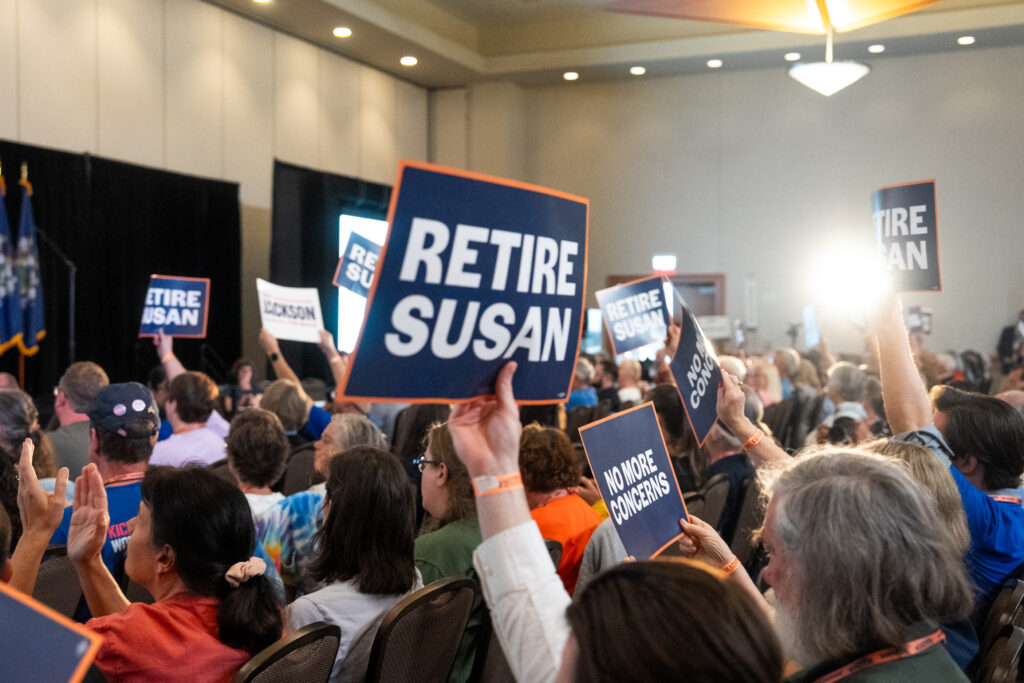
Collins faces her biggest test yet
Susan Collins is used to difficult reelection campaigns.
As the Republican senator told me over the weekend in Augusta, Maine, “I was a top target in 2020, I was the top target in 2014, in 2008. I mean, I’ve always been a top target.”
Collins is, once again, a top target and has tried to use a mix of selective defiance toward President Donald Trump and canny use of her Senate seniority to steer millions to the small state for local works projects to run as far ahead of the Republican president as possible.
But this year may be different.
That is what I found when I went to Maine recently (and reported this story that was published yesterday afternoon).
To put it bluntly: Trump is everywhere in the race between Collins and Democrat Troy Jackson. When voters talk about the contest, they invoke Trump more than they do the two candidates. Democratic ads accuse Collins of doing “whatever Donald Trump wants,” and Jackson has claimed that the president “owns” Collins. The senator’s supporters privately acknowledge that if Collins loses, Trump is likely to take the blame. And even Collins is willing to talk about how Maine voters really don’t like Trump, telling me that he is an “unpopular president” whose “numbers in Maine are terrible.”
The argument against Collins is pretty simple: Her detractors want to punish Trump, deny him a Republican-controlled Senate, and are willing to oust Collins to do it, particularly because they feel she doesn’t do enough to check the president.
Collins told me that argument is shortsighted.
“Although I am certainly not the president’s favorite Republican or favorite senator, by any stretch, I am able to work with members of his team in a way the rest of the delegation cannot,” she said.
But what really stood out in the reporting were my conversations with voters in Maine. Often when I speak with voters, it’s pretty clear who they support in a certain race once I learn their voting history. That isn’t entirely true in Maine.
Take Bob Cravens, 72, who spoke with me between sips of a Manhattan at a popular bar in Ellsworth, Maine.
“It’s not even anti-Susan Collins; it’s anti-Trump,” Cravens said of his vote in this election. “I like Susan Collins. I like what she’s done in the past. I voted for her. I think she’s competent. But God could be running as a Republican and I would vote against him or her because I think this country will be destroyed if Trump has another two years unfettered.”
He wasn’t alone.
I spoke with Doug Smith, 76, and Robert Alley, 83, along Main Street in Bucksport, Maine. The duo has been friends for decades. They both worked at the local paper mill before it closed in 2014.
Smith voted for Collins in 2020. But he can’t do it again in 2026.
“She’s done a lot for the state, but we need people in there that will bring Trump under control,” Smith said. Trump has “shown himself to be who he is” during his second term in office, he said, and Collins hasn’t met the moment.
Alley is a diehard Trump supporter and told me he would vote for him again, if he could. He said he will probably vote for Collins again, but would like to see someone younger run and win. But he cited Collins’s work to help Maine communities as a reason to support her.
“You see this new tar? Supposedly Collins got the new tar there,” he said, pointing at the new pavement on the street.
Interestingly, Collins also has some supporters among anti-Trump voters. Beth Clark, 54, is a self-described liberal and former social worker. She has never voted for Trump, and described the president as “a neo-Nazi in disguise.” And yet, Clark plans to vote for Collins because she supported a youth diversion program.
“She was here a long time before Trump was,” Clark said. “And we need somebody that we know is not like him and I know Susan Collins is not like Trump. She is not.”
Collins and Jackson debated for the first time on Tuesday, and the clash centered on a bunch of the issues highlighted above, like the senator’s ties to Trump, what Collins’s seniority means for federal dollars coming into Maine, and Trump’s unpopular tax and spending bill passed last year.
“Senator Collins is like an arsonist who helped set the fire and now she wants credit for bringing a cup of water to put it out,” Jackson said after Collins touted her work to protect rural hospitals impacted by that bill.
You can read my colleague Liz Goodwin’s full report on Tuesday’s debate here.
And you can read my full report from Bucksport, Maine here.
Want this in your inbox?
Start your day with The Washington Post’s flagship political newsletter. Sign up here.
From across the newsroom
- Trump wants to turn his Palm Beach golf course into the new Camp David, from Meryl Kornfield.
- The unexpected ways that AI is reshaping the U.S. economy, from Shira Ovide.
- Israelis scared by Oct. 7 attack weigh Netanyahu’s political future, from Lior Soroka.
- Reports of sexual violence are up. Data from Cornell and other colleges in 8 charts, from Todd Wallack.
- Another sign of rapidly expanding political map: Pollsters can’t keep up, from Katherine Doyle.
- Christa Pike is conscious and speaking after failed execution, attorneys say, from Brady Dennis, Katie Mettler and Mark Berman.
What I’m watching
Months before Labor Day, Republicans had a unified response to polls and reports of bad news for the party: Wait for the money.
And they were right, to a degree. Republican groups had a substantial money advantage nationally. Party committees and Trump-controlled groups continually built on that advantage. And then the president really opened up his war chest around Labor Day, the unofficial start of the general election.
But what has happened since then? In short: Not much.
That is what my colleague Isaac Arnsdorf found in his latest report that details how the surge in Republican money since Labor Day has been followed by credible polls that show Democratic candidates tied or leading in Alaska, Georgia, Maine, Michigan, North Carolina, Ohio and Texas, basically the same as before Labor Day.
Facing an environment that has shifted greatly since the 2024 election, which saw the party make gains in key battleground states and with voting blocs that had traditionally backed Democrats, one of the few things candidates and party operatives could lean on was money. But what the last few weeks have shown is that the money is only holding some of these races in stasis, not reversing the environment.
And GOP money is being spread out more than ever before, with Republicans now spending campaign cash in places like South Carolina, Kansas and Texas, three historically deep red states.
You can read Isaac’s smart report here.
In your local paper
Kansas Reflector: Farmers in deep red Kansas are frustrated with the nation’s immigration policy, the outlet reports. The state’s agriculture and rural communities need immigrants to keep production going, said farmers, and a lack of immigration reform is hurting their businesses.
Ohio Capital Journal: Two Ohio Democrats, gubernatorial candidate Amy Acton and Rep. Marcy Kaptur, made comments that LGBTQ activists deemed anti-transgender, leading to blowback. Democrats have grappled with how to handle questions about transgender communities amid fervent Republican attacks.
Newsday (New York): Cornell University is bringing in Sally Q. Yates, a former high-ranking official at the Department of Justice under Barack Obama and Trump, to review the school’s handling of sex assault claims after allegations of a gang rape in 2024 at a fraternity house have rocked the campus.
From you
Yesterday, I asked for your thoughts on large oil companies and climate change. Most of you would like to see the companies held liable. But some are skeptical that they will be.
“Of course they should. Oil companies have known since the 1950s of the environmental and climate effects of burning fossil fuels. Only political and legal (i.e. suits) pressure will force them to act,” wrote William Hill. “The case is similar to big tobacco, where companies took decades to change and to pay for the harm their product was known to cause.”
My question stemmed from a Supreme Court case that my colleague Justin Jouvenal wrote is about “whether to let a novel lawsuit go forward that is seeking to hold two large oil companies liable for the effects of climate change.”
“I expect that Big Oil has some responsibility for climate change — but I’m not sure that I can really say how,” wrote Doris B. Mabrey. “Climate Change is much bigger than one business segment.”
And Jerry Tepe wrote, “The case reminds me of the shakedown of big tobacco decades ago. The states got a pile of money much of which was spent on items unrelated to the suit.”
Send a reply
What do you think about senators who use their powerful perch in Washington to steer money home to their states? The practice is core to the argument Collins supporters in Maine are making about her reelection. It reminds me of how former Senate leader Harry M. Reid ran for reelection in Nevada (my home state) in 2010.
Do you think bringing federal money home should matter? How do you balance that argument with other national issues on the table this election? Let me and your fellow Early Brief readers know at [email protected].
Thanks for reading. You can follow me on X at @merica.
The post Susan Collins faces her biggest test yet appeared first on Washington Post.