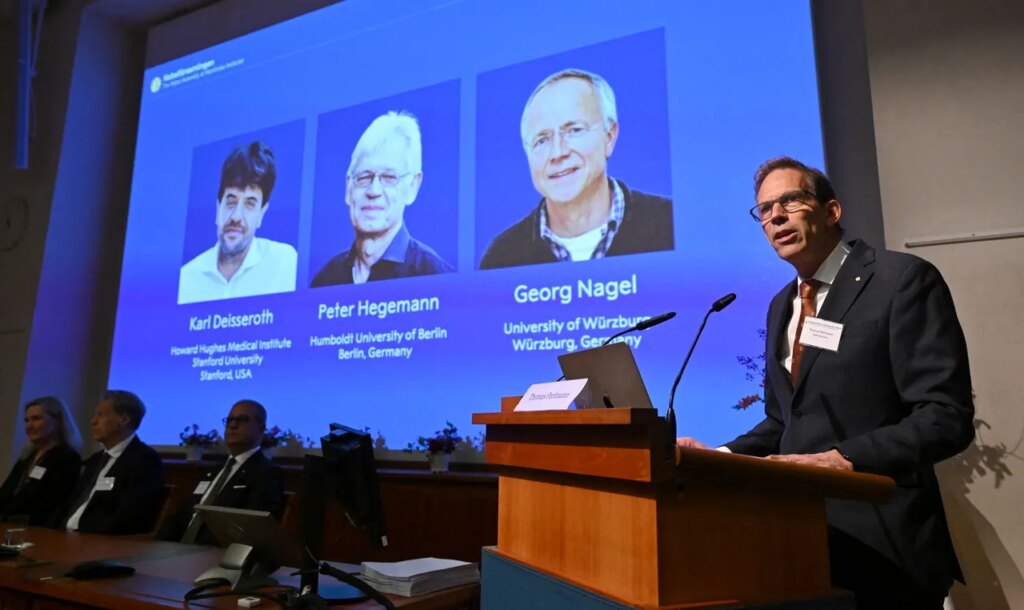
The Karolinska Institute awarded the 2026 Nobel Prize in Medicine to researchers Karl Deisseroth of Stanford University, Peter Hegemann of Humboldt University in Berlin, and Georg Nagel of the University of Würzburg. Their discoveries led to the development of optogenetics, a technique where scientists can turn individual nerve cells on or off using beams of light.
According to Per Svenningsson, chair of the Nobel Committee for Medicine, “Optogenetics provides opportunities for mapping the brain in a way that we could once only dream of.” No other technique allows for such precise study of a living brain, helping researchers better understand the functions of our nervous systems as well as various neurological diseases and disorders.
But this prize is not just a celebration of neuroscience. It also serves as a triumphant example of what can happen when different disciplines of biology converge, as the findings that served as the basis for the development of optogenetics emerged from research in microbiology.
At the end of the last century, Peter Hegemann began a series of studies to understand how the single-celled alga Chlamydomonas is able to detect and react to light. Previous research documented that Chlamydomonas has an “eye spot,” a small orange dot on its surface that contains a light-sensing molecule called retinal.
Hegemann used tiny electrodes to measure the electrical signals generated by the alga and to expand our understanding of this structure’s rapid response. The scientist discovered that the organism was capable of producing an electrical impulse about 0.5 milliseconds after receiving light. This response time is 20 times faster than that of the human eye, whose light detection process takes at least 10 milliseconds.
Hegemann suggested that light detection in the alga must be the result of a much simpler process than that identified in the human eye. In the early 1990s, he proposed that the eye spots contained a protein that both detected the light and responded to it, likely opening as a channel to let ions through. At the time, this hypothesis sparked controversy. Many ion channels had been documented up to that point, but none could respond to light on their own.
To test his theory, the scientist attempted to isolate the light-sensitive proteins from the eye spot. However, when removed from their natural environment, these proteins became unstable. Later, a group of Japanese researchers sequenced the complete DNA of Chlamydomonas, which allowed Hegemann’s team to identify two genes that would create proteins with the expected characteristics of a possible light-sensing channel.
Georg Nagel took the next step of verifying the function of the genes. He introduced copies of each of the identified genes separately into different groups of frog eggs. The eggs began to produce the corresponding proteins, which eventually localized to the cell membranes. Nagel then turned on the lights.
Both proteins functioned as ion channels that opened when exposed to light. He named the genes channelrhodopsin-1 and channelrhodopsin-2. Further experiments showed the protein produced by this second gene—called ChR2 for short—opened especially quickly, the flow of ions occurring in just 0.2 milliseconds. It explained the extraordinary speed of the light reaction originally observed in Chlamydomonas.
When the researchers introduced the gene into mammalian cells—which do not normally respond to light—the cells generated an electrical signal when illuminated. This is what got the neuroscientists particularly excited.
Ion channels are important across many types of cells, but they do some especially heavy lifting in our nervous systems. The electrical impulses that neurons use to communicate with one another, as well as other tissues in our body, are mediated by the flow of ions in and out of the cell. If you can control the ion channels, you can control the neuron.
This is where Karl Deisseroth comes in. Deisseroth was searching for a method that would allow him to toggle the activity of specific nerve cells in a living brain. In his view, this tool could expand our understanding of brain functions and open new avenues for treating conditions such as depression and schizophrenia.
Following the discovery of ChR2, he asked Nagel for the DNA sequence so he could introduce it into rat nerve cells. The neurons, growing in dishes, produced ChR2 and, when illuminated with blue light, reacted immediately—sending an electrical impulse that propagated to other neurons. This result, obtained in 2005, was decisive in establishing ChR2 as a tool for neuroscience.
In the following years, Deisseroth, Hegemann, and Nagel collaborated to identify other proteins capable of activating or deactivating neurons using different wavelengths of light. With this toolkit, researchers can now design experiments where one group of neurons is turned on by one wavelength of light and another set of neurons is controlled by a different wavelength.
The term optogenetics was coined in 2006 and has since been implemented in a variety of studies. “Using optogenetics, researchers have been able to reveal neural circuits governing specific memories, feelings, and behaviors relevant for neurological and psychiatric disorders. In clinical medicine, researchers are using the method in attempts to restore sight in people with visual impairment,” the Nobel Assembly at the Karolinska Institute stated in a press release.
This story originally appeared on WIRED en Español and has been translated from Spanish.
The post The Science Behind the Nobel-Winning Technology That Controls Neurons With Light appeared first on Wired.