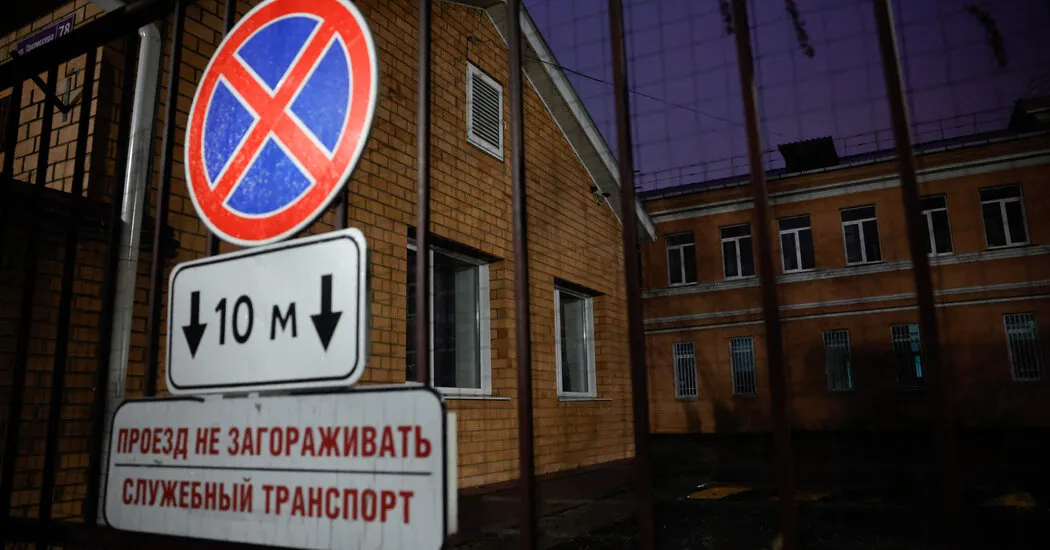
The Russian authorities gave additional information on Wednesday about the mysterious death of a researcher at a Siberian institute that studies the plague, saying that she had been vaccinated against the disease and that no “emergency situations” had been identified at the lab.
Rospotrebnadzor, the Russian health regulator, issued the statement after the United States urged Moscow to be more forthcoming about the possible public health incident.
The paucity of details in Russian official statements and the absence of international health officials on the scene have led to questions about the Russian government’s insistence that it has the situation under control. The world has remained on high alert about public health threats in the aftermath of the Covid pandemic.
On Oct. 2, Darya Shipilova, a 28-year-old researcher at the Anti-Plague Institute of Siberia and the Far East in Irkutsk, died from pneumonia of an unknown origin at a hospital in Shelekhov, the town where she lived, prompting fears of a pneumonic plague outbreak.
Ms. Shipilova had been vaccinated against the plague and therefore “had immunity to the dangerous infections she worked with,” the Russian health regulator said on Wednesday. The statement implied that Ms. Shipilova had a lower risk of contracting the plague, though vaccination would not definitively rule out becoming ill with the disease.
Rospotrebnadzor also said that two commissions monitoring biological safety had inspected the institute. “No emergency situations were identified during work with pathogenic microorganisms,” the health regulator said.
Tests on Ms. Shipilova’s remains, the regulator previously said, had not found evidence of any of the microorganisms she worked with at the institute.
Medical observation has been completed for more than 90 percent of the people Ms. Shipilova had been in contact with, and “no health impairments related to infectious pathology were detected,” the Russian regulator added. Nearly 5,000 laboratory tests revealed no hazardous pathogenic microorganisms, its statement said.
“Preventive and anti-epidemic measures have been organized to an exhaustive extent,” Rospotrebnadzor said in the statement. “There are no epidemiological risks for the population of Irkutsk and the Irkutsk region.”
The Russian authorities released the additional information after the State Department sent a formal diplomatic note, known as a démarche, to Russia asking for more information about a possible outbreak.
Secretary of State Marco Rubio also voiced the request publicly on Tuesday during a trip to Iceland, noting that the United States was monitoring the situation.
“I think it’s incumbent upon Russia to obviously share more information with the world,” Mr. Rubio said. “We’re watching it very closely, hour by hour.”
Ms. Shipilova’s unexplained death prompted the Russian authorities to quarantine part of the hospital where she was taken, the institute’s staff and other people whom she had come into contact with in her final days. Other facilities in and around Irkutsk also implemented restrictive measures, in some cases as a precaution.
In the immediate aftermath of Ms. Shipilova’s death, the Russian authorities gave only sparing public statements, failing to clarify the researcher’s whereabouts before her death or to address questions about whether an accident had taken place at the institute.
Aleksei Tsydenov, the governor of the Buryatia region, which borders Irkutsk, initially said that Ms. Shipilova had died of the plague and then edited his statement to say that she had “possibly” died from the illness.
The Russian health regulator also waited five days after Ms. Shipilova’s death to reveal her vaccination status. An independent Russian publication, People of Baikal, cited a former intern at the institute who said all employees were vaccinated against the plague as a precaution.
The Kremlin spokesman, Dmitri S. Peskov, has regularly referred questions to Rospotrebnadzor, which has not held any news conference on the matter. President Vladimir V. Putin of Russia has not publicly commented.
The relatively thin details from the Russian authorities have unnerved U.S. officials and others around the world who remain scarred by the Covid pandemic and efforts by the authoritarian government in China, where the virus originated, to cover up information.
The Chinese government has so far offered a muted response to the reports from Russia.
“China and Russia maintain close exchanges and cooperation in the field of infectious disease prevention and control, including the plague,” Guo Jiakun, a spokesman for the Chinese Ministry of Foreign Affairs, said on Tuesday in a brief online response to a question about whether Moscow had notified Beijing about the possible plague case.
Pneumonic plague causes a severe rapid-onset lung infection and is considered the most virulent form of the plague. It results from the same bacteria that cause the bubonic and septicemic plagues.
Unlike Covid-19, the disease can be treated effectively with antibiotics, but it must be caught very quickly.
Experts have said that even if plague were confirmed in the Russian case, the risk of widespread contagion would be limited. In a statement on Monday, the World Health Organization said that based on available information, “the public health risk to the general population appears to be low.”
On Wednesday, the organization’s leader, Tedros Adhanom Ghebreyesus, said in a statement that the Russian health authorities had informed the W.H.O. that the Irkutsk region had not registered any confirmed cases of the plague. Russia told the agency that an epidemiological investigation had been conducted, with contacts of the deceased observed and tested, and “no high-threat pathogens had been detected.”
Mr. Ghebreyesus said the W.H.O. had requested further information to clarify the cause of the severe pneumonia, the pathogen that prompted the public health measures, and media reports of a second employee with pneumonia of undetermined cause.
The New York Times was not immediately able to identify any credible media reports of a second employee from the Siberian institute coming down with pneumonia. A spokesman for the W.H.O. declined to provide clarification about what media reports Mr. Ghebreyesus was referring to in his statement.
Ms. Shipilova’s mother, Svetlana Shipilova, said in an interview with a local Russian news outlet, Glubina, that she was upset about friends believing “nasty stuff” about her child, including an unverified report that suggested her daughter had become ill after breaking a test tube.
“Not all doctors even realize that a test tube is impossible to break. Even if you throw it against a wall,” she said from quarantine. “Only an amateur could say that. Even hypothetically, it’s simply impossible to spill or break. They’re so protected.”
President Trump has offered help to Russia in dealing with the situation in Siberia, but Russian officials have responded by saying that they have it under control.
“It is always very good when offers of mutual assistance are made,” Mr. Peskov, the Kremlin spokesman, said.
On Tuesday, Mr. Trump told reporters that he would hold a call “very soon” with Mr. Putin to discuss the matter.
Elena Sofina, the deputy mayor in Shelekhov responsible for social affairs, said in a statement on Tuesday that Russian officials could handle the situation themselves. She called the matter “completely under control.”
“A dangerous diagnosis has not been confirmed, but we are still following all protocol measures,” Ms. Sofina said, adding, “We continue to work.”
Edward Wong, Chris Buckley, Oleg Matsnev and Alina Lobzina contributed reporting.
The post Russia Says It Found No ‘Emergency’ in Plague Lab appeared first on New York Times.