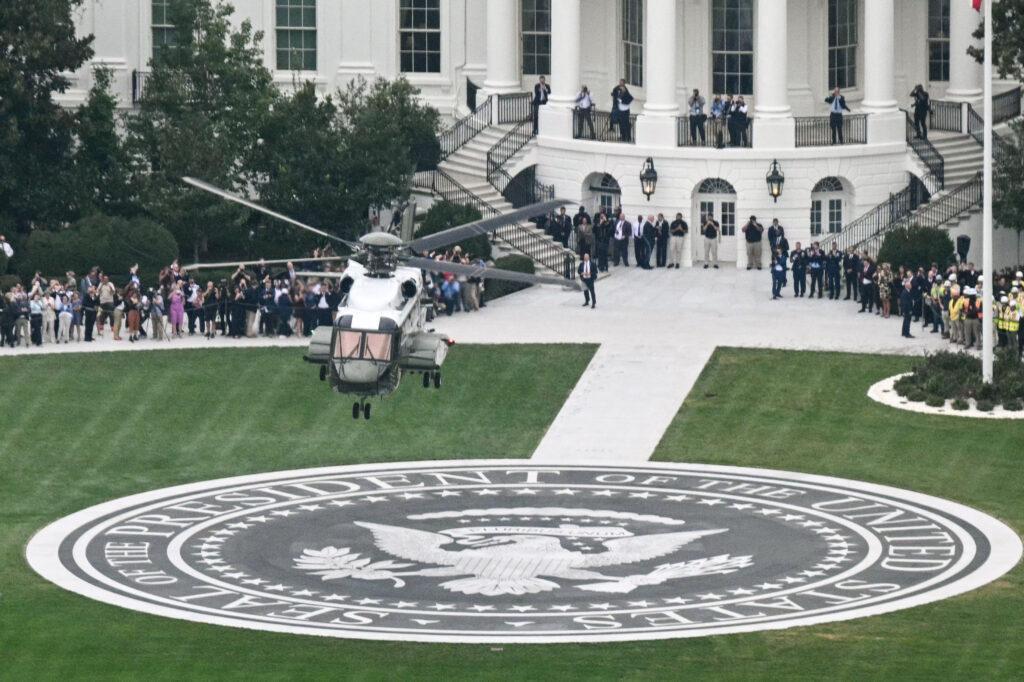
Following a safety incident involving communication issues between President Donald Trump’s Marine One helicopter and Reagan National Airport in August, a new protocol has been set up to make sure air traffic controllers are notified that the president’s helicopter is about to take off, according to two people familiar with the matter.
Under the old policy, Marine One was supposed to give air traffic controllers at National Airport a three-minute warning before taking off, which allows the controllers to clear the airspace and give the helicopter an unimpeded route to Joint Base Andrews in Maryland.
Under the new policy, Marine One still has to give that three-minute warning, according to the people, who spoke on the condition of anonymity because they were not authorized to comment. But now a separate entity, the National Capital Region Coordination Center, also is supposed notify the airport’s air traffic control tower before the president’s helicopter takes off. The coordination center oversees airspace security in the D.C. area.
The arrangement is intended to create a backstop in the event of future communication issues between Marine One and National, which is also known as DCA, they said.
The White House referred The Washington Post to the Federal Aviation Administration for comment. An FAA spokesperson confirmed that a memorandum of understanding regarding the policy had been signed in recent weeks.
The U.S. Secret Service did not respond to a request for comment.
When Trump took off from a temporary spot at the Ellipse on Aug. 4, air traffic controllers at National had not stopped commercial flights. The FAA said there was a “momentary loss of separation” between Marine One and a commercial jet, after which the aircraft continued to move away from each other.
A loss of separation refers to when two aircraft come closer together than they are supposed to. A preliminary FAA estimate found that at their closest, Marine One and the commercial jet were about 0.82 miles apart laterally and about 700 feet vertically, the National Transportation Safety Board said in a preliminary report on the incident.
According to the preliminary report, air traffic control recordings reveal Marine One’s first attempt to contact the air traffic control tower was not received at all, and the second attempt was “broken and completely unreadable.”
Marine One was departing from the Ellipse while construction was underway at the White House, according to the report. Technicians later determined the temporary location was in a position that did not provide a direct line of sight for needed radio communications, according to the NTSB.
Following the incident, the White House said the president was never in danger.
The post New policy aims to give DCA extra warning when Marine One takes off appeared first on Washington Post.