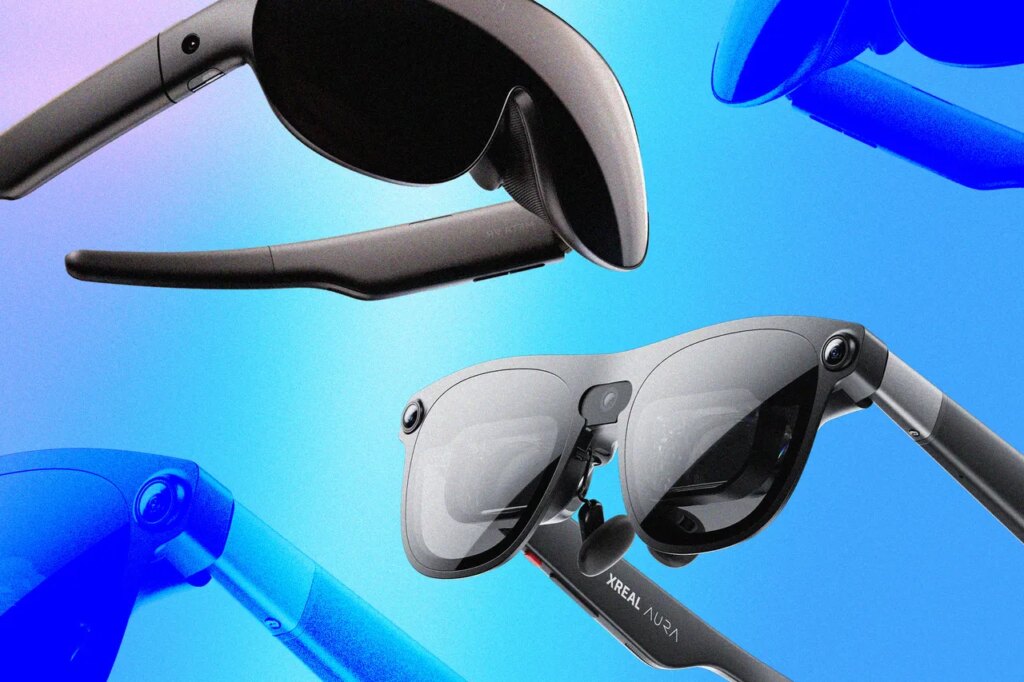
I’m sorry to say, but the $1,299 Meta VR Glasses might just be very good.
That’s despite the company’s well-earned flak over privacy issues with its smart glasses and the general uneasiness people feel about being recorded. But in the 30 to 45 minutes or so I spent wearing the mixed-reality glasses at Meta’s Connect event in September, I was astounded by the video quality and wearability of a device that has for so long come in the form of a heavy, hot headset.
But it’s not the only big dog in the face computer world. Not by a long shot. Xreal, known for its virtual-display glasses, has partnered with Google to build mixed-reality smart glasses on the Android XR platform—the Xreal Aura. On Wednesday, the company announced the official price, starting at $1,279. That’s 20 bucks cheaper than Meta’s VR glasses. Unlike Meta’s option, the Aura glasses come out this year.
The Auras are available for preorder, but only for people who have already placed paid reservations. Preorder options will open up for the general public “in the coming weeks.” The starting price is for a model with 12 GB of RAM and 256 GB storage. Xreal says units will ship in the US, Canada, Japan, and South Korea. It will launch in more regions in 2027.
I tried both. I attended a demo of the Aura glasses, which was deliberately held a day after Meta announced its VR Glasses at Meta Connect. My immediate takeaway was that these glasses are direct competitors, with very similar experiences. Put on a pair, and you can watch videos, play games, or project a multi-monitor workplace setup. Some of those experiences work better on one device or the other.
Same but Different
Smart glasses come in several varieties. The simple ones plug into your phone or laptop and project the screen onto the glasses, acting like a portable monitor that doesn’t require you to crane your neck. Then there are glasses like the Ray-Ban Meta, which feature a camera to capture photos and videos and an AI assistant you can talk to. Display versions of these glasses—and ones coming from Google and Samsung—add a visual component so you can see real-time captions when people speak, translations, navigation instructions, and more.
But mixed reality glasses go a step further, bridging the world of virtual and augmented reality. They’re more akin to headsets like the Apple Vision Pro or the Meta Quest, but in slimmer, lighter designs that aren’t as cumbersome to wear. Snap also recently announced a competing pair called Specs, which cost $2,195 and are shipping later this year.
Neither Meta nor Xreal’s glasses can be mistaken for regular everyday glasses. Meta’s futuristic frames fit like the front half of a VR headset. The Xreal frames are more glasses-forward; chunky but nowhere near as thicc as Snap’s Specs. Both have an attached wired compute puck (the thing that houses all the memory and processing power) that you’ll need to put in your pocket.
On the Meta VR Glasses, the interactive experiences feel smooth and fluid. The glasses can run all the services that already exist on Meta’s Quest devices on a gorgeous 5K micro-OLED screen. They also have more cameras. (Two point straight down at your lap, so you should probably keep pants on when using these things.) That enables hand tracking features that feel very precise. Typing sentences out on a virtual keyboard feels almost seamless. On Xreal’s glasses, it feels more like hunting and pecking.
The Xreal Aura glasses generally feel less polished. The glasses can run anything built in Android. That works most of the time, but in my demo it also led to some apps not syncing right. Android is a huge platform, and not everything will adapt to mixed reality.
What you can do in the Aura much better than Meta’s VR Glasses is walk around. The Aura has lenses with real-world passthrough, meaning when you turn the screen off, it’s like looking through a regular pair of glasses. Meta’s VR Glasses have video passthrough, which can look fuzzy.
Ultimately, the Meta VR Glasses feel better for sitting and experiencing content, or typing something out. But the Xreal Aura adapts to the real world better—or at least makes it easier to see what’s in front of you while you’re walking around.
Meta’s glasses launch early next year, so we’ll have a clearer verdict once we get extensive time with the final hardware.
The post I Put on Meta and Xreal’s XR Glasses. Face Computers Are Finally Getting Good appeared first on Wired.