The shuttered John F. Kennedy Center for the Performing Arts is a deadly place. Just ask President Trump.
This week he said it was “a great danger to anyone who walks inside.” Last month he said that a security guard had narrowly avoided “certain death” after a storm brought down a five-foot piece of ceiling plaster, injuring no one. The center, he said, is in a “virtual state of collapse.”
And yet on most weekday mornings, 100-odd members of the National Symphony Orchestra arrive for rehearsals in the shell of their former home. This week they are rehearsing in the center’s main concert hall for upcoming performances in the Maryland and Virginia suburbs of Prokofiev’s Symphony No. 5, Haydn’s Symphony No. 85 (“La Reine”) and Stravinsky’s Scènes de Ballet.
The theme, as advertised on their website, is “music that finds hope and vitality in the face of adversity.”
So far, none of the musicians have encountered collapsing concrete garage decks, falling 2,500-pound roof sections or “electrical explosions”— risks the center’s management says lurk everywhere.
“We’re just happy to work,” a violinist said last week, while hustling into the building through a parking lot entrance. The violinist, and all other musicians interviewed as they entered the building, asked not be named for fear of retaliation against the orchestra, which still has financial ties to the Kennedy Center.
One musician expressed the hope that her colleagues would “shut up” and focus on music, not politics.
Another said that the orchestra’s presence in the building reinforced the view by some former employees that the administration’s portrayal of the building’s problems have been exaggerated.
“The absurdity of this is mind-blowing,” a longtime symphony patron said.
A Kennedy Center spokesman, P.J. Elliott, said this week that the concert hall was perfectly safe for the musicians but not for the public. The hall “is not a restricted area to essential staff and N.S.O. musicians,’’ he said in a statement. “Musicians can rehearse in it safely during the closure.” He did not explain why.
The development is the latest in the saga of Mr. Trump’s takeover of the center. Briefly: Less than a month into his second term, the president purged the Kennedy Center board of Biden-era appointees, installed allies who made him chairman, then announced that the place would close for two years of renovations. Democratic lawmakers on the board said it was an excuse to avoid the humiliation of plummeting ticket sales and fleeing artists.
In December, Mr. Trump put his name on the center, a living memorial to a slain president, but a judge ordered it off. When he was again denied last month, the president decreed that the renovation would not begin until courts allowed his name on the building front. He followed with a threat to tear the entire place down.
While the drama plays out, one of the nation’s premier orchestras still needs a place to practice for its 2026-27 season, with concerts now in six different places across the region. They and the center’s Opera House Orchestra, which now performs in an annex called The Reach, are the only paid performances that have survived Mr. Trump’s takeover. Local music lovers call it a tribute to the orchestras’ resilience.
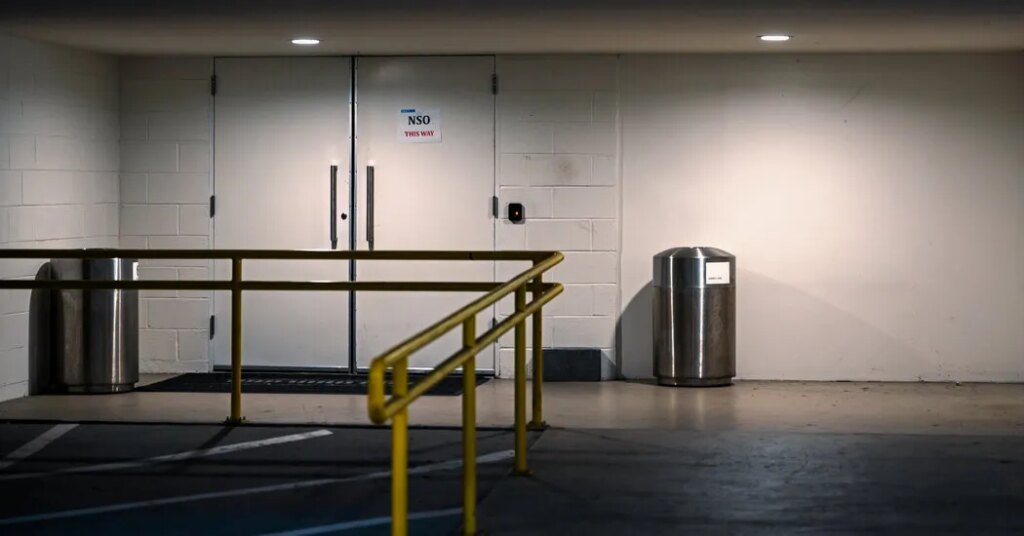
One morning last week, the musicians drove up to a center underground parking garage, Lot A, their instrument cases riding shotgun. They parked their cars and headed through a door with a paper sign taped on it that said “NSO This Way.’’ At one point the orchestra’s conductor, Gianandrea Noseda, glided up carrying a garment bag and paused to hug staff members holding the door.
Matt Floca, the center’s Trump-appointed director, said in reports to the board and the media this year that “moisture infiltration has caused corrosion and weakening of the concrete deck throughout the garages. Hundreds of compromised areas have been identified.”
But Mr. Elliott, the center’s spokesman, said the musicians follow “routes assessed as safe by facilities and management” to the main concert hall. The unsafe areas, he added, are “off limits.” The center continues to rent out its parking garage by the day and month.
David Z. Seide, a lawyer representing the former employees, said in an interview that the orchestra’s rehearsals “confirm what we’ve been saying all along. The building is not a threat to public health and safety.”
“This is part of a pattern of the government routinely saying one thing and doing another,” said Norm Eisen and Kyle Freeny, lawyers representing Representative Joyce Beatty, Democrat of Ohio and an ex officio Kennedy Center board member, who sued Mr. Trump to keep the building open and his name off its front.
Mr. Floca has said that the closure is temporary and is reassessed weekly. Critics, including congressional Democrats, question how things got to this point when Congress appropriated $257 million for a full renovation more than a year ago, and pays annually for maintenance. They speculate that the week-by-week closure is a tactic to circumvent a judge’s order that the center remain open.
In the meantime, the main building’s cafeteria and restaurants have long been closed. A couple of the musicians said they bring bag lunches to eat backstage during their hourlong break. Others dip out to Tazza, a nearby cafe that has struggled since the closure. They have agreed to wear hard hats on the rare occasions they venture outside the concert hall.
“There is a loneliness about it,” an orchestra employee said. “I remember seeing so many different faces from so many different departments, and that just doesn’t happen. You’re often the only one.”
After Mr. Trump put his name on the building, the orchestra’s audiences fell by as much as half. The composer Philip Glass withdrew his new symphony from a scheduled debut with the orchestra, and Béla Fleck, the Grammy-winning banjo player, pulled out of three performances. Its executive director, Jean Davidson, left in March, saying, “It’s no secret that this has been a really hard year.”
Amid an exodus of performers, audiences and donors, the Washington National Opera, also housed in the center since its opening, moved out. But the fates of the National Symphony Orchestra and the Kennedy Center are more deeply intertwined. The center oversees the orchestra’s budget, topping it up when ticket sales and donations fall short, which amounted to about $17 million this year.
In February Mr. Trump began demanding the center close by early July, which would leave the orchestra homeless. The orchestra’s budget request for 2026-27 languished for months without approval from the Kennedy Center board, preventing it from booking alternate venues and retaining guest performers.
Kennedy Center patrons formed Save Our Symphonies, a group supporting the orchestra and other center musicians in financial limbo. World-class performers volunteered to play in private homes, condominium lobbies and other local spots, pausing to explain their situation to Washingtonians while taking care not to talk politics, grant media interviews or otherwise anger the president. The performances have netted them new fans and donors.
The orchestra still lacks an approved budget, but in August received a green light from the Kennedy Center board to book the current season. It announced the dates only weeks before the first performance.
The musicians last month signed a new, four-year contract. An enthusiastic crowd attended the season-opening celebration at the Music Center at Strathmore in North Bethesda, Md., cheering as the concert opened with the national anthem.
“It will be an interesting season,” Mr. Noseda told the audience. “A bit tiring here and there, but also more exciting.”
The post If the Kennedy Center Is ‘Dangerous,’ Why Is the Symphony Rehearsing There? appeared first on New York Times.