When an Instagram influencer named Emily Gellis shared a new video late Friday night, many followers noticed the contrast to her usual fare of shopping, family and sponsored posts.
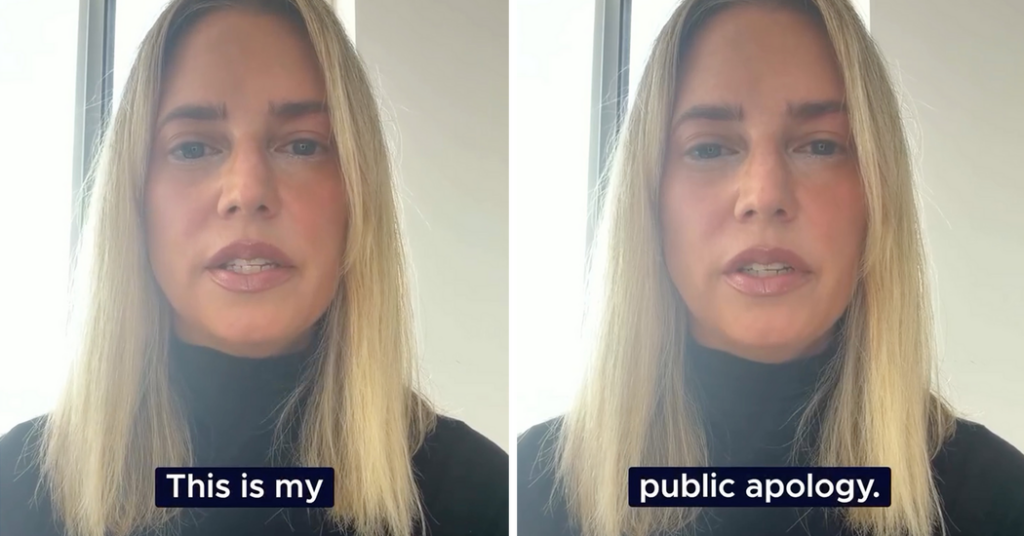
“I am here today to take full responsibility for the harm I caused to Tanya Zuckerbrot, her company F-Factor and her family,” Gellis began. In a shot that captured her from the shoulders up in a black turtleneck in front of a white wall, she seemed to read a prepared statement about her conduct toward Zuckerbrot, a registered dietitian, entrepreneur and — like Gellis — a prolific sharer on Instagram.
“I am deeply sorry,” she said in the six-minute mea culpa, her usually animated affect flat. “Yes, I want to say that again. I am deeply sorry.”
Her followers flooded her comments. “This is like a hostage video,” one said.
Gellis’s video is the centerpiece of a settlement of a lawsuit that Zuckerbrot filed in October 2020, which claimed Gellis defamed and harassed her.
The video apology must remain “pinned” to the top of Gellis’s Instagram and Facebook accounts for three and a half years, according to a transcript of court proceedings filed last month.
The Puritans had scarlet letters, and now the content creators have scarlet posts: video apologies usually negotiated by lawyers for brands and public figures that have come under criticism from influencers pushing commentary not always rooted in facts.
For the women who whittle their free time on New York lifestyle Instagram accounts, Gellis’s austere video was startling as it appeared amid a scroll of the standard imagery that generates likes, comments and commerce. “I found it very unusual,” said Molly McPherson, a crisis communications consultant. “It seemed like less of a heartfelt apology than a negotiated correction.”
Chatter about the video spread across Instagram and around New York last weekend, revisiting F-Factor, a pre-Ozempic-era high fiber diet, as well as Gellis’s relentless campaign, which created a pandemic-days internet spectacle-cum-unscripted reality show.
Apologies and retractions are longstanding remedies sought by lawyers when a client’s reputation has been tarnished by misleading advertising and by misinformed commentary presented as fact, said Daniel Watkins, a defamation lawyer whose clients have included the Rev. Al Sharpton and Robert Sarver, the former owner of the Phoenix Suns.
“What’s changed is that more are now posted online,” Watkins said. “Less common is a public apology where the plaintiff’s fingerprints and the legal pressure behind it are this visible.”
And to people viewing the spectacle of the Gellis apology, those fingerprints seemed very visible: Plenty of comments took note of the pressure she must have faced.
Indeed, defamation lawyers caution that apologies like Gellis’s don’t come cheap. This one was a result of six years of litigation, an involved discovery process and most likely hundreds of thousands of dollars in legal fees.
Gellis declined to comment
In an email, Zuckerbrot said, “After six years, having the truth publicly acknowledged brings relief, but an apology cannot rebuild the company I spent 25 years creating, restore my employees’ jobs or give my family back the years and sense of safety we lost.”
Gellis’s public criticism of Zuckerbrot and her diet company, F-Factor, began in the summer of 2020, at a specific moment in internet culture when most Americans were isolated and easily fixated on drama spilling out on the internet.
Gellis has admitted that she never followed Zuckerbrot’s F-Factor weight-loss program, which is based on a high-fiber diet that she laid out in books and Instagram videos. The program also included packets of F-Factor fiber powder, fiber bars or personal consultation with Zuckerbrot or her employees. (Some clients paid as much as $25,000 to consult with Zuckerbrot directly.)
Relying on anonymous tips that Gellis said she received on social media, she began telling her followers — often posting on her Instagram story dozens of times a day, or more — that the F-Factor diet, especially the fiber packets, were making some people sick. Zuckerbrot denied any widespread problem and questioned Gellis’s research and authority.
In a New York Times article about the public clash, reporters spoke to some F-Factor clients whom Gellis said had complained to her about health problems. They confirmed that Gellis had correctly represented their experiences.
But the reporters also found that one of the most serious allegations Gellis publicized — that the diet caused a miscarriage — was untrue, and was the result of a setup by a woman who purposely lied to Gellis to see if she would propagate this claim without evidence.
In the article, Zuckerbrot defended her products.
In October 2020, Zuckerbrot, who is married to a real estate investor and who has been active in sharing images on social media of her luxury lifestyle, filed her lawsuit against Gellis, claiming that Gellis’s posts resulted in the loss of about 90 percent of F-Factor’s monthly revenue.
In 2023, after the negative publicity and as GLP-1s surged in popularity and caused the entire diet economy to reconfigure, Zuckerbrot shuttered her business. She turned her online attention to speaking out against antisemitism and in support of Israel.
But her legal battle with Gellis continued. This summer, according to a court filing, the two women agreed on a settlement.
The agreement demands that Gellis pay Zuckerbrot $500 a month for 40 years, totaling $240,000. (Zuckerbrot’s spokeswoman said the amount is equal to medical and therapy costs Zuckerbrot incurred as a result of Gellis’s actions.)
More than the video, lawyers said, this financial arrangement is novel and was probably structured to force Gellis to be reminded every month of her transgressions. “It shows someone who wants this woman to pay for the rest of her life,” said Aaron Minc, a First Amendment lawyer.
When it came to the video, Zuckerbrot imposed what is essentially a no eye-rolling rule. “In reading the apology for the purposes of video recording, Gellis shall read it taking effort to look at the device recording as much as practicable,” according to the court filing of the settlement agreement, which continues “so as to limit the appearance and/or number of times she’s looking away from the recording device when reading the apology.”
And the settlement decrees that the video apology will be the first thing scrollers see when they visit Gellis’s page. “The video and written apology will be pinned to the top of all of Ms. Gellis’s social media accounts including but not limited to Instagram and Facebook for three and a half years, and will remain in her social media feeds for an additional one and a half years after,” according to the settlement, which also forbids Gellis from setting her feed to “private” or disabling public comments.
Looking directly at the camera, Gellis admits being responsible for “a sustained and harmful campaign that was not grounded in verified facts,” and said that she was wrong to compare Zuckerbrot to Harvey Weinstein, Jeffrey Epstein and the Sackler family, members of which helped market OxyContin as a minimally addictive painkiller. “I now understand that this behavior was excessive, invasive and harmful,” she said in the video.
Last week, before Gellis had posted the video herself, Zuckerbrot did so on her own accounts, first reaching out to friends to ask that they too share it. “I want it to go viral and for the truth to get out,” she wrote in a text message reviewed by The Times.
But what she posted was not Gellis’s six-minute apology. It was a 13-minute edit of the video that Zuckerbrot had spliced with highlight clips of Gellis’s years-old posts, mocking Zuckerbrot’s manner of talking and making health claims that she lacked evidence to support, including that the diet caused someone to suffer a heart attack.
Zuckerbrot’s post was widely shared and received thousands of comments of support like, “It’s about time!!” and “Justice is finally served.”
Hours later, Gellis shared the six-minute Emily’s version on Friday evening. Her supporters, some of them critics of the diet, offered her comfort. “Everyone knows exactly what this is. You did what you needed to do,” one person wrote. “Emily blink twice if you’re OK,” another said.
Zuckerbrot succeeded in the legal battle, noted McPherson, the crisis P.R. consultant. But public opinion can be a different matter. “It’s clear from the sheer volume of her negative posts that Gellis veered from being an online critic to being a hater,” she said. “But the video apology is a hard watch and to some it can appear a hollow victory.”
To Zuckerbrot, it feels like a fresh start and she plans to focus on her business. “I am looking forward to relaunching F-Factor and returning to the work I love,” she said in an email.
The post How an Influencer Has to Say ‘I’m Sorry’ appeared first on New York Times.