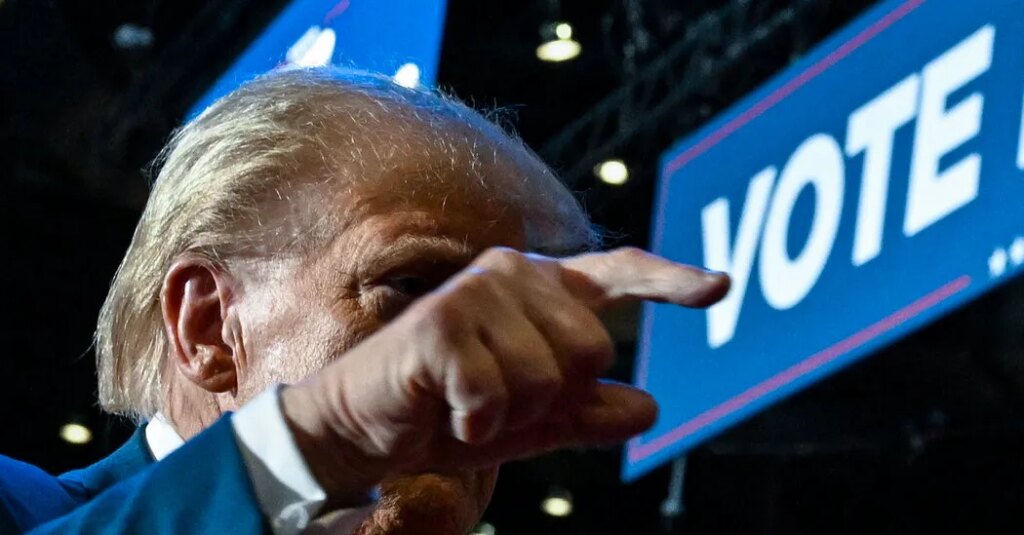
President Trump will not be on the ballot in the next election for president. But his obsession with the supposed problem of vote fraud — especially when it comes to mail-in voting — all but guarantees that he will continue to press the issue when his successor is chosen. The Supreme Court is inviting him to try.
The courts have provided mixed verdicts on Mr. Trump’s attempts at vote suppression in advance of the 2026 midterms. But the rulings have handed him an unambiguous gift: a road map for shaping the universe of eligible voters to his liking in the presidential election year of 2028.
Last month, the Supreme Court gave tentative approval to one of the administration’s attempts to ferret out improperly registered voters, including noncitizens. The Department of Homeland Security decided to expand a database called Systematic Alien Verification for Entitlements, which for almost four decades has allowed federal, state and local government agencies to verify the citizenship and immigration status of noncitizens applying for public benefits using biographic and other details. Under the Trump expansion, the database added Social Security records, and the administration invited localities to use it to make bulk demands to determine eligibility for voting, not just benefits.
These Social Security records have never been used in connection with voting, and they are known sometimes to be incomplete or out of date. The Trump plan could have been a potential tool for mass disenfranchisement of legal voters in the midterms.
But in a ruling on Sept. 25, the Supreme Court, with the three Democratic appointees dissenting, overruled those courts and allowed the regulation to go into effect — but with an important limitation. Because another federal law limits major changes to voting rules within 90 days of an election, the database can be used only to inquire about specific individuals, not to conduct “bulk searches.” As the justices wrote in their unsigned opinion, the 90-day “moratorium limits the potential impact” of allowing the immediate use of the D.H.S. database.
But there is plenty of time for “bulk searches,” and thus mass voter purges, in 2028. A decision that was small comfort for 2026 turns out to be no comfort at all for 2028.
It’s a similar story even when the Supreme Court rules outright against the Trump administration, as the justices did last month when they prevented the president’s regulation on mail-in voting from going into effect. On March 31 of this year, the president sought via executive order to impose major new obligations on the states, requiring them to provide the Postal Service with lists of individuals who had requested mail-in ballots. He also established new requirements for the size of ballot envelopes and the kind of bar codes to be used on the ballots themselves. About two dozen states sued to stop the new rule, arguing that there was no time to make such significant changes before the midterms and that the rule placed an unlawful burden on the states in any case.
In an unsigned opinion of just a single paragraph, the Supreme Court agreed with the states and blocked the rule from going into effect in 2026. But the justices’ cryptic words left open the possibility of a similar rule returning in time for 2028.
By one reckoning, the decision on the Postal Service regulation was a strong 7-to-2 repudiation of the Trump administration’s position, but the outcome of the case was actually a lot less clear. Only Justices Clarence Thomas and Samuel Alito would have allowed the rule to go into effect in 2026. Justice Brett Kavanaugh, writing for himself, said there was a “fair prospect” that the rule was legal, but he voted against it because implementation would be difficult so close to Election Day in 2026.
As for the opinion joined by the other six justices, it gave two reasons (each just a single sentence) for ruling against the president. First, the administration was “unlikely” to prove that the regulation was lawful, and second, it was too late to enforce the rule in 2026. It may be that Chief Justice John Roberts and Justices Neil Gorsuch and Amy Coney Barrett — the conservatives in the majority — thought that the real issue was timing, not the merits. And since none of the justices gave any explanation for why the Postal Service rule violated the law, they all but invited the administration to make minor or cosmetic changes and try again in time for 2028. In other words, Mr. Trump may yet turn this loss into a win. (Related cases are still pending in the lower federal courts, and as the midterms approach, emergency litigation on possible further last-minute changes to voting rules seems likely, too.)
Given Mr. Trump’s passion on the issue of mail-in voting — he is a longtime crusader against it, even though he himself votes by mail — it seems a certainty that he will try again to curtail the practice in 2028.
There’s precedent for Mr. Trump’s returning for another bite at the apple, especially on an issue, like tariffs, that’s important to him. In February, the Supreme Court invalidated the entire regime of tariffs that the president had introduced with great fanfare in 2025; the justices, by a 6-to-3 vote, said that the statute Mr. Trump cited did not give him the authority to impose the tariffs. Instead of accepting that judgment, President Trump immediately imposed a nearly identical set of tariffs, acting under the supposed authority of a different law. Legal challenges to those tariffs are now working their way through the courts.
As with tariffs, President Trump is unlikely to take no for an answer on vote suppression. He’ll rewrite regulations rejected by the Supreme Court, and he’ll appeal when lower courts rule against him. Earlier this year, a group of localities — including Nashville and Dallas — challenged a Federal Emergency Management Agency policy of withholding counterterrorism funds unless they overhauled routine aspects of election administration.
On Sept. 26, Judge Amir H. Ali, of the U.S. District Court for the District of Columbia, held that FEMA had no legal right to use these funds to force localities to change their rules on such matters as ballot form, auditing rules and the eligibility of voters and poll workers. The Trump administration invariably appeals adverse rulings, and if the decision is overruled, there will be plenty of time before 2028 for the president to use counterterrorism money to force the localities to bend to his will.
When it comes to curtailing the right to vote, it’s never too early — or too late — for President Trump to put up a fight.
Jeffrey Toobin is the author of “The Pardon: The Politics of Presidential Mercy.”
The Times is committed to publishing a diversity of letters to the editor. We’d like to hear what you think about this or any of our articles. Here are some tips. And here’s our email: [email protected].
Follow the New York Times Opinion section on Facebook, Instagram, TikTok, Bluesky, WhatsApp and Threads.
The post Trump’s Problem With Voting appeared first on New York Times.