In President Trump’s first term, news reports of sexual abuse allegations at San Jose State University prompted a Justice Department investigation that forced the school to make extensive policy changes and pay the victims and to remain under federal monitoring for four years.
But the intense focus on allegations that a Cornell University student was assaulted by multiple men at a fraternity party has barely drawn a response from the federal government. The hands-off stance reflects the more muted approach that Mr. Trump’s administration has taken to sexual abuse cases on campuses in his second term.
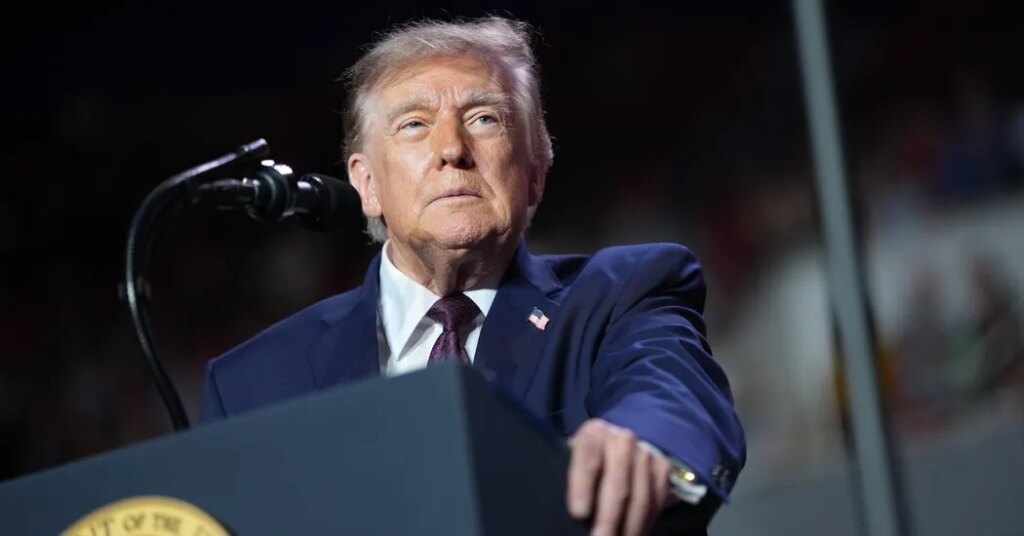
“I don’t know that much about it,” Mr. Trump told reporters on Thursday in response to a question about the case. “But Cornell is a fine school, and I’m sure they’ll do what’s right.”
Government officials have not said whether they plan to investigate the allegations or the university’s response under Title IX, the federal civil rights law that bans sex discrimination in education and allows federal officials to investigate university responses to such cases.
The administration’s lack of action so far on the Cornell case comes amid an apparent drop from Mr. Trump’s first term in resolved investigations of sexual assault, which are cases that end with a signed agreement to remedy violations of civil rights law, according to a review of public records. The administration has largely used Title IX to open dozens of investigations aimed at removing protections for transgender students, blocking transgender athletes from participating on female sports teams and eliminating gender-neutral bathrooms from schools.
During the initial 20 months of Mr. Trump’s first term, the Education Department’s Office for Civil Rights, which investigates discrimination complaints in schools, resolved more than 150 cases of sexual harassment and sexual violence, according to a public government database. The database does not show investigations that remain open.
In the first 20 months of Mr. Trump’s second term, the same database shows the office has resolved one case. Julie Hartman, an Education Department spokeswoman, said the department had resolved dozens of sexual harassment and sexual assault cases, but declined to provide documents or explain why they were not in the database. The New York Times could not independently verify the full scope of the department’s claim.
The Justice Department, where civil rights investigators examine allegations of systemic discrimination in colleges and universities under Title IX, has seen a similar shift away from sexual assault and harassment cases over Mr. Trump’s two terms.
In addition to the San Jose State settlement, which resolved an investigation into the school’s head athletic trainer abusing female student athletes, the department in Mr. Trump’s first term reached settlements requiring new measures to fight sexual misconduct at Case Western Reserve University; the University of Maryland, Baltimore County; Utah State University; Ellensburg School District in Washington State; and Fulton County Schools in Georgia.
In the second Trump administration, the Justice Department has not produced anything similar.
Civil rights lawyers who previously led investigative units at both departments said they would have opened investigations into Cornell by now.
Catherine E. Lhamon, who oversaw the Education Department’s Office for Civil Rights under Presidents Joseph R. Biden Jr. and Barack Obama, said the allegations had received “a wildly tepid response” from the university and the government.
Ms. Lhamon said the threshold for resolving a federal investigation was whether a school had taken sufficient steps to end a hostile learning environment and to ensure the discrimination did not persist.
“It is the school’s job to ensure that students have equal access to education and can learn without discrimination,” said Ms. Lhamon, now executive director of the Edley Center on Law and Democracy at the University of California, Berkeley. “That has been a Title IX requirement since the law was first passed in 1972.”
Shaheena Simons, who led the Justice Department team focused on civil rights in schools under Mr. Trump and Mr. Biden, called the administration’s lack of resolved cases by this point in Mr. Trump’s term a sign that it doesn’t take seriously its role vetting sexual assault allegations under Title IX.
“D.O.J. absolutely would and did look into allegations like this,” Ms. Simons said. “Our investigations exposed some really profound failures by colleges and by campus police. And now that avenue for accountability is effectively gone.”
A spokeswoman for the Justice Department, Kiersten Pels, said the department “does not generally confirm or deny the existence of investigations,” though it has announced other civil rights investigations.
Protecting women and girls “remains a top priority,” Ms. Pels said, adding that “protections against discrimination based on sex are fully in force, and schools that fail to meet their obligations will be held accountable.”
Ms. Hartman, the Education Department spokeswoman, said the situation at Cornell was “horrific” and should not be politicized to criticize the Trump administration.
The drop-off in resolved sexual misconduct investigations comes after a decades-long political battle in Washington over how to enforce the sexual discrimination ban under Title IX. Each of the past three presidential administrations has rewritten, or attempted to rewrite, those enforcement rules.
In 2011, Mr. Obama’s administration issued a public letter telling colleges that sexual harassment and assault create an environment so hostile that women’s access to education is jeopardized and violates their civil rights.
Mr. Trump’s administration rescinded that letter in 2017 and rewrote the guidelines, providing more protections for people facing accusations.
In 2024, Mr. Biden’s administration attempted to overhaul those rules again, extending protections from sexual discrimination to transgender students. A federal court blocked the move, and the Education Department announced last week that it had formally repealed those changes.
But the most significant change to civil rights enforcement during Mr. Trump’s second term has been his push for a broader reorientation of federal investigation targets. Those changes include ending the federal government’s oversight in dozens of school desegregation orders, focusing on antisemitism cases that mostly stem from anti-Israel protests, and purging programs that promote diversity, equity and inclusion.
The administration’s shift to using Title IX to reverse transgender protections is rooted in a series of executive orders Mr. Trump started signing on the first day of his second term. The orders have led educators to de-emphasize sex discrimination, victims’ advocates and civil rights lawyers said.
“I had one university president ask me if they really needed to hire a Title IX coordinator,” said Jody Shipper, a civil rights lawyer and consultant who, in 2004, became the first person in that role at the University of Southern California.
Title IX coordinators generally oversee a university’s compliance with the federal law’s ban on sex discrimination. The university president, she said, told her: “No one is going to fault me if I don’t have one.”
“If university presidents think their governor doesn’t care, and that Trump doesn’t care — what do I even say to that?” Ms. Shipper said.
At the same time the university’s investigation into the rape allegations was unfolding, Cornell was among a handful of elite schools facing the full force of Mr. Trump’s civil rights inquiries with very different focuses.
On March 20, 2025, the Education Department opened an investigation into Cornell’s handling of pro-Palestinian demonstrations tied to the war in Gaza. Four days later, it opened a second investigation — this time into allegations of fostering anti-white and anti-Asian discrimination with school admissions policies.
In April, as Cornell administrators were already deep into grappling with the gang rape allegation, the Trump administration identified $1 billion in funding cuts to the university’s research grants — federal funding that has become the lifeblood for elite research universities — to pressure the school into adopting the administration’s new discrimination priorities.
Cornell agreed to some of the changes last fall as part of a settlement with the government that shelved the investigations.
As attention on the Cornell case has mounted, Mr. Trump has shown interest in one aspect of the case: the appointment by the New York governor of Letitia James, the state’s attorney general, as a special prosecutor to review allegations and the handling of the complaint.
Ms. James led a civil fraud lawsuit against Mr. Trump and his company in 2022 that resulted in a massive financial penalty. She now faces federal mortgage and bank fraud charges from the Justice Department. She has denounced those as politically motivated and denied any wrongdoing.
When reporters asked on Friday about the appointment of Ms. James to look into the Cornell case, Mr. Trump said, “I feel badly for whoever she’s looking at, because they won’t get a fair shake.”
The post Cornell Case Highlights Drop in Resolved Sexual Assault Cases Under Trump appeared first on New York Times.