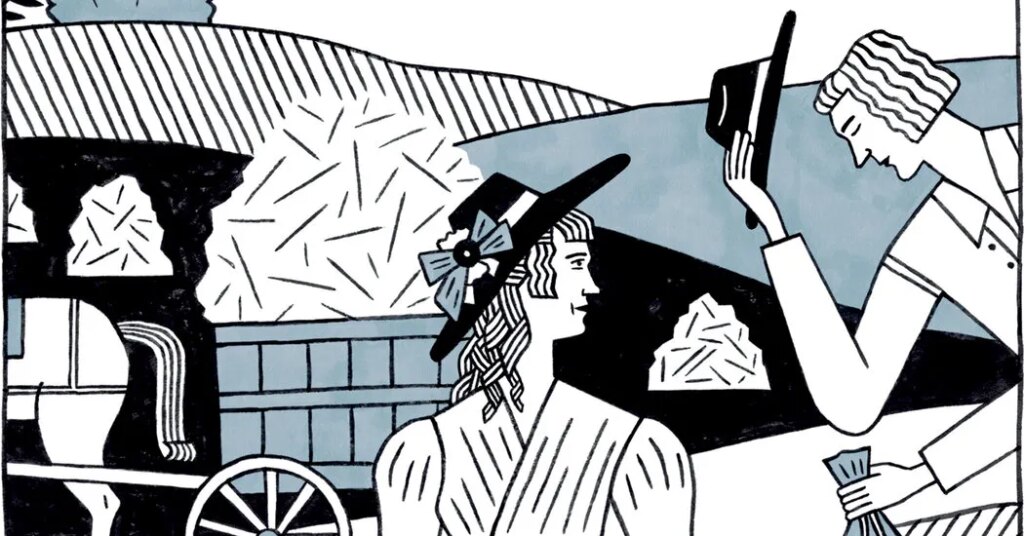
THE INVISIBLE HAND OF MARIA EDGEWORTH: How a Nineteenth-Century Novelist Taught the World Economics, by Jeanna Smialek
Students of economics have likely encountered the Edgeworth box — a simple, square diagram intended to analyze the dynamics of a hypothetical market with only two buyers and two products. Most likely they have not encountered Maria Edgeworth, aunt of the box maker, Francis Ysidro Edgeworth, and famous in the first decades of the 19th century as one of the most accomplished writers and thinkers in the nascent field of political economy.
The female Edgeworth is the subject of “The Invisible Hand of Maria Edgeworth,” Jeanna Smialek’s charming, engaging and highly instructive biography. But the real topic of this resonant book is the distance between the two Edgeworths — the gap between Maria’s richly textured accounts of work and profit among enterprising Irish peasants and their shiftless landlords, and her nephew’s reduction of these same dynamics to a schema resembling a tic-tac-toe game.
Using the rise and fall of Maria Edgeworth as a lens, Smialek asks what was lost when women were pushed aside and economics was transformed from an accessible, widely debated set of concerns to the more narrow academic discipline it has become today.
“The Invisible Hand” reads like a cross between “Jane Eyre” and a pop history of economic liberalism. Smialek, a longtime economics reporter for The New York Times and the author of a well-regarded book on the Federal Reserve, is a fluid writer who runs swiftly through Edgeworth’s early years as the exuberant and neglected child of Anglo-Irish aristocrats in the 1770s.
Sent off to a miserable boarding school by an eccentric father and a strict stepmother, Edgeworth tries to kindle her parents’ respect and admiration in the letters she writes home. Her father checks in on her studies and asks her to compose fables for him. Desperate for affection, his daughter eagerly complies. The younger Edgeworth is rescued in her early adolescence, after her stepmother dies, and her bereaved father, Richard Lovell Edgeworth, takes a fresh interest in his child.
Smialek emphasizes this extraordinary family’s immersion in the philosophical culture of the day. Richard Lovell was part of a heady discussion club, the Lunar Society, and attended society dinners with luminaries like the naturalist Erasmus Darwin and the economist Thomas Malthus.
Besotted by the ideas of Adam Smith — which Smialek summarizes at some length — Richard Lovell summoned his daughter back from school in the 1780s so they could set about improving their Irish estate. Once absentee landlords, they now introduced basic economic incentives unfamiliar in the feudal tradition, like wages and limited property rights for tenants.
Yet while her father educated her, pushed her to read economic treatises, encouraged her to translate French literature and treated her as his intellectual equal in their daily life, he remained deferential to traditional gender mores. After a close friend of his sent a discouraging letter in 1782, Richard Lovell forbade his daughter to publish her writing.
Then, in the 1790s, a few years after the friend was killed in a horse riding accident, Edgeworth’s father changed his mind and the dam broke. First came a defense of literary ladies (published anonymously) and collections of children’s stories, and then in 1800, Edgeworth reached wider literary fame with her novel “Castle Rackrent,” which Smialek calls “a rollicking satire about life on an Irish estate.” Narrated by a servant whose son eventually buys out the dissolute landholding family, “Castle Rackrent” provided a rare glimpse into Irish life. The king himself was said to have read it to better understand his subjects, and Jane Austen once suggested that Edgeworth’s books were some of the only novels worth reading.
Yet these works were not just compelling stories and character portraits, but vehicles for her ideas. Much like an early Ayn Rand, although with a lighter touch, Edgeworth perfected the art of making characters into symbols. The servant in “Castle Rackrent” is industrious and efficient, showing how rational management techniques could best traditional practice. In books like “The Parent’s Assistant,” she took the didacticism of children’s literature and applied it to economics. Her fictional characters illustrated the wisdom of Smith’s liberal principles by doing things like dividing their labor when weaving hats in order to earn enough money to buy cherries.
And Smialek argues that Edgeworth, known to contemporaries as “the great Maria,” did not simply repeat the ideas of the economists she knew, but made real interventions in the growing field of political economy. She gently poked at Smith’s tendency toward abstraction, and supported the idea of utility — rather than labor — as the foundation of value, a strikingly modern understanding. And she took her work seriously, even turning down a marriage proposal from a Swedish diplomat she truly loved, for fear she could not be both a wife and an author.
Smialek’s account peaks with the Irish potato famine, which Edgeworth witnessed up close. In Smialek’s telling, the famine in the 1840s and ’50s was something akin to the Great Depression in the 1930s: an existential crisis that shook the field of economics to its foundation. Edgeworth, previously suspicious of relief for the poor like many in her class, threw herself into publicizing the disaster and fund-raising for the famine’s victims. She also tried to spur debate about its ultimate causes, using her fame to question the practical and economic wisdom of cultivating the potato as an exclusive crop. Drawing on her correspondence with luminaries like the economist David Ricardo, Edgeworth urged her contemporaries to think less about abstract theories of international trade and more about their real-world consequences.
Edgeworth would not hold sway in such debates for long. True, she inspired two other writers, Harriet Martineau and Jane Marcet, who powerfully influenced economics in the 19th century (and each of whom deserves her own biography). But as economics caught a nasty case of physics envy, and practitioners strove to turn their field into a science, there was no more room for scribbling women.
Smialek has tapped an important vein of scholarship on women in economics, and she’s generous in acknowledging the research of others. Her synthesis also has real value: Even as a scholar in the field who has uncovered the contributions of women economists to the work of Milton Friedman, I found much that was new here.
At the same time, the book’s structure, with chapters alternating between Edgeworth and the more famous thinkers of her time, can wear thin. Edgeworth occasionally becomes lost in this back and forth. Readers may also tire of her extended disquisitions on the conflict between Ricardo and Malthus; yet because Smialek writes so well, those with a taste for the topic will find them enjoyable.
“The Invisible Hand of Maria Edgeworth” reminds us that the fate of thinking women waxes and wanes. In the wake of the Enlightenment, fortunate women like Edgeworth found some breathing room, even if they had to smuggle their ideas into fiction. But when the Victorian era arrived in the final decades of her life, thinking became less a gentleman’s hobby and more a real profession, and women lost ground rapidly. Aspiring professors of economics came to believe that when writers like Edgeworth insisted “that economics could be understandable to housewives and children,” Smialek writes, “they cheapened it.”
Yet looking at our current moment, with rising socialism on the left and studied rejection of economic principles on the right, we might regret that instead of becoming cheap and common, economic thinking became expensive and rare. And we might wonder if a new Maria Edgeworth, blending first principles with the human touch, is just what we are missing.
THE INVISIBLE HAND OF MARIA EDGEWORTH: How a Nineteenth-Century Novelist Taught the World Economics | By Jeanna Smialek | Knopf | 271 pp. | $32
The post This Novelist, Beloved by Jane Austen, Helped Make Capitalism Big appeared first on New York Times.