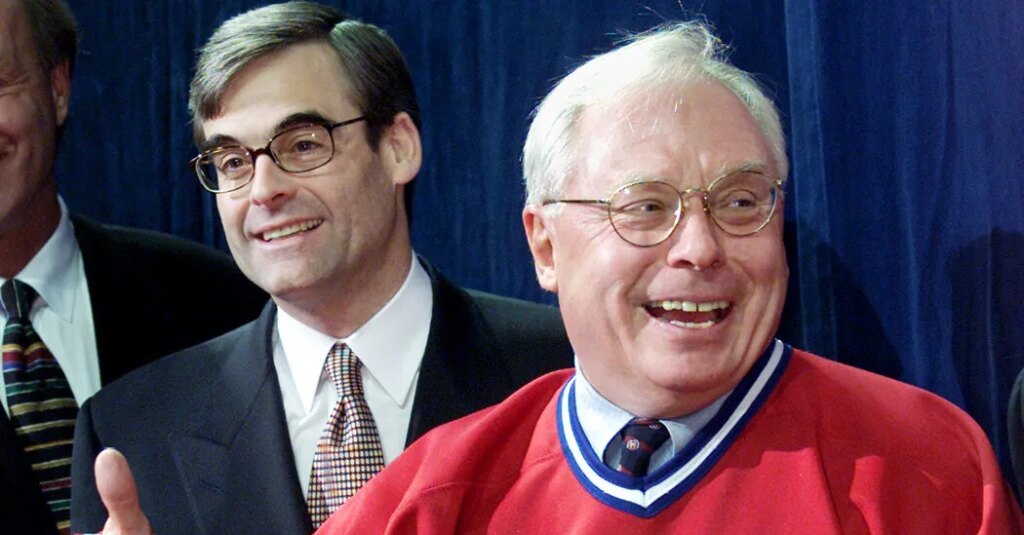
George Gillett Jr., an entrepreneur whose best known acquisitions were in sports — ski resorts, the Miami Dolphins, the Harlem Globetrotters, the Montreal Canadiens, the Liverpool soccer club and a Nascar racing team — died on Sept. 22 in Denver. He was 87.
His death, in a memory care center, was caused by Alzheimer’s disease, his son Foster said.
There were other businesses in his big portfolio — meatpacking plants and television stations — but sports were a constant. In early 1967, he bought a small stake in the second-year Miami Dolphins of the American Football League and briefly became their business manager.
Later that year, he joined a group of investors that bought the Globetrotters for $3.7 million from the family of Abe Saperstein, who founded and ran the comic hoops troupe whose stars included Meadowlark Lemon and Fred “Curly” Neal.
Shortly before the 1969 N.B.A. draft, Mr. Gillett mused about signing Lew Alcindor, the superstar center for the University of California, Los Angeles, later known as Kareem Abdul-Jabbar.
“We’re very serious,” Mr. Gillett told The South Bend Tribune. “I am not sure how much it would take to acquire Alcindor but it will be a lot of money.” Adding Mr. Alcindor, he said, “would lend credence to our cry that we play good basketball as well as provide good comedy.”
But Mr. Gillett missed out. Mr. Abdul-Jabbar, the No. 1 overall pick in the draft by the Milwaukee Bucks, signed with them for a five-year, $1.4 million contract.
During Mr. Gillett’s time with the Globetrotters, they were the stars of a popular CBS children’s cartoon series. They added routines written by Hollywood comedy writers and continued to tour the world. Mr. Gillett and his group sold the team to Metromedia, a media company, for a reported $12 million, in 1976.
His ambitions grew. He built the privately-held Gillett Holdings into a conglomerate that owned more than a dozen television network affiliates, a chain of some 20 newspapers, commercial printing companies and a meat packing firm. In 1985, he acquired the Vail and Beaver Creek ski resorts in Colorado for $37 million.
He modernized Vail — he was known for installing high-speed chairlifts — and helped make it a worldwide destination when the resort hosted the 1989 World Alpine Ski Championships. By day, he skied with his bankers; by night, he brought them up on sleds to one of his mountains where they “drank schnapps and admired the starlit sky,” The New York Times wrote in 1988. He emphasized customer service and friendliness. His identification tag while at Vail said simply, “George, Racine, Wisconsin.”
But then came financial collapse. In 1991, three years after his company’s cash flow reached $1 billion, he filed for bankruptcy, and lost control of his empire — its growth fueled in part by junk bonds — to an investment group led by the New York financier Leon Black.
Mr. Gillett blamed himself, telling The Associated Press that his company’s downfall was drastically overpaying for a TV station in Tampa, Fla., in 1987, shortly before a recession hit the economy.
“The word ‘bankruptcy’ is indelibly imprinted in my life even though the statute of limitations for credit purposes is seven years,” he told The Denver Post in 2001. He added, “I have accepted full blame and make no excuses.”
“I lost it, but I never forgot how to do it. With my family behind me, I knew I could do it again,” he added.
George Nield Gillett Jr., was born on Oct. 22, 1938, in Racine, Wis., to George, a physician and surgeon, and Alyce (Herbert) Gillett.
Though he enrolled in Amherst College, he dropped out, returning to his studies at Dominican College in Racine while working nights as an inspector at an American Motors plant in Kenosha. He graduated in 1961.
After several years in sales for Crown Zellerbach and as a management consultant for McKinsey & Company, Mr. Gillett made his Dolphins and Globetrotters deals. After selling the Globetrotters, he bought and sold a golf club factory and two TV stations, and in 1978, acquired the ailing Packerland Packing Company in Green Bay, which he overhauled by shifting production to low-calorie, low-cholesterol beef.
Mr. Gillett used $150 million in profits from Packerland to pay for infrastructure improvements at Vail and Beaver Creek, The Montreal Gazette reported in 2001.
He moved on quickly from the bankruptcy. He bought ski resorts from California to New Hampshire. He built Corporate Food Brands America, which processed and packed meats, and sold it in 1999 to Iowa Beef Processors for $584 million in stock and assumed debt. The sale positioned him to buy the Canadiens.
In 2001, Mr. Gillett paid an estimated $275 million for 80 percent of the team and 100 percent of the Molson Center (now the Bell Center) — an American takeover of a beloved Canadien franchise that no Canadian individual or company bid on.
“What we’ve essentially done is made a real estate investment,” he told The Denver Post. “But ultimately, we will be judged not on the real estate investment but on the success of the hockey team.”
The team was mediocre and didn’t win its 25th Stanley Cup, as he had hoped. In 2009, he sold it, as well as the arena and the entertainment division he created, for about $550 million to the Molson family. By then, he had turned his attention to soccer: namely, the Liverpool club of the English Premier League.
Two years earlier, he and Thomas O. Hicks, the owner of the Texas Rangers of Major League Baseball and the Dallas Stars of the National Hockey League, bought the team for $340 million.
But that purchase was fraught. The two were regarded as interlopers by Liverpool fans and the debt they used to finance their purchase undermined them. In 2010, the team’s board chose a buyer, New England Sports Ventures, the owner of the Boston Red Sox. Mr. Gillett and Mr. Hicks, believing the club was worth more than the $480 million sale price, tried to block the sale in court but failed.
“They’ve invested about 140 million pounds of their own money in this and they’re losing it all,” Martin Broughton, the team’s chairman, told the BBC at the time. “This was actually their last chance to leave Liverpool with their heads held high. The legacy has not been a healthy one.”
Mr. Gillett started his association with Nascar in 2007 when he bought majority control of Evernham Motorsports, which he later merged with the racing team of the storied driver Richard Petty. In 2010, amid reports of the racing team’s financial distress, Mr. Gillett sold his stake to a group that included Mr. Petty.
A year later, Ray Evernham, Mr. Gillett’s partner, filed a lawsuit in state court in North Carolina seeking $19 million that he said Mr. Gillett owed him. He settled for what he called “pennies on the dollar.”
In addition to his son Foster, Mr. Gillett is survived by his wife, Rose (Foster) Gillett, whom he married in 1967; two other sons, George III and Alexander; eight grandchildren and his stepmother, Ida (Gontek) Gillett. His son Andrew, Foster’s twin brother, died in 2011.
Mr. Gillett loved skiing so much that in his first season owning Vail, he was on its slopes for 135 days of that winter.
In 1988, he told The New York Times Magazine that a “very prominent American businessman” called to ask him if he would consider selling Vail.
“I told him, ‘Look, I don’t want there to be any misunderstanding,’” he recalled saying. “‘The answer is unequivocally no. I won’t have lunch with you, nor breakfast or dinner. I am not going to have rumors start. This will be the last asset I ever sell.’”
The post Beef, Comedy, Sports and a Big Bad Bet. George Gillett Jr., Tycoon, Dies. appeared first on New York Times.