Most national attention in this year’s midterm elections is focused on congressional and governors’ races.
But Democrats are also making a strong push to win power in state legislatures across the country, forcing Republicans to play defense in a terrain they have dominated in recent years.
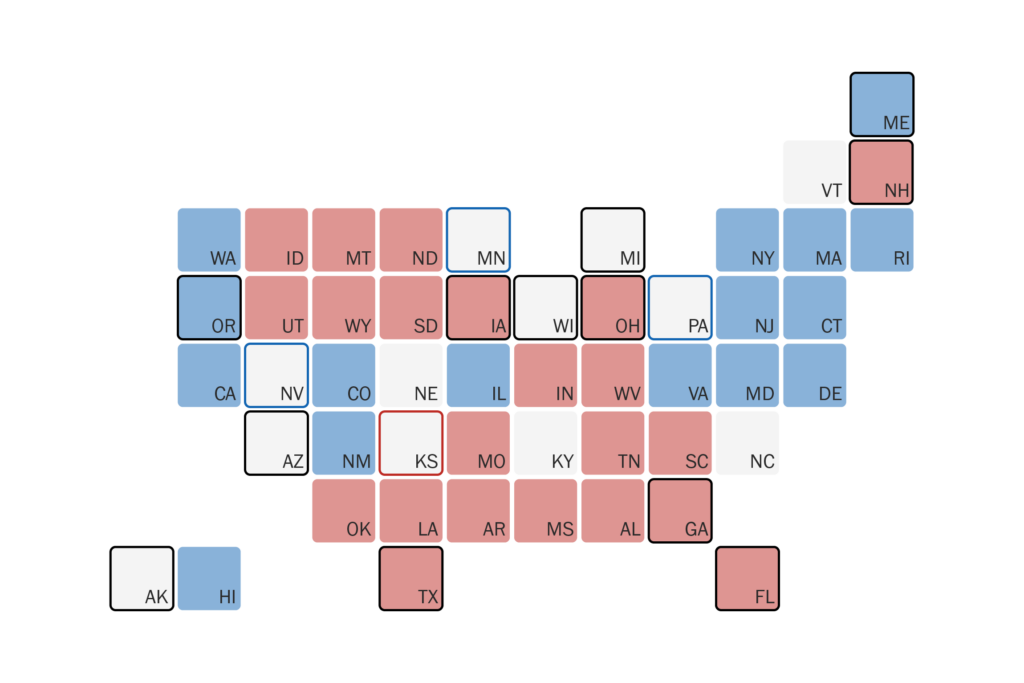
Democrats are on offense. They could break up full Republican control in as many as six states and win unified control in as many as seven of their own, a Washington Post analysis found.
Republicans are on their heels, with the chance to disrupt full Democratic control in only two states and pick up full control in as many as five states.
The results in these state races could be more significant to many voters than the outcomes in federal contests, given legislatures’ ability to set policy affecting large aspects of life and business. Because Congress is often gridlocked and politics are increasingly polarized, states have become more aggressive in filling the resulting power vacuum.
State legislatures determine policies on such issues as redistricting, abortion, voting, education and taxes. A party having unified control of state government by controlling the governorship, the state House and the state Senate, often called a “trifecta,” is critical for passing legislative priorities without the opposition party’s veto.
Republicans have consistently held more state legislative seats than Democrats since the 2010 election, when the GOP netted nearly 700 seats and seized control of 20 legislative chambers.
“2026 is proving to be a once-in-a-generation opportunity for Democrats to shift the balance of power away from Republicans,” Heather Williams, president of the Democratic Legislative Campaign Committee, the party’s state legislative campaign arm, said in a statement.
Republicans’ counterpart, the Republican State Leadership Committee, referred to this year’s elections in an April memo as a “political environment that is likely to be one of the most challenging for state Republicans in recent years,” adding that their strategy involved a “defensive-first posture.”
Potential trifectas
Democrats are aiming to win unified control of Minnesota, Pennsylvania and Nevada’s state governments in November.
They are likely to emerge successful in Minnesota, where Sen. Amy Klobuchar (D) is heavily favored to win the governor’s race and Democrats hold the state Senate. The state House is tied 67-67.
Democrats face a steeper climb in Pennsylvania, where they are hoping to defend a slim majority in the state House and take the Senate, now controlled by Republicans. Only half of the chamber’s seats are up for election, aiding Republican efforts to defend their 27-23 majority. Democrats haven’t held a trifecta in the state in decades, making November a rare opportunity.
Gov. Josh Shapiro (D), who is on track to easily win reelection, has campaigned with and contributed funds to Democratic candidates as he makes the case for a potential presidential bid.
Republicans’ state legislative campaign arm predicted that Democrats may seek to redraw Minnesota and Pennsylvania’s congressional districts if they win unified control. Minnesota’s districts are split 4-4 and Pennsylvania’s are split 10-7 in favor of Republicans. Some Democrats in both states have touted the possibility, though neither Shapiro nor Klobuchar have committed to doing so.
Democrats may also seize a trifecta in Nevada if Attorney General Aaron Ford defeats incumbent Gov. Joe Lombardo (R).
Republicans’ strongest opportunity to gain a trifecta is in Kansas, where Democratic Gov. Laura Kelly is term-limited. State Senate President Ty Masterson (R) is favored to win the race to replace Kelly, which would give Republicans unified control in the state.
In four states — Michigan, Wisconsin, Arizona and Alaska — both parties are hoping to gain unified control of state government.
Democrats have the clearest path to a trifecta in Michigan, which it held from 2022 to 2024. The party is favored to win the governor’s race and holds a narrow majority in the state Senate, while Republicans narrowly control the state House.
Both chambers and the governorship are up for grabs in Wisconsin and Arizona, which have Democratic governors and Republican legislatures. Wisconsin Democrats, aided by new statewide maps replacing those that benefited Republicans, are targeting their first trifecta in the state since 2010. The GOP is hopeful that Rep. Tom Tiffany (R) can win the state’s governor’s race, a toss-up, and restore unified Republican control.
The DLCC is also investing in races for both chambers of the Arizona legislature, hoping to flip them and win unified Democratic control in the state for the first time since the 1960s. Democratic Gov. Katie Hobbs is favored to win reelection in a competitive race.
Either party may also gain unified control of Alaska’s government. The state uses ranked-choice voting for the closely contested gubernatorial race between one Democrat and three Republican candidates. Both chambers of Alaska’s legislature have been governed by a bipartisan coalition in recent years and may have different compositions after the midterms.
Trifectas at risk
Six Republican trifectas and two Democratic ones may be broken in November, potentially preventing the passage of some of the parties’ legislative priorities.
Republicans safely control both legislative chambers in Texas, Georgia, Iowa, Ohio and Florida. But the five states are expected to have competitive governor’s races.
Incumbent Republican Gov. Greg Abbott is likely to win reelection in Texas against Democratic state Rep. Gina Hinojosa, and Republican Rep. Byron Donalds is favored against former congressman David Jolly in Florida’s gubernatorial race. No Republican incumbent is running in the other three states, which all appear more vulnerable for Republicans.
Democrats are also targeting both legislative chambers in New Hampshire, which is under unified Republican control. Though Republican Gov. Kelly Ayotte is likely to win reelection, Democrats have a “better than 50/50” chance of flipping the House, according to Andrew Smith, director of the University of New Hampshire’s survey center.
Republicans are hoping to defeat Democratic Gov. Tina Kotek in Oregon, where the legislature is safely in Democratic hands.
Some Republicans are also hoping to break Democrats’ trifecta in Maine, where Democrats have a two-seat majority in the state House. It’s possible but “hard to imagine” that Republicans will flip the chamber in 2026, said Mark Brewer, chair of the University of Maine’s political science department.
Supermajorities
The parties are also hoping to gain legislative supermajorities in chambers across the country. With a supermajority, usually comprising two-thirds or three-fifths of members, legislatures can override governors’ vetoes and pass their desired legislation.
Democrats’ targets include breaking GOP supermajorities in both chambers of Florida’s legislature, as well as Kansas’s state House and Ohio’s state House, all of which could have a Democratic governor after the midterms. In Iowa, the party is hoping to break the Republican supermajority in the state House and prevent Republicans from gaining a supermajority in the state Senate. Democrats are also hoping to break the Republican supermajority in North Carolina’s state House and prevent a Republican supermajority in the state Senate under Democratic Gov. Josh Stein.
Trifectas over time
The number of legislative trifectas has steadily and dramatically increased this century, with 38 states having one-party government. Less than 20 states were governed entirely by one party in the late 1990s.
The numbers in the past five years mark a record high since the 1950s, reflecting increased polarization and decreased voter interest in “ticket-splitting,” when a voter casts a ballot for candidates of opposing political parties for different offices in the same election.
The importance of trifectas
Much more legislation is enacted when a state government is under one-party control, according to a Washington Post analysis, including bills on politically divisive topics.
Nearly all new legislation that redistricted states’ congressional districts was in states with unified party control of government. The same is true for policies on issues such as abortion and gun rights, on which Democrats and Republicans often struggle to reach bipartisan compromises.
Methodology
Data for trifectas is from Carl Klarner’s State Partisan Balance Data, 1937-2011 dataset, Ballotpedia and Multistate. We checked discrepancies between sources against state government websites. A state is labeled with potential to gain or lose a trifecta if the gubernatorial seat or either of the legislative chambers are vulnerable. A gubernatorial seat is considered vulnerable if the Cook Political Report rating for the race is competitive (leans Republican, toss-up or leans Democratic). As a baseline, a legislative chamber is considered vulnerable if the opposing party would gain control of the chamber by flipping five total seats or less than 10 percent of the number of seats up for election. We manually evaluated the vulnerability of the chambers in the baseline. Nebraska, which has a unicameral and nonpartisan state legislature, is not included in the analysis. Data for legislative bills is from LegiScan.
The post GOP is at risk of significant state legislative losses, Post analysis finds appeared first on Washington Post.