A normally ho-hum procedural vote in a small state was closely watched across Germany on Tuesday, when a far-right politician was elected to lead a state legislature for the first time since the Nazi era.
In the legislative election last month in the state of Saxony-Anhalt, the Alternative for Germany party, labeled “suspected extremist” by Germany’s domestic intelligence service, won 39 of 83 seats. The party, known by its German initials AfD, far outperformed every other party, delivering a shock to the country’s postwar consensus.
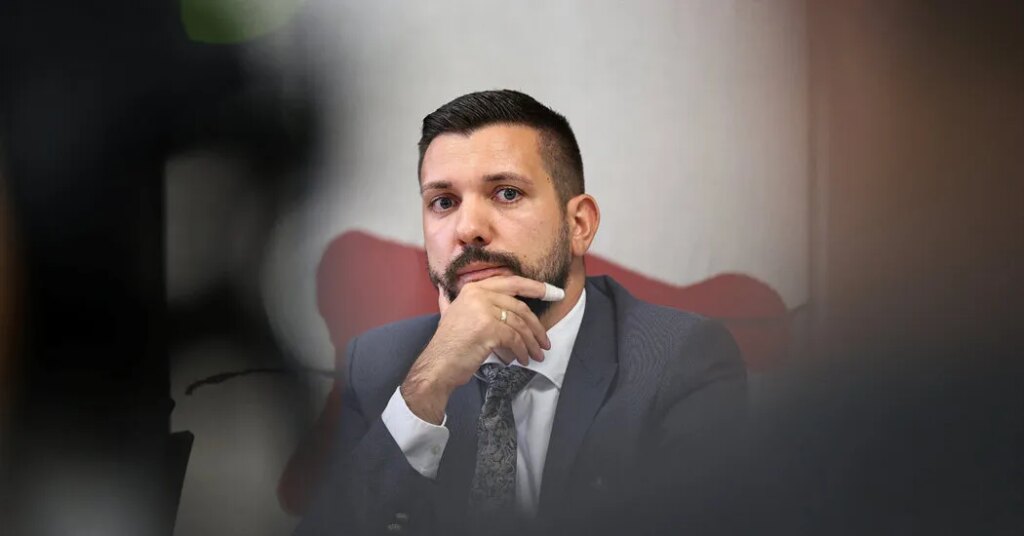
The next step toward taking power occurred on Tuesday, when lawmakers were sworn in and elected the AfD’s Tobias Rausch as president of the Parliament. In that role, Mr. Rausch, 35, will preside over the legislative agenda, parliamentary bureaucracy and ceremonial roles, like hosting memorials commemorating the Holocaust.
In the anonymous vote, 48 lawmakers voted for Mr. Rausch, meaning that he likely received the support of some members of mainstream parties that have officially refused to work with the AfD.
A higher, more important hurdle awaits in December, when the state Parliament is expected to fill the most powerful state position, minister president — the equivalent of governor, with control of the executive branch. It is unclear if the AfD’s candidate, Ulrich Siegmund, can win that vote; until then Sven Schulze of the Christian Democrats remains acting governor of Saxony-Anhalt, one of Germany’s least populous states, with about 2.1 million people.
What would the AfD do in power?
The party has made it clear that it does not intend to allow business as usual.
The AfD successfully ran on an anti-immigration, anti-establishment campaign, pro-fossil fuel campaign, but such issues are decided on the federal level, beyond the reach of a state government. At the state level, it plans to focus on education and culture issues.
During the campaign, Mr. Siegmund vowed to segregate schools, separating the children of asylum seekers from other students, and to replace all rainbow flags in schools with German flags. The party has called for more patriotic arts from institutions that rely on state funding.
In the state Parliament, the AfD tried to solidify its power by increasing the number of seats on the legislative committees from 11 to 12, giving the party six seats rather than five. After threats of lawsuits by the other parties, it backed down.
But the party still plans to try to create and fill a second state legislative vice-presidential seat, giving it more control over the day-to-day running of the house.
On a symbolic level, it has shuffled the traditional seating arrangement in the legislative chamber. Rather than be positioned on the far right, the AfD will sit in the center, a statement of how it sees itself. The progressive Greens will sit on the farthest right.
Can the AfD wield power without a majority?
While the AfD’s result last month was historic — it won 44 percent of the vote, more than double its performance five years ago — it fell three seats short of a majority in the state Parliament, so it cannot elect the state’s leaders on its own. (The conservative Christian Democrats, long the state’s dominant party, fell from 40 seats to just 15.)
Though coalitions are common in Germany, the mainstream parties have refused to work with the AfD in forming governments. But a new, fringe party said its five legislators would vote for Mr. Rausch, enough to make him the Parliament leader, in exchange for the small party taking the position of vice president of the legislature.
That party, the Sahra Wagenknecht Alliance, was formed in 2024, in a split from the Left party.
It has vowed not to vote for Mr. Siegmund for governor, so the AfD will have to look elsewhere for those votes.
Who is Tobias Rausch?
Although the AfD went into this election with a number of extremist politicians, Mr. Rausch is portrayed in the German news media as somewhat more moderate.
“I’m not a hard-liner; I’m pragmatic,” he recently told the D.P.A., a German newswire. Unlike others being sworn in on Tuesday, he also has plenty of experience, having sat in the statehouse since 2016 and having run the AfD parliamentary group since 2021.
But Mr. Rausch is not without controversy. The AfD was caught up early this year in a scandal involving its deputies hiring the family members of other deputies, in a kind of circular nepotism network that ensured that state money that goes to running lawmakers’ offices would stay in their families.
Mr. Rausch was at the center of the furor. He has publicly acknowledged that his siblings and friends from his soccer club were once hired either by his office or by others in the AfD.
Who’s in the new statehouse?
Because the 39-member AfD group includes only two women, the new statehouse is overwhelming male. Only 22 percent of the lawmakers will be women, the lowest among the 16 statehouses in the country, down from 28 percent in the previous Parliament.
The AfD is also bringing some unusual lawmakers into the house, including a former officer of the Stasi, the East German secret police, and a survivalist. Another holds a Ph.D. in Arabic studies, and two lawmakers who had their homes raided in an investigation into their ties to a banned far-right extremist organization.
The post Germany’s Far Right Claims Its First Statehouse Speaker Since 1945 appeared first on New York Times.