SA-NUR, West Bank — Emboldened by Prime Minister Benjamin Netanyahu’s government, Israeli settlers in the occupied West Bank have been carrying out a campaign of violence and intimidation unmatched in recent memory, attacking and displacing Palestinian communities and establishing scores of government-backed settlements and illegal outposts that are drastically reshaping the long-disputed map.
Having built an expansionist footprint far beyond what seemed possible just a few years ago, the extremist settlers are racing to lock down gains ahead of this month’s Israeli election, while their supporters, some at the highest levels of government, are eager to shore up votes and secure their agenda. The goal is to create facts on the ground that would be difficult to reverse even if a less supportive government wins power.
The sweeping shift in West Bank settlements has unfolded over the past three years, amid Israel’s war in Gaza in response to the Hamas-led Oct. 7, 2023, attack, as well as the U.S.-Israeli war against Iran, which diverted attention away from the plight of Palestinians losing their homes and land.
But over the past year most of all, Israel has taken accelerated action to cement its control over the territory, with a surge of new settlements and outposts, expanded land registration and purchasing avenues for Israelis, increased demolition of Palestinian homes, checkpoint and road restrictions that fragment communities, and a sharp rise in settler violence that the government has shown little willingness to rein in.
Between January and August, the United Nations documented more than 1,600 settler attacks causing injury or property damage, an average of more than six a day, up from last year’s already heightened level. At least 76 Palestinians in the West Bank have been killed by gunfire from Israeli forces or settlers since the start of the Iran war on Feb. 28, according to the U.N. humanitarian office. Some small Palestinian towns such as Deir Jarir and Al-Mughayyir, northeast of Ramallah, outside of which settlers have set up outposts, have seen repeated killings.
With a cabinet that includes far-right patrons of settlement such as Finance Minister Bezalel Smotrich, whose portfolio includes settlement policy, and National Security Minister Itamar Ben Gvir — both settlement dwellers themselves — constraints have evaporated on a movement dedicated to establishing Israeli control over territory it occupied in the 1967 war — which many Israeli Jews see as part of an ancient homeland but much of the world sees as illegally settled Palestinian land.
Between 2013 and 2022, the Israeli government approved only three settlements, according to Peace Now, an Israeli anti-settlement watchdog group. Since then, the government has approved more than 100, including 34 in March alone, and retroactively legalized outposts erected by settlers in violation even of Israeli law. By some counts, the total number of settlers has ballooned to more than 540,000, who live among some 3 million Palestinians.
Palestinian communities report that settlers from outposts attack and terrorize them in towns up and down the West Bank, casting a pall of violence and fear over daily life. At least 4,300 Palestinians have been displaced across the West Bank this year, with attacks accounting for about 60 percent of displacement, according to the U.N.
In the days before the Oct. 27 election, Israel is set to proceed with a tender process for part of a long-stalled development project known as E1 — a plan to build thousands of settlement housing units in a strategic corridor that could separate East Jerusalem from the rest of the West Bank.
Smotrich says the point of the project is to “bury the idea” of a Palestinian statehood.
“The settler movement has never had more state support and resources at its disposal than it has under this Israeli government,” said Amjad Iraqi, a senior analyst for the International Crisis Group, a Brussels-based think tank. He said a lesson from recent years, particularly the war in Gaza, has been, “We will never get more impunity than we have now. So let’s take as much as we can grab.”
On Sept. 29, more than 100 radical settlers rioted in the West Bank town of Jalud, preventing a Palestinian family under escort by the Israel Defense Forces from returning to their home, from which they had been displaced by settlers.
“The rioters blocked roads, set fires, structures & vehicles on fire and hurled rocks toward security forces,” the IDF said.
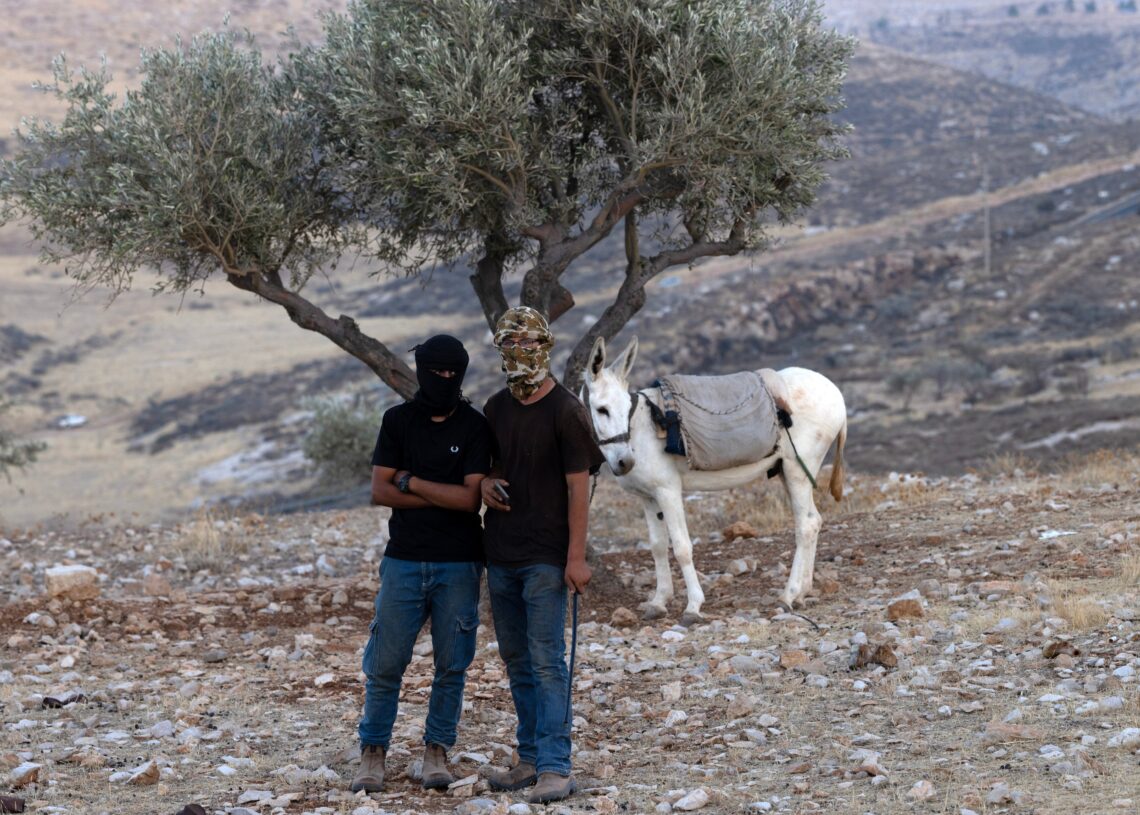
For the past three months, once each morning and evening like clockwork, at least two young settlers, approaching from the direction of an illegal outpost and shepherding herds of sheep and goats, ride up on donkeys to the Kaabnah family home, near the town of Taybeh on the outskirts of Ramallah.
A spotlight on an IDF military tower illuminates the area as night falls. The settlers built their outpost under its shadow.
Tolerance of outposts, illegal even under Israeli law, appears only to have grown. Earlier this year, soldiers could be seen sitting at a table for lunch with residents of the Sha’agat Yehuda outpost in the northern West Bank, in what locals said was no unusual scene.
Volunteers, some Israeli and some foreign, sleep on the floor of the Palestinian home in “protective presence” shifts.
In late August, masked settlers approached the home, and one threw rocks at the family as another grabbed and rattled the fence enclosing the property, staring and filming.
Nayef Kaabnah, 55, a construction worker, says he has lived in the house for 25 years. The father of seven is set on remaining, although his life there with his wife and children under the threat of settler violence has become a daily nightmare. “Where would I go if I left? … Whoever leaves is soon forced to leave their home again,” he said.
The intimidation began after Oct. 7, but in recent months it’s become unbearable, he said. “They come every day. Morning and evening.”
The same intimidation played out the following week. Israeli border police arrived on the scene only after the settlers had left.
One of the officers, who would not give his name, threatened to arrest a Washington Post photographer. Asked why he would not instead arrest the man throwing rocks, the officer responded, “That is not my job.”
On Route 60 to Sa-Nur, an Israeli settlement on a hilltop overlooking Palestinian towns of the Jenin governorate below, road signs pointed the way in Hebrew, English and Arabic. Many of the Arabic-language lines had been graffitied out.
Top right-wing Israeli ministers were in attendance at a ribbon cutting this spring to celebrate the government-approved reestablishment by some 16 Israeli families of the small compound, one of the four Jewish settlements in the West Bank evacuated during Israeli leader Ariel Sharon’s 2005 disengagement plan, which removed roughly 8,500 Jewish settlers from the Gaza Strip at a time when it seemed that land swaps could pave the way for peace.
In a move long sought by settler activists who never forgave the Israeli government for giving up even slivers of occupied territory, all four — Ganim, Kadim, Sa-Nur and Homesh — have been officially repopulated by settlers this year. The reopening of Kadim in August marked the full reversal of the plan.
“It’s like being back in the greater Israel, what more can I say?” Nechama Leah Aviner, a 36-year-old who lived in the settlement as a teenager, said as she unpacked. Families, who described themselves as pioneers on a sacred mission, upon arrival began setting up washing machines, putting out tubs of Lego bricks, stowing vacuums and printers in caravan homes, all under IDF guard. A partly deteriorated mosque towered over the move in.
The ruined walls marked with Palestinian graffiti would be replaced by “many beautiful things,” she said. String lights were suspended, freshly hooked up to electricity.
New resident Shira Segev, 43, said she sees herself as part of Israel’s front line.
After Oct. 7, she said she woke up and realized “we have to do something important. We can’t just live and that’s it.” To her, that meant moving to this isolated northern West Bank settlement. “Our country told us to come back. … They told us to come back because we need safety,” she said, calling the settlement a “bumper” between Israelis and Palestinians.
“Wherever there are Jews, wherever there is an army, there is quiet,” she said.
One of the three IDF soldiers standing guard at Sa-Nur’s yellow checkpoint gate, who spoke on the condition of anonymity because the soldier was not authorized to offer their views to the press, said the settlement used to be “just sand” before the “traumatizing” evacuation. “So seeing this place come back … rebuilding, coming back to the place where you were, it’s exciting.”
On move-in day, Ayelet Hashachar Stern, carrying her young son, one of seven, said she hopes her two mobile homes will become a real house today.
Asked if she would raise her family in the settlement one day, her 15-year-old daughter Emuna smiled timidly. Her mother jumped in: “Maybe she’ll establish a new one.”
The following month, a few hundred meters from Sa-Nur, Israeli settlers forced a Palestinian family to exhume the freshly buried body of their 85-year-old father Hussein Asa’asah, family members said.
The settlers told them the body was too close to the settlement, saying, “‘If you don’t remove the body from here, we will remove it our way,” said Mohammad Asa’asah, 51, the man’s son, sitting in a tent for a mourning ceremony. The family dug up their father’s body from the village cemetery where many of their other family members lay, and reburied him with new prayers in another town.
“This is against morality. My father was buried twice,” said the son. “This is our land, the settlers want us to leave, but we will not leave.”
In the face of international condemnation, Israeli leaders have issued rare rebukes of violent settlers. But the settlement boom continues apace.
Last month, Britain banned goods made in Israeli settlements, with British Foreign Secretary Ed Miliband saying settler violence amounted to “ethnic cleansing of Palestinians.” A group of European foreign ministers called on the Israeli government to halt settlement expansion.
In August, U.S. ambassador to Israel Mike Huckabee called violent settlers “terrorists” after a standoff in the northern West Bank town of Qusra, where settlers besieged Palestinian homes. But any constraints by the U.S. have largely diminished. On the first day of his second term, Trump lifted Biden-era sanctions on West Bank settlers.
Trump has previously rejected the idea of Israel annexing the West Bank outright, but he has not forcefully objected to an approach that pursues that end in all but name.
Netanyahu has condemned the “handful of rioters” who he said were “harming Israel’s standing in the world.” The same week, he vowed to create even more settlements, telling settlers: “You are fulfilling the vision of the land of Israel, and this is our land.”
Israel has advanced administrative measures that “entrench Israeli control over the West Bank,” including steps implementing land registration in Area C, the U.N. noted in a September report, referring to the majority of the West Bank’s area, under full Israeli control by designation, in which Palestinian-held land could be transferred to Israel under new policies. Settlers have also been pushing into Area B, the portion of the West Bank under shared authority, and Area A, which is meant to be in full control of the Palestinian Authority.
Inaugurating two new West Bank settlements on Sept. 27, a month before the election, Smotrich said that the ruling government was “continuing the settlement revolution,” to prevent “the terrible idea of establishing a terror state,” by which he meant a Palestinian state, “in the heart of the state of Israel.”
Júlia Ledur contributed to this report.
The post With attention on Gaza and Iran, Israeli settlers grab land in West Bank appeared first on Washington Post.