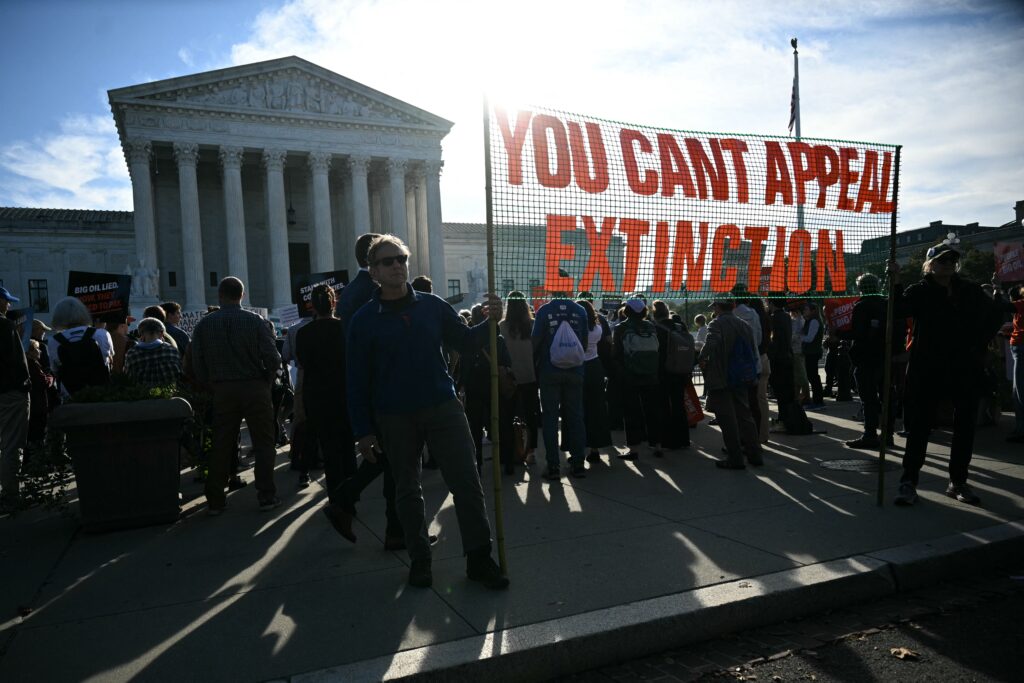
Monday’s oral arguments in Suncor v. Boulder on Monday suggested that many of the Supreme Court justices understand the danger of an economic tsunami if they allow a case in Colorado to move forward.
The city and county of Boulder sued Suncor and ExxonMobil under state law for contributing to climate change through global emissions, seeking significant damages for indirect harms. The Colorado Supreme Court allowed the local governments to test this novel theory of liability, but the energy companies argue that federal law and the rights of other states preempt such litigation. The legal issues are “a little complicated,” as Justice Neil M. Gorsuch put it, but the consequences of setting a de facto national energy policy via jury trials are predictable.
“Presumably, if you prevail, the next day, a municipality in every single state will file a lawsuit,” Chief Justice John G. Roberts Jr. told the attorney representing Boulder during nearly two hours of arguments. “They’ll probably copy your pleadings.”
Roberts is right, and there are already dozens of such pending cases in courts across the country. Together, these suits seek untold billions in damages. This could be a financial boon for trial lawyers, but the broader strategy is to impose a backdoor “carbon tax” that, as one former member of Boulder’s legal team explained, would push energy companies to “bankruptcy.” Such a tax is politically infeasible through the traditional democratic process.
Many companies other than energy producers also contribute to climate change and could suffer if this new legal standard took hold. “Anyone is a potential defendant for a suit like this — any manufacturer, any business,” Justice Brett M. Kavanaugh said.
A narrow way for the high court to block the suit is to say that the Clean Air Act already gave the Environmental Protection Agency the job of choosing “whether and how” to address greenhouse gas emissions, as Justice Ruth Bader Ginsburg wrote in 2011 for an 8-0 majority in American Electric Power Co., Inc. v. Connecticut.
That case is one of what Kavanaugh called the “four corners” of the court’s relevant precedents, all of which frame interstate air pollution as a federal policy problem. Justice Amy Coney Barrett seemed to agree.
Another way to resolve the dispute would be to recognize that Boulder’s lawsuit poses a threat to federalism. The suit seeks to use a Colorado law to regulate emissions in other states by penalizing Suncor’s production nationwide. The Constitution ensured states retained their equal sovereignty when they joined the union, but the justices seemed more skeptical of that argument.
After Justice Samuel A. Alito Jr. recused himself last week, the energy companies’ path to a five-justice majority became more difficult. That made a punt on procedural grounds more of a possibility, but most of the questions posed Monday focused on the merits of each party’s arguments. If the justices choose to duck in this case, they will eventually need to confront a growing wave of climate litigation suits. They have an opportunity now to close the floodgates before unelected juries put American energy producers out of business.
The post The Supreme Court foresees a shakedown of the energy industry appeared first on Washington Post.