Martha Raddatz, the chief global affairs correspondent for ABC News, is co-anchor of “This Week with George Stephanopoulos.”
On Oct. 7, 2001, the United States and allies went to war in Afghanistan, where the al-Qaeda terrorists who had plotted the 9/11 attacks were harbored. With the 25th anniversary of the war’s start, my mind turns to Joshua Webster — 21 years old at the time, a 6-foot-4 Californian from a middle-class Catholic family. He had enlisted in the military in 1999 to help pay for college.
He graduated two years later from Army Ranger School at Fort Benning, Georgia. On Sept. 11, 2001, Webster and his fellow Rangers awakened early, still sore from having completed a final, grueling three-month field test. Eager to share his news with his family, Webster stood in line at the single pay phone and, just after 9 a.m., got through to his mother. But she had bigger news for him — two planes had just hit the World Trade Center. Word spread quickly among the Rangers, who huddled around a radio someone had managed to find.
Like just about everyone else across the country, the soldiers spent that morning in shock. But unlike the rest of the country, they were sure of one thing: They were going to war.
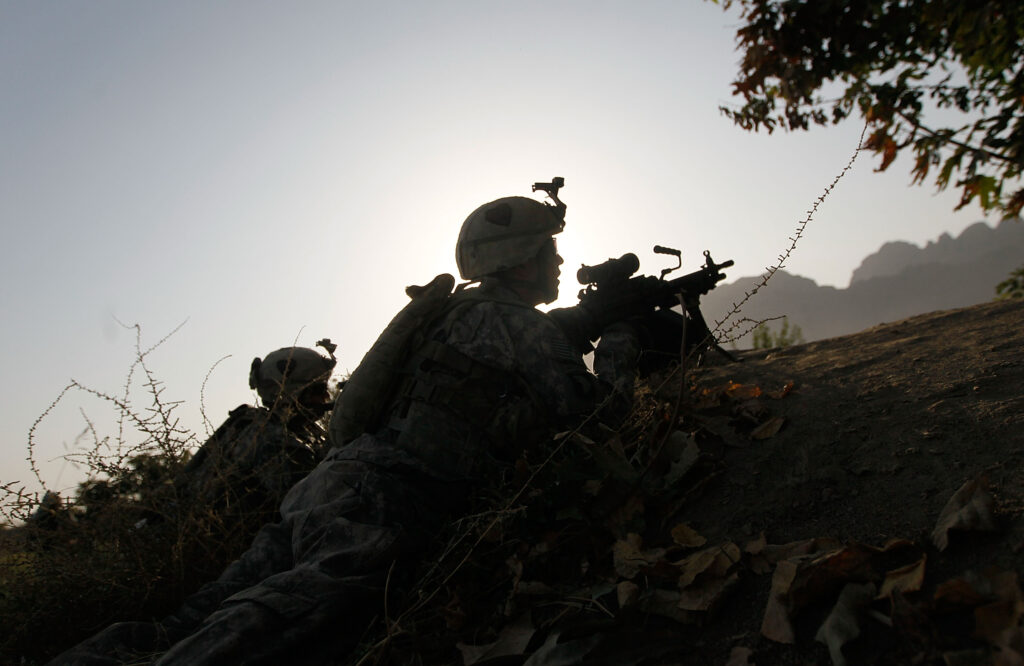
And they did — many of them for several deployments. The wars that started that day in Afghanistan spread to Iraq and Syria and went on for years. Forever wars seemed to mean forever service.
In fact, Josh Webster would spend 20 years in the military; he retired in August, five years after American troops abruptly pulled out of Afghanistan, leaving Kabul in the hands of the Taliban. His career took him from the Army Rangers to Air Force pararescue, and back to the Army as an officer. In Afghanistan and Iraq, he risked his life time and again to save those who had been wounded in combat. He also managed to squeeze in that college degree — a bachelor’s from UCLA.
I met Webster in 2011 on a pararescue helicopter in the mountains of Afghanistan. He told me about saving an Army captain who had been shot in the head by the Taliban and fallen into a ravine during fierce fighting. Both he and the wounded captain, Webster said, were among those whose lives had been transformed by 9/11.
The attacks that day spiked recruitment in all branches of the military, and made those already in the service more eager to stay. As the wars went on, the plans and lives of all Americans who had signed up or extended their tours were completely upended. In too many cases, the challenges and nightmares of their deployments extended into their years as veterans.
In 1980, 18 percent of U.S. adults were veterans; by 2022, that figure had dropped to about 6 percent. Many Americans today, especially those with college degrees, don’t know anyone on active duty. The years of “Thank you for your service” are long gone. As a nation, we are woefully disconnected from the men and women who have fought and are fighting our wars.
The service members who deployed after 9/11 knew the value of the press and largely welcomed the coverage. Respect for the First Amendment was fully ingrained as journalists embedded with their units to report on their triumphs, tragedies and, when warranted, their mistakes as well.
With a Pentagon that now resists coverage and brands the press as treasonous, the stories from this latest war and the human faces of the military are largely lost or overrun by debate. The men and women who serve are far too often lumped in with the politics and policymakers. They should not be.
Our service members are not making policy. They are not sending us to war. They took an oath to defend the U.S. Constitution, and to obey the orders of the U.S. president and their officers. They are part of the 9/11 generation of warriors, and I have been privileged through my work to know many of them.
The troops of the “Greatest Generation” fought the one war in our history that had near-unanimous approval from the American people. But we should honor the veterans of Fallujah and Tora Bora as much as we have honored those who fought at Normandy and Iwo Jima. This generation of warriors, like the one that fought in Korea, is no less great.
Yes, World War II had a moral clarity that other wars have not had. But the warriors of all our conflicts have shown courage, commitment, and patriotism.
They hold their love of country so dear that they are willing to fight and to die for it.
These people deserve our respect and gratitude, and maybe they will remind us that we all can do better — if we think in terms of our own “missions,” the small and large ways we might work to better our communities, our fellow citizens and our country. As our nation marks 25 years since America fought back against a massive terrorist attack, that lofty ambition seems a good way to go.
The post The 9/11 generation of warriors deserves our respect appeared first on Washington Post.