Elisabeth Rosenthal is a senior contributing editor at KFF Health News and author of “An American Sickness: How Healthcare Became Big Business and How You Can Take It Back.”
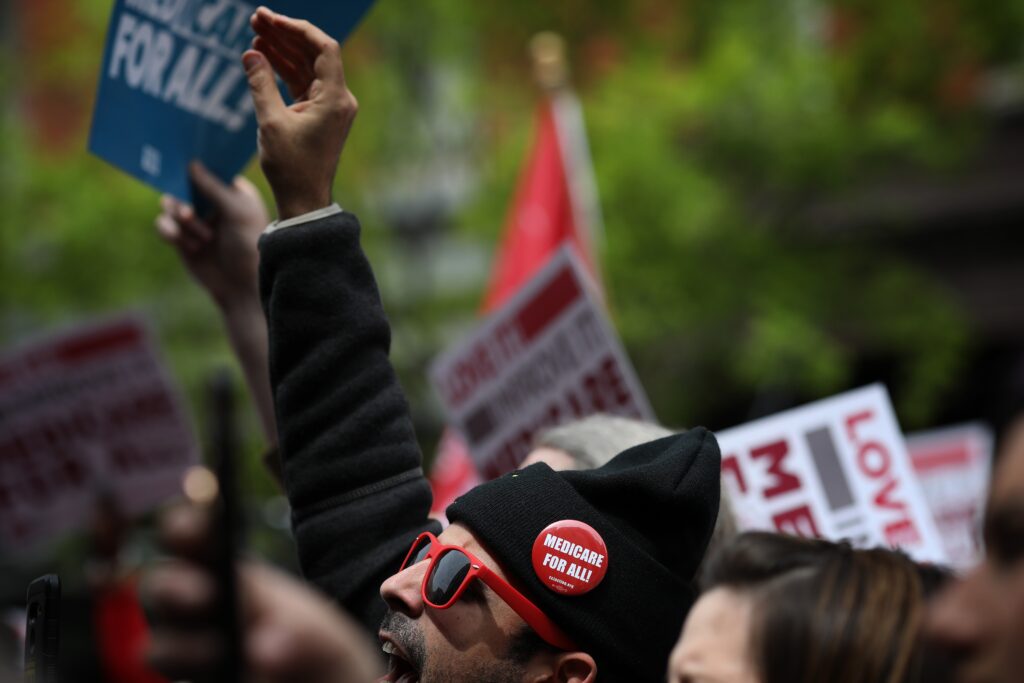
As Americans grow increasingly frustrated with their health care system, a reform proposal that has long been kicked around on the Democratic periphery is showing up in debates and on political platforms: Medicare-for-all.
According to a 2025 Economist-YouGov poll, nearly 60 percent of Americans favor a system of Medicare-for-all, while 85 percent of Democrats support it. For years, Democrats in Congress have proposed symbolic Medicare-for-all bills that have had no chance of passage but have been supported by dozens of members.
Democratic Sen. Chris Van Hollen of Maryland added his support in December. “I was listening to my constituents,” he told me. “It’s just reached the complete breaking point. Our system is unaffordable and unsustainable with premiums going up, co-pays going up and up.”
At a time when more than 100 million Americans carry medical debt, it’s easy to get behind a promise of free, or free-ish, no-hassle health care. But turning an inspirational slogan into law gets gnarly. Those three words, Medicare-for-all — a pledge to bring universal health care to every American — mean not one thing to supporters but many. And all versions face considerable obstacles to enactment.
“Medicare-for-all is a slogan, not a concrete proposal, so it’s hard to have an opinion on,” said Amy Finkelstein, an MIT economist who, with Stanford’s Liran Einav, wrote “We’ve Got You Covered,” which laid out what the pair considered a realistic and fiscally responsible plan for providing basic insurance to every American.
“What we can afford is a basic plan — what we call a shack, not a chateau,” Finkelstein said. Its bedrock would be a government-funded skinny plan less generous than Medicare, with potential constraints such as a limited number of physical therapy visits or stricter criteria for getting a knee replacement but guaranteed robust basic coverage for catastrophic medical conditions. She estimated that most Americans would opt for supplemental coverage.
The most high-profile political proponent of Medicare-for-all this election season is Abdul El-Sayed, the Democratic senatorial candidate in Michigan, who has made a more sweeping proposal central to his platform, far more chateau than shack.
It would create one plan that covers a suite of medical needs with no cost to patients — including dental and vision care, which traditional Medicare doesn’t cover.
(Traditional Medicare has increasingly come to resemble private insurance with premiums and co-insurance, and unlike standard commercial plans, it has no annual out-of-pocket maximum. To fill such gaps, patients buy separate “Medigap” and drug plans.)
“The most important thing is just to make Medicare whole — meaning no charge for medical care — rolling back the complexity and costs of the last 10 years,” El-Sayed told me.
His program would start off covering children and adults five years younger than the current eligibility age for Medicare and close the gap over a period, he estimates, of eight years. To ease the transition for the health care system, he would initially set the Medicare payment rates to mirror the totals doctors and hospitals receive now to avoid a “price shock” to their operations. Future increases would be limited to the rate of inflation.
One big question is how to make the financing work in a highly profitable industry. National health spending was projected to hit $5.7 trillion in 2025, or nearly 20 percent of U.S. gross domestic product.
Yes, the United States spends twice as much on health care per person compared to many peer countries. And, yes, health insurance is often a company’s second-largest expense after payroll.
But how will the government divert financial outlays of employers and households into a new Medicare-for-all system without new taxes or massive government spending?
When polls ask voters whether they would support Medicare-for-all if it meant losing their insurance or paying new taxes, support often drops.
“You could decide to raise taxes and cover more,” Finkelstein said. “If you don’t want to cut current Medicare benefits, you could decide to bust the budget, which seems to be a common practice.”
As president, Joe Biden said he would veto any Medicare-for-all bill, given the cost, which was estimated at up to $40 trillion over 10 years. The bills in Congress don’t include very detailed financing plans.
Economists who have mapped out the possibilities are divided on a realistic path.
A group of Yale researchers estimated that converting to a Medicare-for-all program could save $450 billion annually. That’s in part because a government plan could negotiate — or simply set — far better prices for hospitals, doctors, drugs and devices than private insurers. It would reduce the overhead created by private insurance with its army of negotiators, coders and claim deniers — and reduce profits.
There are strong forces pushing back against such “rightsizing” of exorbitant prices, most notably: insurers, hospitals, and drug and device manufacturers. In 2022, they spent over $700 million on lobbying and have been a powerful force for job creation. But a grand Medicare-for-all proposal may simply be a strategy to open the debate to lesser possibilities. President Barack Obama’s initial Affordable Care Act proposal contained ambitious ideas — such as drug price negotiation — that fell by the wayside to get the votes for passage.
Texas Democratic Senate candidate James Talarico supports what he calls Medicare for Y’all — allowing people under 65 to buy into Medicare.
“There are versions of Medicare-for-all that could potentially include our proposal, and versions that could look extremely different,” Finkelstein said.
Support in some parts of the industry is growing.
According to one survey, more than half of all physicians have said they’d prefer some sort of single-payer system. Though the American Medical Association is opposed, its student and resident sections are pressing to overturn the opposition. The American College of Physicians, the nation’s second-largest physician group, also supports Medicare-for-all. Obama called the ACA a “starter house.” It was “an improvement, but it has not met the need,” Van Hollen said.
Now the growing number of Medicare-for-all proponents will have to define exactly what kind of new house they can accept and afford.
The post Medicare-for-all is back. Now comes the hard part. appeared first on Washington Post.