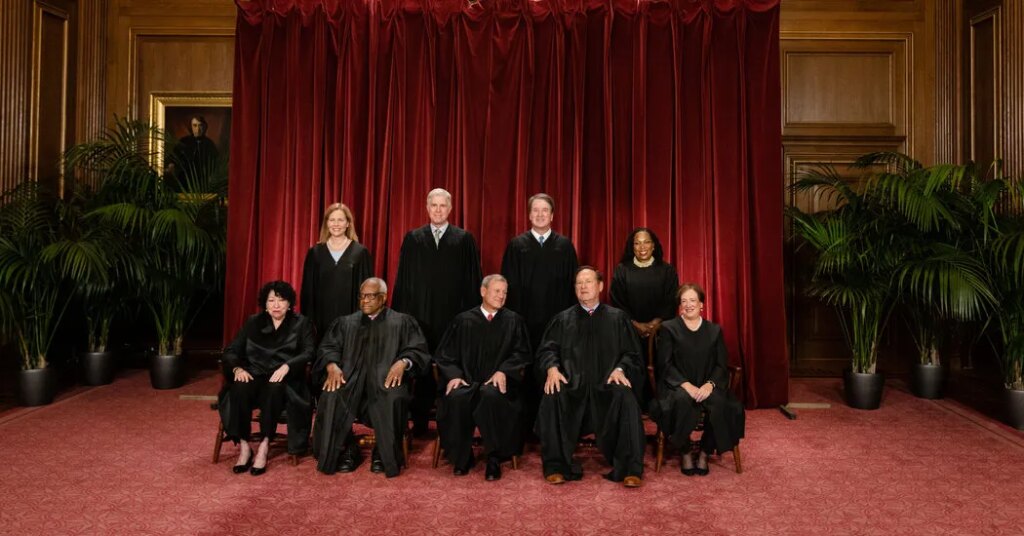
At a public appearance this spring, Chief Justice John G. Roberts Jr. insisted, as he regularly does, that members of the Supreme Court are not “political actors.”
Yet with the court’s new term beginning Monday, scarcely a month before the closely watched midterms, the court may be unable to avoid getting uncomfortably pulled into electoral politics.
With partisans on both sides primed for potential election challenges, lawsuits to settle hotly contested elections could end up before the court, potentially with the control of Congress at stake. They would land on top of an already packed docket of cases on culture war issues and President Trump’s agenda that were selected by the justices to be heard from the thousands of petitions they receive each year.
The result could be another consequential and controversial span on the bench for the justices, even as their public poll numbers have dipped and elected leaders and candidates, particularly in the insurgent wing of the Democratic Party, have called for an overhaul of the court.
The court “knows what an extraordinary politicized moment we are in,” said Jeffrey Rosen, a law professor at George Washington University Law School. For that reason, the justices would prefer not to be involved in lawsuits that would affect results or allow state officials to affect results.
But, he said, if the justices see a true post-election emergency, “it’s hard to imagine they wouldn’t intervene” if called on.
The court will hear oral arguments in about 60 cases, starting on Monday with a major environmental lawsuit, and continuing through late April. During that period, they will deliberate at private conferences, draft and exchange opinions and release the court’s rulings. The most closely divided decisions are typically announced on the final days of the term in late June or early July. But the justices also field emergency requests and issue quick-turn orders without a lengthy briefing period or hearing arguments.
The new term was foreshadowed by a busy summer for the court, which grappled with a series of emergency requests critical to the nation’s political system.
The justices blocked both President Trump’s plan to dramatically overhaul how Americans vote by mail in the upcoming election and three separate times stepped in to block Missouri from using a congressional map drawn to advantage Republicans. At the same time, they allowed the administration to deploy an online system combining citizenship information, Social Security numbers and other sensitive data about millions of Americans to help states hunt for supposedly ineligible voters.
In each case, the majority issued unsigned orders that academics and advocates said suggested that the justices were trying to avoid changing voting rules or creating confusion for state election officials ahead of November.
“There is a robust majority of the court that does not want to be the decision maker that’s going to be the one allowing the chaos to happen,” said Roman Martinez, a lawyer who argues frequently before the court and is a former law clerk to Chief Justice Roberts.
In the mail-ballot matter, election officials from both parties had cautioned that Mr. Trump’s mail-in ballot plan would be disruptive and confusing, potentially putting millions of votes at risk. In the Missouri case, the court warned of “electoral chaos” if the state were to change course so close to the election and use the GOP map, as pressed by Republican officials.
Even in the online database case, where the court sided with the Trump administration, the justices seemed to try to dampen the impact on the upcoming election. They noted that their own ruling could be limited by what’s known as a 90-day “quiet period” before elections that prevents elections officials from making broad changes to state rolls ahead of the vote.
Erin Murphy, another former law clerk to Chief Justice Roberts, said the court seemed to be sending the message: “Stop doing this to us because we really don’t want to be in this position.”
That posture could change after the election if there are disputes over vote counts or the certification of elections. There is already a flood of election-related litigation filed around the country by both parties and concerns about the possibility of voter intimidation and the seizure of ballots.
If the court were to get drawn into closely contested elections that could determine control of Congress, it would raise echoes of the post-presidential election period in December 2000. That was when the Supreme Court put a stop to a Florida recount in the election that sealed George W. Bush’s victory over the Democratic nominee, Al Gore.
The Supreme Court was likewise the final arbiter of Mr. Trump’s challenges in December 2020, rejecting post-election challenges involving the use of mail ballots in Pennsylvania and a Texas lawsuit seeking to throw out election results in four battleground states that President Trump lost.
“Everyone’s eyes are on the election,” said Cecillia Wang, national legal director at the American Civil Liberties Union, which is preparing for a possibly intense burst of post-election challenges.
Such challenges would pose a conundrum for the court, putting it at the heart of the deeply divided political landscape, even as polls show Americans increasingly disapprove of its work and worry the court is putting its thumb on the scale in partisan battles. Democrats particularly have grown to believe the court, with a 6-3 majority of Republican nominees, is too conservative, according to a new Gallup poll.
A poll conducted by Marquette Law School in September found that 57 percent of Americans, a sizable majority, now believe the justices are motivated mainly by politics rather than law. The percentage of those approving of the court dipped to 43 percent.
Those numbers were divided along party lines. Sixty percent of those surveyed said the court has ruled in Mr. Trump’s favor often or fairly often. Seventy-eight percent of Democrats said the court was going out of its way to avoid ruling against Mr. Trump.
In an interview with CBS News posted on Friday, Justice Samuel A. Alito Jr., who is one of the court’s most reliable votes in favor of the president’s agenda, insisted that the court “is not part of any political movement. And we are not attempting to further any political agenda.” He added: “We are trying to interpret the Constitution as best we can and apply it in the cases that come before us.”
The court’s poor showing in the polls coincides with a drumbeat of calls, particularly from Democrats, to change the structure of the Supreme Court should they win control of Congress next year. There is broad, bipartisan support for eliminating life tenure for justices and for enacting an enforcement mechanism for an essentially voluntary ethics code that the justices adopted in 2023, according to the Marquette poll. The public is more closely divided, however, on proposals to expand the number of seats on the high court.
Exacerbating the court’s unfavorable numbers, pollsters have indicated, could be its rulings against Mr. Trump and the anger those decisions have sparked from the president and his conservative allies. Mr. Trump has sharply criticized the court, particularly the three justices he nominated, who last term ruled against some of his signature policies, including tariffs and birthright citizenship.
The president said in an interview with Time magazine published last week that he regretted picking Justices Neil Gorsuch, Brett M. Kavanaugh and Amy Coney Barrett.
“I gave them the position of a lifetime,” he said, “and they voted against me often.”Major aspects of the administration’s agenda will once again be tested before the court. Notably, the justices will review the administration’s policy of deporting immigrants to countries where they have no ties and its practice of indefinitely detaining immigrants who crossed the border illegally years ago.
D. John Sauer, the solicitor general, has also asked justices to clear the way for the administration to fully enforce its ban on transgender troops serving in the military and to make it easier for the president to install his allies as United States attorneys throughout the country.
And the justices have been asked to weigh in on Mr. Trump’s appeal of a $83 million jury award against him for defaming the writer E. Jean Carroll after she accused him of sexually assaulting her in the mid-1990s in a Manhattan department store. The court has already left in place a $5 million civil judgment against Mr. Trump after a jury found in 2023 that he had sexually abused and defamed Ms. Carroll.
Apart from Mr. Trump’s agenda, the court plans to hear a series of other consequential matters, including a blockbuster case dealing with gun control in December.
After years of ducking the question, the justices will consider whether state and local laws banning semiautomatic rifles violate the Constitution. The case deals with laws in Illinois and Connecticut but will likely determine the fate of similar laws throughout the country aimed at restricting military-style rifles.
The widespread availability of semiautomatic rifles, such as AR-15s, continues to be a deeply polarizing issue. Owned by millions of Americans, the rifles have also been used in high-profile mass shootings, including in the Sandy Hook and Uvalde elementary school massacres.
The legal battle over assault weapons bans is the latest Second Amendment fight to come to the court. Since 2008, when the justices declared an individual right to own a gun apart from military service, they have contended with how to evaluate the validity of gun restrictions.
Religious rights, particularly for Christians, have also been on a winning streak at the court and will be back on the docket this year.
In November, the court will hear a case brought by the Archdiocese of Denver challenging Colorado rules that require preschools that receive public funding to accept the children of gay and transgender parents.
Accepting those students would be at odds with the church’s teachings and mission, said the archdiocese and two Catholic schools. But lower courts upheld Colorado’s law, saying the state could require participating schools to abide by anti-discrimination rules, as long as the requirements were applied to schools across-the-board and without regard to religion.
The justices have also been asked to hear a case from Texas challenging a state law that requires every public school classroom to display a Protestant version of the Ten Commandments. Three other states — Alabama, Arkansas and Louisiana — have recently enacted similar laws.
The post How the Midterms Could Complicate the Supreme Court’s New Term appeared first on New York Times.