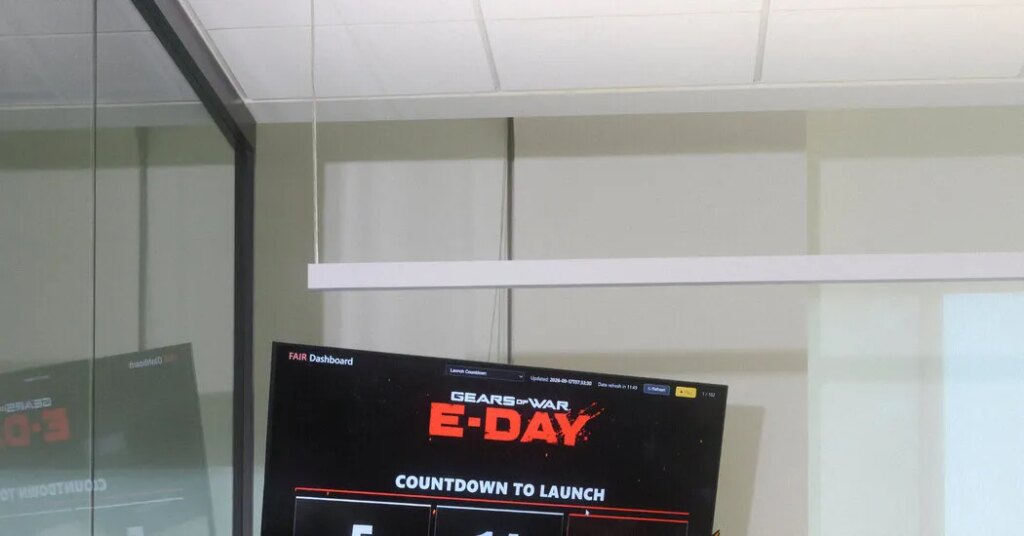
Gears of War: E-Day, the newest game in Xbox’s sci-fi military franchise, is a top-to-bottom chronicle of war’s devastation. Collapsed buildings billow with fire and smoke effects, resembling real-life tragedies, while faces convincingly convey an infantry squad’s heavy, unspoken emotions.
The narrative trajectory of the prequel, where a towering city becomes wreckage during the inciting conflict between humanity and a subterranean alien horde, has unintended parallels with the modern game industry. After nearly six years in development, E-Day arrives this week amid a major Xbox leadership reset, studio closures and a series of layoffs.
The leadership team at the Coalition suggests the franchise has been reset in its 20th year to forge a sustainable path, perhaps one that can survive the current tumult.
And the third-person combat and flow in E-Day are certainly an evolution, as if the developers behind Gears of War 4 and Gears 5 stopped tracing over the exact lines of previous games and instead redrew the original trilogy from memory. The war veteran Marcus Fenix and his bulky squadmates now jump up, over and through combat arenas.
A straight shot of a bridge or a mad dash over a collapsing highway would have choked older Gears games, which cleverly shrunk their views to emphasize other cutting-edge effects. E-Day’s large vistas are brutal tone-setters. Concrete wreckage is interrupted with gaps, slices and collapsed building materials. Bodies, as well, and not just alien ones.
Such a technical reinvention aligns with E-Day’s somber story, about people trying to escape a city-wrecking alien scourge.
Juan Vaca, the game’s story director, expressed bittersweet pride about the results. He was a scout sniper in the Marines, and E-Day includes callbacks to mourning a best friend and others whom he served alongside.
“I use it as a way to honor them and think about not only the deaths, but how we found out about them,” he says. “This is a game about grief.”
At first glance, the Coalition’s offices at the edge of downtown Vancouver, British Columbia, reflect an older Gears era. Staff members suggest that the framed concept art, action figures, themed Xbox consoles and life-size monster puppet are not great fodder for photography because they are all sourced from previous games.
Although familiar characters and plot points have returned in E-Day, most of the digital nuts and bolts — artistic assets, the underlying 3-D-rendering engine, animations — are brand-new.
“Start with an empty hard drive,” the studio lead, Mike Crump, told his team.
In 2014, Epic Games, which is best known for Fortnite, handed the rights to its Gears of War franchise to Microsoft, which had a Vancouver studio that had been struggling. The last-ditch shot: become a Gears-only studio. (Years earlier, a similar transition played out for Microsoft’s Halo series.)
The Coalition worried it might lose existing fans if its first entry in the franchise, Gears of War 4 (2016), strayed too far. Matt Searcy, the studio’s creative director, called the final product more of a jog than a hard sprint.
Gears of War (2006) and its third-person camera innovated a “cover shooter” mechanic of peeking with guns from safe, crouching positions, something first-person games like Halo couldn’t do. This flank-and-cooperate gameplay landed in a gritty universe where friends could team up and push back alien invaders.
“There’s tons of stuff from Gears 4 on the cutting room floor because people came in having worked on all these other Triple-A franchises,” said Searcy, using a profanity that would not be out of place in the mature games.
As Gears 5 (2019) began production, the Coalition attempted what Searcy called “open-heart surgery” to add a seemingly simple move: a jump. But what comes natural to Super Mario is not the same for armor-clad soldiers like Marcus or the studio’s older codebase. The idea was “too disruptive” and got scrapped.
Instead, the game introduced desolate landscapes that players traversed via high-speed sleds before climbing off to explore classic, Gears-styled combat alcoves, and a newbie-friendly helper bot. These ideas and Gears 5-exclusive multiplayer modes do not return in E-Day.
But late last month, Vaca and colleagues in the Coalition’s design and animation departments were laid off.
Searcy and his Coalition colleagues were diplomatic about their previous game during formal interviews, but he was more candid while playing a cooperative E-Day session in a Coalition computer lab. “We learned a lot on Gears 5,” he said with a laugh between bursts of machine-gun fire.
From his Bay Area home office, Vaca said several things included in E-Day were from his life, such as Marcus’s squad using a tourist map to get its bearings. Vaca similarly relied on a tourist map during his turbulent 2004 deployment to Haiti, and still keeps it among his valuables.
Vaca also sees himself in the game’s pair of new characters: Mags Carter, a jaded mentor whose name refers to “the document that challenges the king,” and Lucas Reyes, a younger and more regretful soldier. Vaca describes Lucas’s story as “a chance to tell young, impressionable men that there is a path to redemption through doing good.” The stories told through terse, minimalist dialogue and emotional faces are a highlight for a series that has occasionally erred on the cheesy side of sci-fi.
The game’s handling of grief is not confined to life and death. One mid-game sequence sees the characters remark on the shoddiness of Mags’s post-military apartment. “Once the war broke you, you’re just disposable,” Vaca says about the all-too-common veteran experience of re-entering society without work or support.
Representatives from Coalition declined to comment on the layoffs.
One week earlier, Coalition leadership described continuity as an important studio principle. Many of the team’s leaders worked together at Electronic Arts’s offices in Vancouver before joining what became the Coalition in 2010.
“Every time you hit a challenge as a group and you master it and overcome it, you now have a place of strength to work from when you tackle your next set of challenges,” Searcy said. “What you get out of continuity is a confidence.”
Gears of War: E-Day has received positive reviews, but there are plenty of challenges for the Coalition. It was one of the developers of last year’s Gears of War Reloaded, a remake of the debut 2006 game and the first released on the PlayStation. But shortly after Xbox named a new chief executive, E-Day was announced as an Xbox console exclusive, limiting the game’s audience.
Crump, who leads the studio, suggested it would produce future Gears games more quickly, and its technical director, Kate Rayner, noted that E-Day’s development began before the rise of generative A.I.
“We’re looking to the industry,” she said, “to see what’s going to happen.”
On a recent sunny afternoon, more than 100 Coalition employees cheered as Crump celebrated a milestone by slicing into an E-Day cake. His makeshift knife was a toy version of the “Lancer,” the franchise’s signature chain saw-tipped gun, and someone played a revving sound as it touched the frosting.
Crump then spoke to the “blood, sweat, and tears” that went into E-Day’s making. When pressed on the series’ future, he spoke about “what’s right for the franchise,” like taking six years to retool core technologies. That response, about franchise over staff, recalls emotional E-Day moments where soldiers grapple with the cost they bear for larger leadership decisions. As the character Mags Carter remarks, “War doesn’t care about our good intentions.”
The post E-Day’s 6-Year Journey Inside the Rapidly Changing Xbox Industry appeared first on New York Times.