PARTITA, by Barbara Kingsolver
For an unassailable humanist, Barbara Kingsolver inflicts some real nightmares on her characters — even the people she seems to love most. If and when she rewards them with peace and self-knowledge, it’s such a relief that readers may be tempted to applaud, like passengers on a turbulent flight whose pilot has just safely landed the plane.
Kingsolver understands that life can be an ingenious villain. Along with her decades-long environmentalism and her call for empathy and moral justice, her abiding theme is that we can survive the unsurvivable, which is fortunate because someone or something may be lurking nearby to make us prove it.
Livia Cable, the Appalachia-bred narrator of Kingsolver’s new novel, “Partita,” is wry, resilient and as forthcoming a companion as you could ask for. Decades ago, she was a dazzling 20-year-old piano student who thought she’d escaped her roots and her Antarctically cold mother for a conservatory in Indiana. But fate showed its claws, and she was forced to return, with bone-deep ambivalence, to Tennessee.
Livia is middle-aged now and owns a small dairy farm with her eminently decent husband, Charlie, who lost a leg at 6 when his grandmother accidentally backed over him with a ride-on mower: “Everybody knew the story. High summer, big yard, a big chore for an older lady. Charlie was bringing out a Coca-Cola for his mammaw, as his mother had asked him to. Over the mower, she hadn’t heard his little voice calling her.”
That was not the last tragedy to come around. In the first two pages of “Partita,” Livia tells us that when she was 11, her beloved older brother, Cyrus, stepped in front of a train, ending his emotionally riven life and sending her family even further into Eugene O’Neill territory. On Page 3, she gets an unexpected call from Sigurd, an old lover she hasn’t spoken to since he dismantled her life when she was in college. Sigurd wants to see Livia because a medical diagnosis has him checking the rearview mirror. For Livia, it’s a destabilizing request. “I put down the phone with my hands shaking and a sick feeling that I’d been waiting for something like this,” she thinks. “Not a train, but a reckoning coming at me.”
Seeing Sigurd again could bring emotional closure or catastrophe, and Livia suspects it will be the former. She’s married to Charlie, for one thing. (They have no children, and he’s still smitten with her after decades.) And she has an ominously “ruined” right hand she somehow blames on Sigurd.
Livia refuses to give Sigurd an immediate answer. She takes a week to decide whether subjecting her heart to him again would be like straightening the welcome mat for a vampire. “Partita,” an imperfect but deeply wrenching novel, plays out during the seven days that Livia spends reeling in the years.
In the book’s college flashbacks, she meets Sigurd in 1989. Livia’s a broke scholarship student with an Appalachian accent that turns “well” into “whale,” which would have been a deal-breaker for her piano instructor if he hadn’t heard her play. Sigurd is a typesetter and union organizer thrusting Marxist tracts at people on the sidewalk.
In case he doesn’t sound like a good time, I should note that he’s also the hottest thing Livia has ever seen. When they first meet, he’s wearing “well-fitting” jeans, and has “arms and wrists like Michelangelo’s David, I swear, with power you could see in the muscles and sinew but tenderness in the hands. I shivered. As if those hands had touched me already.”
Kingsolver once argued in The New York Times that literary authors are foolish to dodge the subject of sex. And dodge it, she does not. At least not in “Partita.”
Even before Livia parts ways with her sweet but unelectrifying college boyfriend — a woodwinds player with two friends she refers to as Percussion and Bassoon — she and Sigurd have a showstopping tryst in a piano practice room that makes the famously sensual scene in “Ghost” look like a YouTube pottery tutorial. The scene matters because, among other things, this is a book about the difference between love and lust and the perils of misdiagnosing your condition.
“Partita” is Kingsolver’s first novel since her Pulitzer-winning epic, “Demon Copperhead.” That book reimagined “David Copperfield” to humanize Appalachia’s opioid epidemic, in the process extending a middle finger to the Sackler family as well as to the pre-bearded incarnation of JD Vance, who wrote about the crisis in the song of himself that was “Hillbilly Elegy.” Compared to “Demon Copperhead,” with its reclamation of Dickens, “Partita” could seem circumscribed. But Kingsolver has never been a minimalist as a writer or a thinker (her stunner “The Poisonwood Bible” being a case in point).
In “Partita” — the term refers to a Baroque suite bustling with different styles of dance music — she takes on not just sexual obsession and classism, but also itchy what-ifs, human decency, the engulfing power of music and the butterfly effect of dreams deferred. Kingsolver is interested in what we accrue over our lifetimes, like iron filings to a magnet. Or shrapnel.
“Partita” often relies on tropes: the sexy stranger. The blast-from-the-past phone call that knocks memories loose. The prodigal daughter’s return home after a parent’s death, as well as the intense clutter the parent leaves behind as a metaphor for emotional inheritance. (“Mine, all mine,” Livia says ruefully.)
But the tropes work, and Kingsolver might not have been able to contain so much of the messiness of living without giving readers familiar signposts and structure. Christopher Nolan recently said of film criticism, “To be able to identify the mechanism does not invalidate the mechanism.” By which I think he meant: If you’re enjoying the train ride, don’t complain about the tracks.
A handful of mysteries pull you through Kingsolver’s novel. You’re curious what this sentence, casually dropped early on, refers to: “I’d carried a child.” You want to know how Sigurd “ruined” Livia’s hand. Can Livia still play Ravel, Bach, Schubert, Chopin and the rest? And if she can’t, does she even know who she is anymore? (On one level, Kingsolver has written a thriller about a pianist’s hands. I mean, check out the book cover.)
“Partita” has a few sluggish chapters, but they fall in the middle when the author may have been resting up for the heart-hammering final third of the novel. What floors you in these pages is partly Livia’s terrible luck and the hateful person or two who seem determined to compound it. The book has moments so Thomas-Hardy-sad that you feel like you’ve got rain in your veins. But what’s even more moving is that — at moments when Livia, as strong as she is, feels broken — someone who barely knows her will do her a small but consequential kindness that pulls her out of a chute and puts her on a ladder.
Like Livia, Kingsolver left Appalachia for Indiana and a piano scholarship. She’s back in Appalachia now and still plays, but she has shared that a genetic condition curls the fingers on her left hand and necessitates regular surgeries and rehab. I’m interested in the parallels only because Kingsolver writes so transportingly about music and musicians that you can tell the passion in “Partita” is genuine.
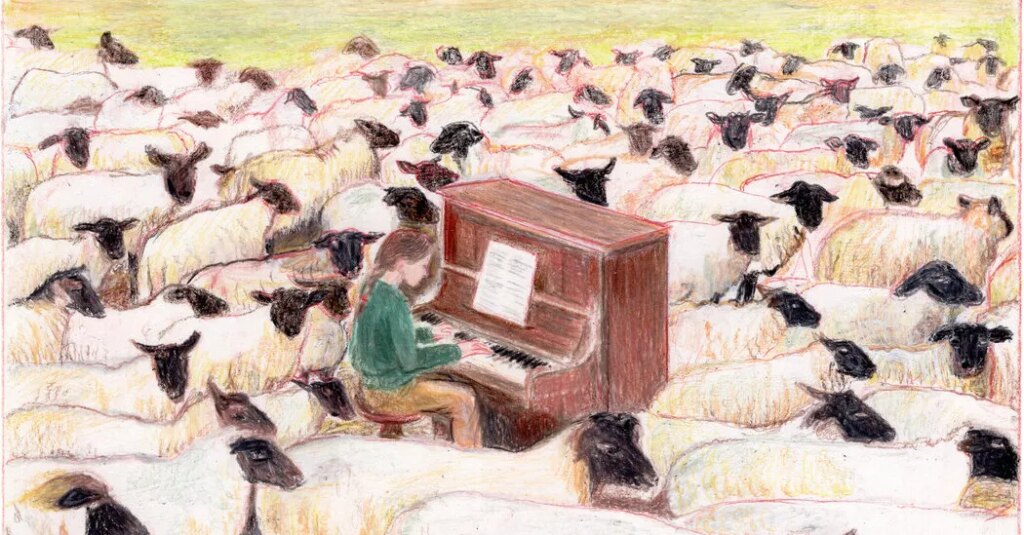
Livia’s attempt to master each difficult piece becomes a metaphor for how much of life is a trial-and-error migraine. But the piano remains her religion. As a kid, she practiced on an upright in an empty church. Later in life, when neighbors wonder why they’re not seeing her on Sundays, she tells us something cheeky and also beautiful in its way: “I was only ever in it for the music.”
PARTITA | By Barbara Kingsolver | Harper | 338 pp. | $32
The post Barbara Kingsolver’s Latest Is a Sexy Novel About Life’s ‘What-Ifs’ appeared first on New York Times.