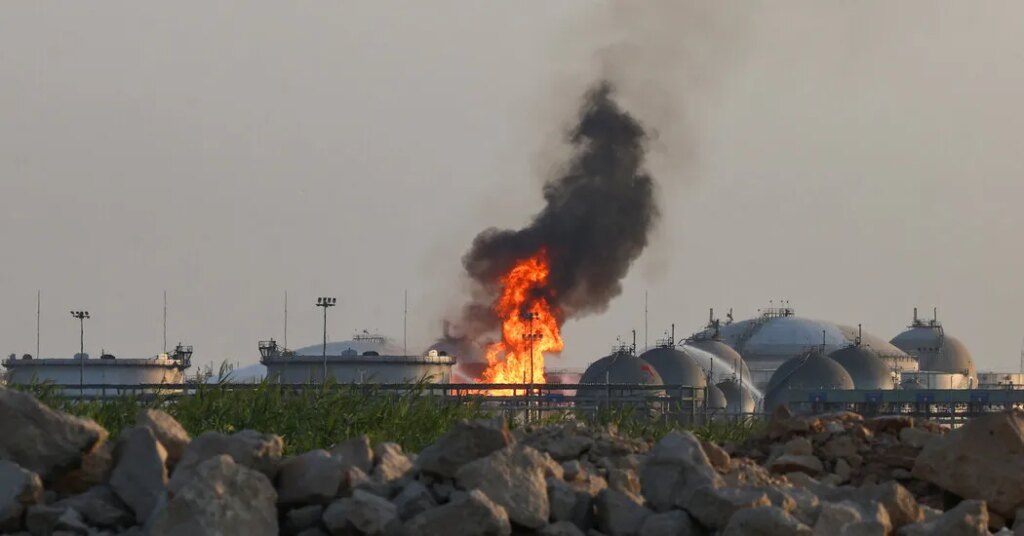
Yemen’s Iran-backed Houthi militia said it had hit oil facilities in the Saudi capital and fresh airstrikes hit Yemen’s capital early Sunday, heightening fears of a wider war.
The Houthis said Saturday’s missile and drone attack had caused fires at the site, and videos verified by The New York Times show a fire at an oil refinery in Riyadh belonging to Aramco, Saudi Arabia’s state-controlled oil company. Maj. Gen. Turki al-Maliki, the spokesman for the Saudi-led coalition, rejected the Houthi account in comments to the Saudi-owned newspaper Asharq Al-Awsat, calling the group’s claim to have targeted Riyadh “misleading.”
Hostilities intensified further overnight, as Houthi-run media reported that Saudi Arabia had carried out a fresh attack on Sanaa, the Yemeni capital. Saudi officials did not immediately comment. The Houthis have accused Saudi Arabia of launching hundreds of airstrikes in Yemen during the latest escalation, most of which Saudi officials have not publicly acknowledged.
Saudi Arabia, which led a military coalition into Yemen’s civil war in 2015 and remains the principal foreign backer of the country’s internationally recognized government, has been drawn back into direct confrontation with the Houthis after years of relative calm.
A cycle of cross-border violence began in July, after the Houthis accused Saudi Arabia of bombing Sanaa’s airport. The Houthis responded by launching drone and ballistic-missile attacks on Saudi military bases, ports and airports, while also targeting oil tankers in the Red Sea.
The ground war then widened sharply last month, when the Houthis launched a lightning offensive down Yemen’s Red Sea coast, seizing the strategic port of Mokha and Perim Island in the Bab al-Mandab Strait. The advance shattered a fragile military stalemate that had lasted years and gave the Houthis a far stronger position along one of the world’s most important shipping routes.
As the conflict has escalated, it has drawn Yemen more deeply into the wider war between the United States and Iran. With shipping through the Strait of Hormuz disrupted for months, Saudi Arabia has become more reliant on oil export routes through the Red Sea, increasing the stakes of Houthi advances near the Bab al-Mandab Strait.
Col. Majid Abdullah al-Nuzaili, a spokesman for forces aligned with Yemen’s government, said on Sunday that government aircraft had struck what he called “vital targets” in Sanaa and Saada, the Houthis’ longtime stronghold in northern Yemen. He said government forces had also carried out dozens of strikes and operations against Houthi reinforcements around Taiz, the country’s third-largest city.
The area around Taiz has been the scene of fierce fighting in recent days between the Houthis and government-aligned forces. The city sits at a strategic crossroads between Houthi-held northern Yemen, the government-controlled south and the Red Sea coast, making it a crucial prize for both sides.
“We remain anxious and afraid, fearing that the Houthis may enter the city,” said Ala’a, a Taiz resident who asked that only his first name be used because of possible reprisals. “It is the first time I have seen my neighbors’ children still awake at 3 a.m. because of the bombardment.”
Yemen, one of the world’s poorest countries, has been devastated by more than a decade of war and the latest escalation has only compounded the humanitarian crisis. More than 800 people have been killed since the fighting erupted last month, according to the World Health Organization, while the World Food Program says more than 150,000 people have been displaced in recent weeks.
Saeed Al-Batati and Dylan Collins contributed reporting.
The post Houthis Claim Attack on Oil Site in Saudi Capital as Yemen Conflict Escalates appeared first on New York Times.