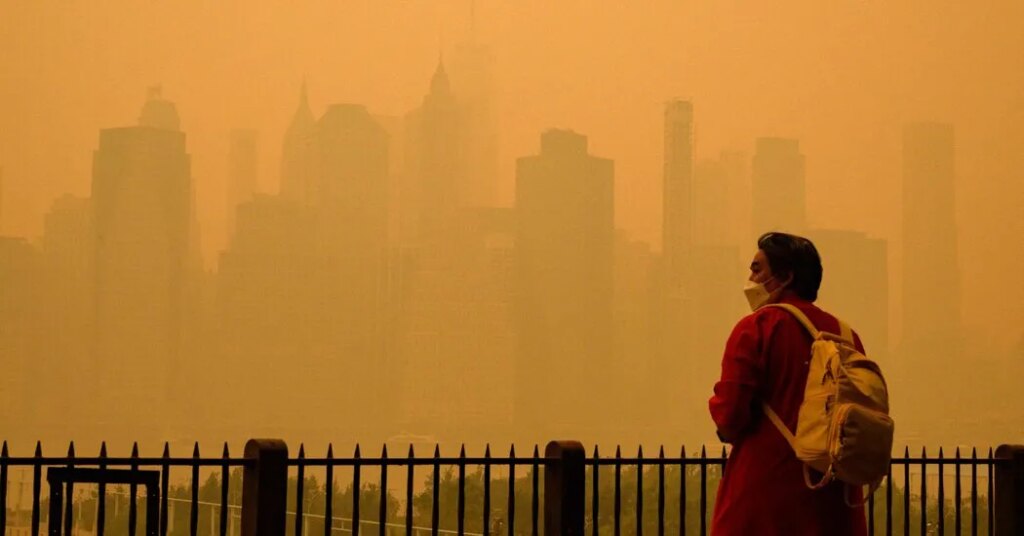
In July, as smoke drifted down from Canadian wildfires, New York City officials initiated an emergency response to what was expected to be historically poor air quality.
Outreach workers fanned across the city. Police officers handed out masks. For a period on July 16, New York City had the third-worst air quality in the world.
Then the skies began to clear, and the response was concluded. But in a way, the emergency wasn’t really over. A series of studies have found that even after the orange-gray smoke has disappeared, wildfires worsen air pollution in subtle and unexpected ways.
Researchers have quantified the risks over time, and over wide geographic areas, posed by small particulates called PM2.5, a constituent element of wildfire smoke. But scientists are now pointing to another, invisible hazard on the rise: ground-level ozone.
Ozone gas occurs naturally, and in the upper atmosphere it is protective, shielding the planet from solar radiation. But at ground level, ozone is toxic to the lining of human airways and has been linked to increased rates of asthma in children as well as heart disease and lung problems in adults.
“There’s very little doubt that ozone exposure can cause premature mortality,” said Dr. John Balmes, a physician and epidemiologist at the University of California, Berkeley, who has studied ozone.
Ground-level ozone is monitored at about 1,200 locations. But these measurements cover only about 2 percent of the country, and most of the sensors are concentrated in cities.
Jun Wang, an atmospheric chemist at the University of Iowa, set out with his colleagues to make a better map. It was an ambitious undertaking.
Dr. Wang worked with a team that used machine learning, a kind of artificial intelligence, to crunch enormous amounts of data from satellites, surface measurements and atmospheric models to calculate ozone levels down to the square kilometer, across the entire country.
The results, published in June in Science, were sobering.
Like PM2.5 levels, ozone levels steadily declined through the early 2000s. But in 2015, they started climbing again, a shift that had “gone undetected by the sparse monitoring network,” the authors wrote.
No one had noticed that fires had been steadily erasing progress made on ozone for over a decade. “The trend actually reversed solely due to wildfire,” said Meng Zhou, a researcher at NASA and an author of the study. “We did not expect that the impact would be that big.”
The researchers estimated that from 2022 to 2024, 43 million people were exposed to potentially hazardous levels of ozone because of wildfires.
The magnitude of the effect surprised even Dr. Balmes. “It’s on the order of three to six years of progress reversed,” he said. “That’s pretty dramatic.”
Minghao Qiu, an atmospheric scientist at Stony Brook University, led a team that used a similar machine-learning approach to study the interaction of smoke and ozone.
Their results, published in April in Science Advances, independently confirmed that ozone levels spike on smoky days, supporting the conclusion that wildfires have been driving the ground-level ozone increases.
“The EPA has done a tremendous job in reducing ozone since the Clean Air Act,” said Dr. Qiu, “But now we’ve introduced a new source, and it’s changing really quickly.”
Dr. Qiu’s paper identified another unnerving trend: While Western fires primarily affected particulate levels in Western states, their effects on ozone occurred mostly in the East. The fires were worsening ozone levels thousands of miles away, where there was no smoke in the sky at all.
Because changes in air quality can be subtle, and are spread over huge geographic areas, they can be difficult for us to perceive. But the impacts on health are consequential.
Each of us breathes about 40 lbs. of air each day, according to Dr. Wang. The surface area of our lungs dwarfs the body’s other points of contact with the outside environment.
It is twice that of the gut, and thirty times that of the skin. Our bodies meet more of the world through the act of breathing than any other way.
“People pay attention to their diets, but do they pay as much attention to air quality?” Dr. Wang said. “The amount of air we consume is much greater, but we don’t think about it.”
Daniel Jaffe, an atmospheric scientist at the University of Washington, said that it was important to recognize that most ozone still comes from industrial emissions, and that regulation of those sources remained critical.
But global warming is accelerating, and a hotter, drier future will bring ever larger fires and more smoke.
Last year, Dr. Qiu and Marshall Burke, at Stanford, led a team that also used machine learning to predict the future toll from wildfire smoke. Under a high-warming scenario, they projected that smoke could cause around two million deaths in the United States over the next 30 years.
The economic impacts were even harder to grasp: costs associated with smoke-related deaths exceeded all other climate damages combined.
“This whole field is evolving very rapidly, because wildfire itself is evolving very rapidly,” said Dr. Qiu. “We didn’t have such massive fires even five years ago.”
The post Scientists Warn of Another Unseen Risk From Fire: Ozone appeared first on New York Times.