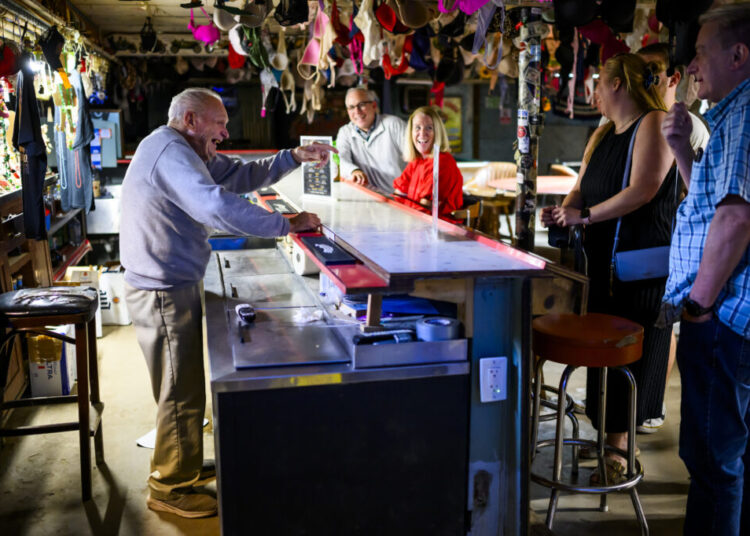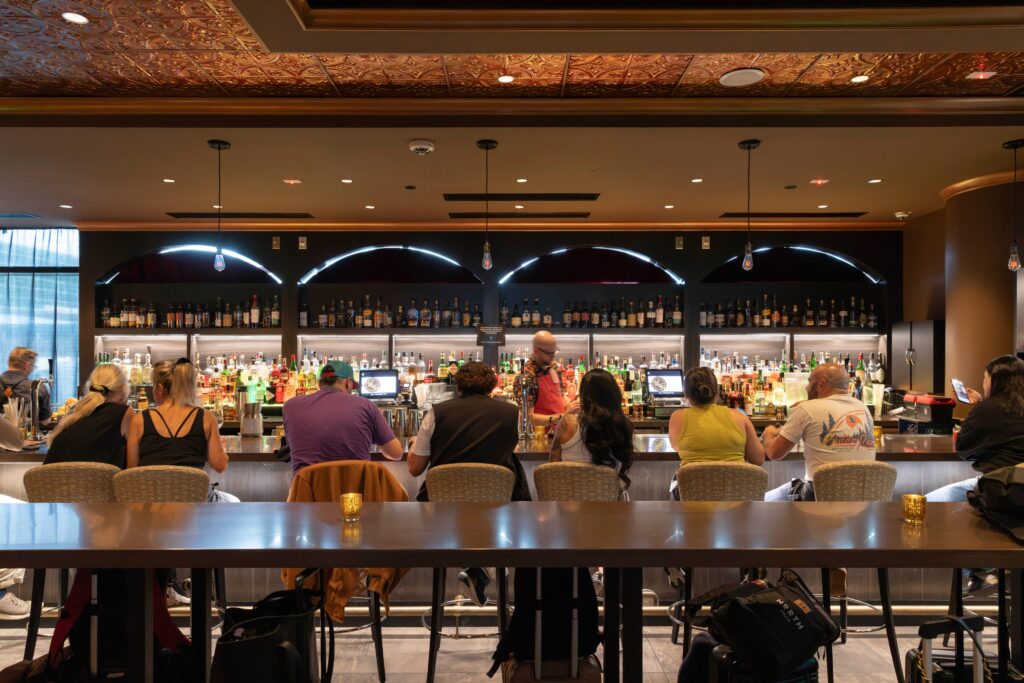
At Denver International Airport, travelers looking for a cocktail bar near Gate A38 first have to find a bookstore.
The facade is part of Williams & Graham, an airport outpost of the Denver speakeasy known for hiding its original bar behind a bookcase. The airport version carries the concept into the terminal: Passengers enter through the pint-sized shopfront, then pass through a bookcase into a dimmer, more intimate bar that feels deliberately removed from the concourse outside.
That kind of escape is becoming easier to find in airports, even when the bars themselves are not.
Over the past several years, hidden and speakeasy-style bars have begun appearing in terminals across the country. They are the latest evolution in a broader shift in airport hospitality: Restaurants and bars that once existed largely to serve a captive audience are increasingly being designed as experiences in their own right. The bet is that travelers do not just want somewhere to kill time before a flight; they want places that can make that time feel more enjoyable, more distinctive and, for a little while, less like being in an airport.
Speakeasies are particularly well suited to that goal. Airports are highly controlled environments, with security checkpoints, boarding procedures and constant instructions about where to go next. A hidden bar introduces an element of unpredictability into a journey otherwise designed to eliminate it.
“Airports are among the most controlled consumer environments we encounter,” said Thorsten Merkle, a professor at ZHAW Zurich University of Applied Sciences’ Institute of Facility Management who studies airport food-and-beverage behavior. “There is relatively little opportunity for genuine discovery.”
That contrast is part of the appeal, Merkle said. In an airport, where passengers are usually directed toward what comes next, the act of discovering finding something for themselves can be particularly exciting.
That was part of the thinking behind Blinded Tiger, one of the newer additions to New York’s John F. Kennedy International Airport. Tucked inside a duty-free retail space in Terminal 8, the bar was conceived during the terminal’s expansion and modernization as something travelers would not expect to encounter between security and their gate.
“We are seeing a shift in what travelers expect,” said Steve Johnson, president and CEO of North America for Avolta, which operates the bar. “Whether it’s an upgraded airline seat or a hidden bar that feels more like a night out rather than a layover, there’s a growing appetite for exclusive, elevated experiences.”
Early on, many travelers discovered Blinded Tiger by chance while browsing the adjoining duty-free store. But Johnson said that changed as word spread: Some passengers began seeking it out during layovers or arriving at the terminal early enough to stop in, and the bar now has repeat visitors who make it part of their trips through Terminal 8.
That change — from frequenting taking whatever establishment happens to be near the gate to actively seeking out a particular place — is significant, said Jeannie Walters, author of “Experience Is Everything” and CEO of Experience Investigators.
For years, airport concessions had little reason to compete on experience, she said. Travelers were hungry, often had limited options after security and were largely a captive audience. “The bar was set low,” Walters said.
Now, she said, airports increasingly recognize that what happens inside the terminal shapes how travelers remember the entire journey.
“A forgettable food court sends a message about the whole trip, and so does a genuinely great one,” Walters said.
That helps explain why airport operators are investing not just in better food and drinks but in places with a story attached to them.
“People love a discovery, like we found something rather than just consumed something,” Walters said. “Knowing where the secret is is half the fun.”
At Portland International Airport in Oregon, Aurora pushes the idea further. The pre-security bar is tucked inside the beer hall Loyal Legion, behind an otherwise unmarked entrance bearing a small sign that reads, “Curiosity Opens the Door.” Employees do not proactively tell travelers how to get in; those who ask about the sign are given the code.
Inside, the emphasis is as much on respite as secrecy. There are no televisions, and the airport’s public-address announcements do not play inside.
“The intent with Aurora was to provide a quiet and comfortable space that is almost impossible to find at any airport,” said Kurt Huffman, its managing partner.
Huffman said the concept was partly inspired by the rise of airline lounges, which have trained travelers to seek out more comfortable places to spend time before a flight. But lounge access often comes with a premium credit card, airline status or an eligible ticket — and the most popular ones can be crowded themselves.
“We wanted to build a space that was just as comfortable and just as exclusive but for anyone curious enough to ask where they could find it,” Huffman said.
That desire for separation has become an increasingly important part of the airport experience, Walters said. Lounges originally promised frequent travelers somewhere “away” from the masses, but their popularity has complicated that proposition.
“The idea of speakeasy experiences lends itself to providing a small escape from the crowds,” she said.
American Express has taken the concept in another direction by putting a hidden bar inside a lounge that is already meant to provide that reprieve.
The company’s Centurion Lounge at JFK includes 1850, a Prohibition-era-inspired cocktail bar concealed within the larger space, since the lounge opened in 2020. The bar’s name nods to the year American Express was founded.
“A great lounge already gives you that feeling of stepping away from the airport for a little while,” said Audrey Hendley, president of American Express Travel. “With 1850, we wanted to take that one step further as an escape within the escape.”
Hendley said the appeal is partly the surprise of encountering something unexpected during a trip in which so much is scheduled and planned. American Express’s 2026 Global Travel Trends Report found that 87 percent of travelers surveyed like to leave room in their itineraries for unexpected local discoveries.
“That sense of discovery is such a big part of why people love to travel in the first place,” Hendley said. “1850 brings that sense of stumbling onto a great New York find into the airport.”
The company is now borrowing some of the same cues for Sidecar, a new small-format airport lounge concept. The first opened at Harry Reid International Airport in Las Vegas in March, with a speakeasy-inspired atmosphere, restaurant-style service, small plates and curated drinks. Unlike 1850, Sidecar is not a secret room within another lounge; it is designed for eligible cardholders with limited time before their flights. A second location is planned for Charlotte.
The format is slightly outside the mold of Williams & Graham, Blinded Tiger and Aurora, but its arrival speaks to the same underlying shift: Travelers are increasingly being offered different ways to spend the time between security and boarding, rather than a one-size-fits-all waiting experience.
“Travelers increasingly want the time before their flight to feel like part of the trip, not simply time spent waiting for it,” Hendley said.
That distinction matters because waiting is such a defining feature of air travel. Walters said a memorable restaurant or bar can change how passengers perceive that time, even when it cannot shorten it.
“A great bar or restaurant reframes a layover from ‘dead time I’m stuck in’ to ‘time I get to spend somewhere interesting,’” she said. “It doesn’t make the wait shorter, but it changes how you emotionally account for it.”
Speakeasies are unlikely to become the new default airport bar — travelers still need fast coffee, quick meals and convenient places to stop near the gate. Merkle sees the hidden bars instead as one piece of a broader move toward airport dining that is “more differentiated and experience-oriented,” with concepts built for different travelers and different moments of a trip.
“The interesting development is therefore not necessarily the speakeasy itself,” he said. “It is the recognition that airport passengers do not suddenly become one homogeneous consumer group simply because they are traveling.”
The post At airports, secret bars promise an escape. If you can find them. appeared first on Washington Post.