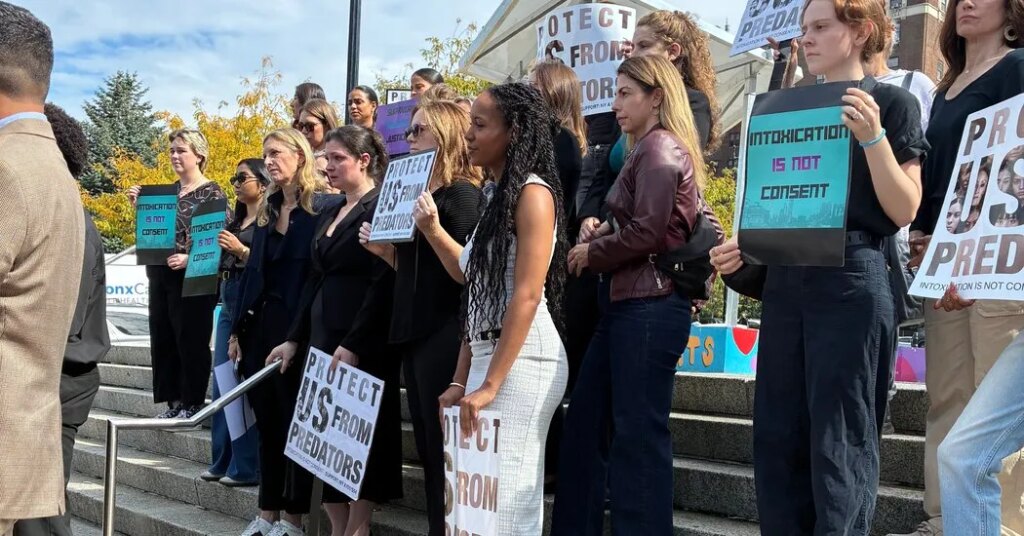
Dozens of legislators, sexual assault survivors and activists on Thursday demanded changes to New York’s rape law, which they said blames victims who became intoxicated before an assault.
Activists and prosecutors who have worked to change the law since 2019 have been emboldened by the case of a woman who asserts that she was sexually assaulted while incapacitated by seven men at a Cornell University fraternity.
The State Senate has repeatedly passed legislation that would make it easier to prosecute someone accused of sexually assaulting a victim who had willingly consumed drugs or alcohol before the attack.
But the Assembly has consistently failed to bring the bill for a vote. On Thursday, the bill’s supporters said the Cornell case could provide the momentum needed to change a law that they say helps predators escape justice.
“New York needs this,” said Nathalia Fernandez, a state senator from the Bronx who introduced the Senate version of the bill. “Our survivors need this.”
Assemblyman Jeffrey Dinowitz, a Bronx Democrat who introduced the bill, said he is hopeful that this “horrifying” incident at Cornell “is the straw that broke the camel’s back.” (None of the men accused by the woman has been charged with a crime; lawyers for at least three have issued statements denying criminal wrongdoing.)
The two legislators called for the changes during a news conference along the Grand Concourse in the Bronx, where they were joined by other politicians; Darcel Clark, the Bronx district attorney; and sexual assault survivors, including Dani Bensky, a victim of the convicted sex offender Jeffrey Epstein.
The women held signs that said, “Intoxication is not consent,” and yelled, “Day 1,” demanding that legislators take up the bill on the first day of the legislative session that starts on Jan. 6.
The legislation would allow prosecutors to charge someone with third-degree rape in cases in which a victim who was under the influence of drugs or alcohol was unable to control their behavior and was assaulted by someone who should have “reasonably” understood the victim’s condition.
Under the current law, people who were voluntarily intoxicated cannot claim that they were mentally incapacitated during an assault, unless they can show they were physically helpless. This means that they had to be unconscious or physically unable to communicate consent at the time of the act, a burden that prosecutors said is often too high for victims to clear. At least two dozen states have laws similar to the legislation supported by activists and prosecutors.
Defense attorneys have opposed changing the law, saying that the current language gives prosecutors the power to go after predators who assaulted someone who chose to drink or get high. They said that the proposed law could lead to people being prosecuted who believed that the person they had sex with had given consent, but who later claimed they were too intoxicated to know what was happening.
“Intoxication, whether voluntary or involuntary, is never a defense under New York’s rape laws,” said Yung-Mi Lee, the legal director of the Criminal Defense Practice at Brooklyn Defender Services. “It is not a loophole or an exclusion. Instead, as with all other crimes, the prosecution must meet their high burden of proof beyond a reasonable doubt.”
Mr. Dinowitz said that opponents in the legislature have expressed fears that the change in the law could disproportionately affect Black and Latino men, who they said are more likely to face unfair prosecution and incarceration. Carl Heastie, a Bronx Democrat and the State Assembly speaker, has repeatedly declined to advance the measure even though it has had broad bipartisan support.
But since the details of the Cornell case have emerged, the pressure to address concerns about the law has grown. On Wednesday, Mr. Heastie announced that the Assembly had formed a working group to examine the state’s sexual assault statutes.
On Thursday, several women who spoke at the news conference and identified themselves as sexual assault survivors called on Mr. Heastie to bring the bill for a vote in the next session.
Ashley Staggers, 27, who said that she was sexually assaulted while in college after a night of drinking, said no evidence exists to show that amending the law to protect sexual assault survivors would compromise the rights of minority men.
“Assembly member Heastie, justice for Black men cannot come at the expense of justice for women,” said Ms. Staggers, a Black woman who was recently crowned Miss Manhattan.
Lizzie Asher, a lawyer who helped write the bill, said that she was skeptical about the Assembly working group.
It is time, she said, “to take action and not simply express our anger and dismay and call for actions that are not going to produce immediate, impactful results.”
A spokeswoman for Mr. Heastie did not respond to a message seeking comment.
Gov. Kathy Hochul, who on Thursday named Letitia James, the New York State attorney general, to serve as a special prosecutor in the Cornell case, has not commented directly on the legislation.
In a post on social media on Wednesday, the governor said that while New York has “some of the toughest laws on sexual assault,” she has asked her staff to examine “what we can do when the next session of the legislature convenes.”
“I think we can do better,” she said.
The post N.Y. Lawmakers and Victims Push to Change Rape Law in Intoxication Cases appeared first on New York Times.