Infighting among Iranian government officials escalated this week with the jailing of a prominent hard-line lawmaker who is a vocal opponent of a diplomatic deal with the United States to end the war and who has regularly lashed out at Iran’s negotiating team.
The lawmaker, Hamid Rasaei, a cleric who has regularly lashed out at Iran’s negotiating team, is a member of the ultra-hard-line political party Paydari. He was convicted of publishing false information two years ago with the intent to harm the speaker of Parliament, Gen. Mohammad Bagher Ghalibaf, who is also Iran’s lead negotiator with the United States.
Mr. Rasaei was sentenced to 10 months in prison in June and summoned to Evin prison in Tehran on Sept. 15. He turned himself in on Sunday. He is currently being detained at the prison ward designated for clerical inmates, according to official Iranian news reports. He is the first sitting lawmaker to be jailed, according to the news reports.
“They want to send me to jail — I feel absolutely no shame,” Mr. Rasaei said in a video message published by Iranian news media before turning himself in. He said those engaged in corruption and a “coup” should be ashamed.
In public comments and interviews with state television, Mr. Rasaei had regularly accused President Masoud Pezeshkian’s government of “a coup.” In one televised interview he said the negotiating team was defying the new supreme leader, Ayatollah Mojtaba Khamenei, and forcing him to accept Washington’s conditions to end the war.
“This coup exists; this coup cannot be denied,” Mr. Rasaei said.
The case has become the latest flashpoint in divisions tearing at Iran’s leadership over the war with the United States. Officials are fighting over whether to concede and reach a deal or continue the war. Mr. Ghalibaf represents the pragmatic side favoring negotiations, and Mr. Rasaei is the face of the opposition to a deal.
The judiciary’s decision to prosecute Mr. Rasaei is largely viewed as an attempt to rein in the rowdy, and sometimes violent, hard-liners and their support base, analysts say. The hard-line supporters physically assaulted Mr. Pezeshkian and the foreign minister, Abbas Araghchi, at the funeral of Ayatollah Ali Khamenei, the supreme leader who was killed in February at the start of the war.
“By prosecuting one of the most prominent critics of engagement with the U.S., the system wants to send a domestic message to the rest of the critics that it will not tolerate dissent if a deal comes through,” said Sina Azodi, the director of the Middle East studies program at George Washington University.
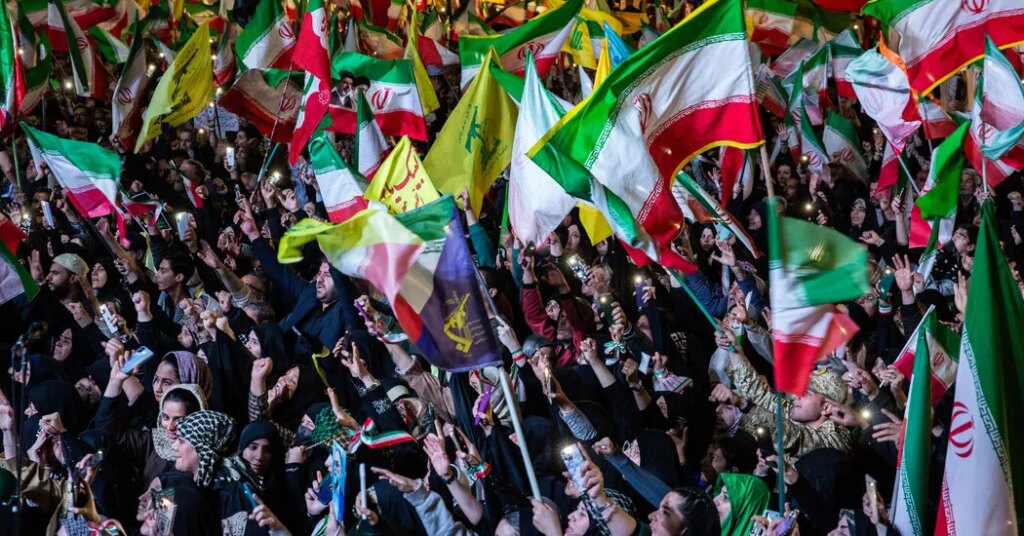
In Iran, the arrest has inflamed divisions and dominated nightly rallies that hard-liners have been holding since the start of the war.
“Ghalibaf release Rasaei,” a large crowd of men and women shouted at a rally last week in the city of Borujerd, according to videos on social media. At other rallies in Tehran, crowds have called for Mr. Ghalibaf to be prosecuted for “staging a coup” and have chanted slogans against the judiciary, videos showed.
At least 15 lawmakers from Mr. Rasaei’s political party have joined nightly protests in Tehran and railed against Mr. Ghalibaf and the rest of the negotiating team. They have sharply criticized Mr. Ghalibaf, saying he had betrayed his colleagues in Parliament.
“Are you not ashamed of this kind of governance in the middle of an existential war?” Mohammad-Manan Raeisi, a hard-line lawmaker from Qom, Iran, said at a street rally this week. “You have called for unity but you cannot unify with the revolutionary class.”
Mr. Raeisi said Mr. Ghalibaf would have a hard time attending any events at mosques and public places without facing a backlash.
Mr. Ghalibaf has not publicly commented on the arrest and the criticism, but a member of his communication team, Amir Hossein Yazdanpanah, noted in Iranian news outlets that Mr. Rasaei had been convicted in court and said that “everyone must follow the law.”
Hard-liners have faced fierce pushback by other conservatives, including the editor of Mashregh media, which is affiliated with Iran’s Islamic Revolutionary Guards Corps. He said last week that hard-liners were selectively obeying the judiciary, praising it when their opponents were punished and assailing it when one of their own was convicted.
“The street was supposed to be the place to defend the country’s prestige against America and Israel, not to defend convicts like Rasaei and attack the pillars of the government,” the journalist Mostafa Rezaei wrote on social media.
The court case against Mr. Rasaei dates to 2024, when he published a front-page article in a conservative newspaper he oversaw. He accused Mr. Ghalibaf of “manipulating Parliament’s official documents” and called him a dictator. Mr. Ghalibaf sued him. In June this year, the court issued its final verdict and then summoned him to serve his sentence.
Ahmad Zeidabadi, a political analyst in Tehran who is close to the reformist political faction in government, said in a video analysis on his social media account Thursday that arresting Mr. Rasaei had been politically motivated.
“Jailing him signals that if they want to push things further, they will be dealt with,” Mr. Zeidbadi said of the hard-liners.
Shirin Hakim and Rozhin Razavi contributed reporting.
The post Iran Jails Hard-Line Lawmaker, Exposing Deep Rifts in Its Leadership appeared first on New York Times.