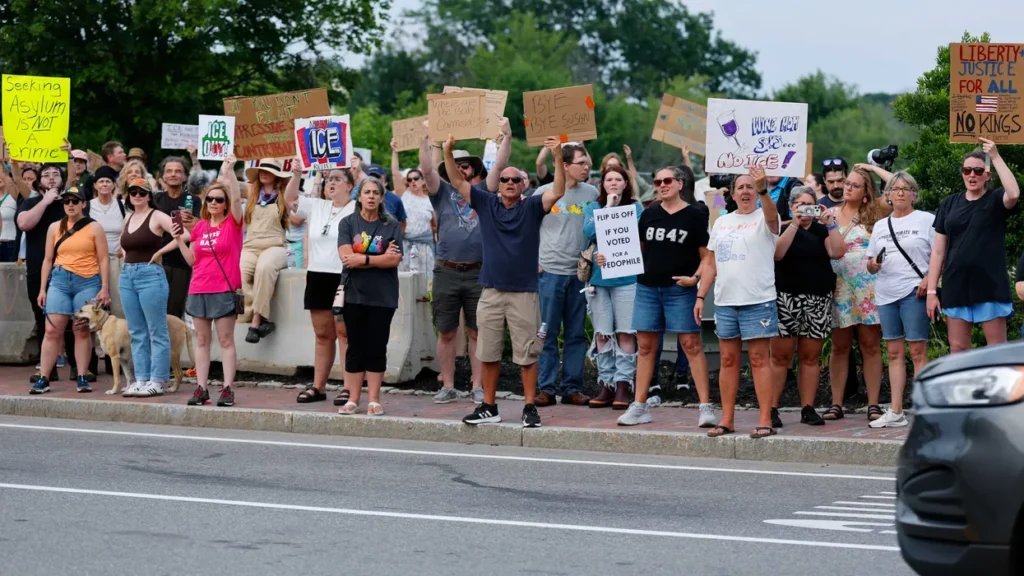
A newly unsealed court filing alleges that Homeland Security agents compiled surveillance files, complete with photographs, license plates, and other personal details, on ordinary people who did nothing more than watch or record Immigration and Customs Enforcement agents in Maine, routing that information into a Palantir-built investigative system never designed for bystanders.
Palantir is the brainchild of Peter Thiel, the antichrist-obsessed far-right billionaire who has intensely pushed MAGA causes.
According to Wired, the case stems from a proposed class action filed in federal court by four Maine residents, who say agents harassed them for exercising their right to observe ICE enforcement during a January operation dubbed “Catch of the Day.” Their filing describes agents repeatedly cruising past observers’ homes, and in one instance, placing a woman on a standing order for extra screening at the border that’s set to last well into 2027.
“The government is treating people who exercise their First Amendment rights and seek to hold it accountable as criminal suspects, and that’s what we’re asking the court to stop,” said JoAnna Suriani, an attorney with Protect Democracy representing the observers.
At the center of the allegations is a single agent, referred to in court papers only as “Agent J.C.,” who the filing says logged at least six observers (the government says eight) into the Investigative Case Management system, the database Homeland Security Investigations relies on to build its cases. Two people J.C. filmed in a Home Depot parking lot were tagged in his notes as a “Threat to Law Enforcement, Professional Protestor,” and their images were passed along to a Customs and Border Protection officer who ran them through a facial-recognition tool.
The filing lays out one particularly detailed sequence: on January 20, Polyxenia Pantos, one of the observers, stood several car-lengths away filming an arrest in Portland. By that afternoon, J.C. had pulled the plate off the vehicle Pantos stood near and run it through Accurint, a law-enforcement lookup tool owned by LexisNexis, surfacing the registered owner’s identity, fellow observer Carlyn Williams, her home address, phone numbers, and who she lived with. He then shared her photo with colleagues asking whether she matched the protester, and when told she didn’t, said he was logging her into the system regardless.
Later that day, Williams says an agent phoned her, introducing himself only as being with Homeland Security, and warned that encouraging her spouse’s observation habits could risk landing someone “on a domestic terrorism watchlist.” Under oath, J.C. testified he warned only of possible arrest for continued conduct, and government lawyers dispute that any watchlist was ever mentioned.
The entry eventually created in Williams’ name reportedly tied her to a vehicle “used to interrupt ICE arrests” and matched her license photo to footage of a woman described as aggressively inserting herself into an arrest scene. A government privacy document from 2016 indicates that records like hers automatically populate a companion border-screening system, meaning the entry could flag her for scrutiny at ports of entry going forward.
Palantir has held the underlying contract since 2014, building the system atop its Gotham platform, and expanded its relationship with ICE through a roughly $96 million support deal signed in 2022, followed by an additional $30 million awarded in 2025 to build a related tracking tool called ImmigrationOS.
Former acting ICE Director Todd Lyons told Rep. Maxwell Frost (D-FL) in an April letter that the agency maintains no such tracking system for protesters, and the government’s motion to dismiss frames the episode as an isolated lapse rather than policy, arguing the agent believed in good faith he was documenting genuine threats rather than building a watchlist entry.
The post ICE quietly feeding protester photos into far-right billionaire’s surveillance machine appeared first on Raw Story.