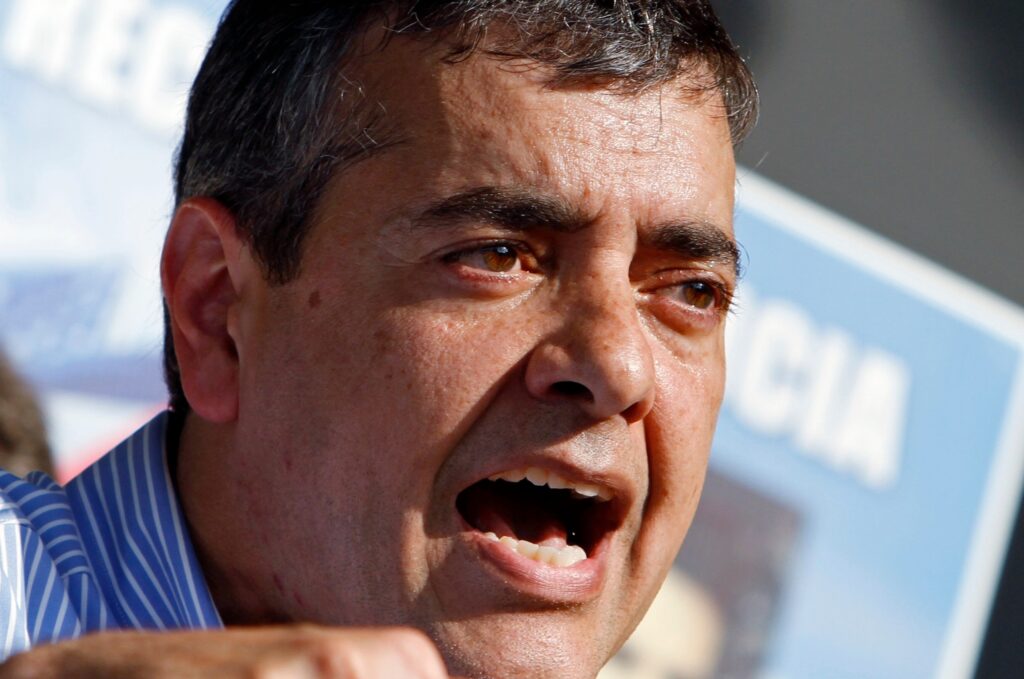
A former Florida congressman and political mentor to Secretary of State Marco Rubio was sentenced to a decade in federal prison Friday for his role in a secret $50 million campaign to lobby officials in Washington on behalf of the Venezuelan government.
David Rivera, a Republican from Miami who served one term in the U.S. House from 2011 to 2013, was convicted in May on counts of failing to register as a foreign agent and conspiracy to commit money laundering.
Prosecutors had accused him of accepting the $50 million, three-month contract with a U.S. subsidiary of Venezuela’s state-owned oil company after his stint in Congress. Rivera then sought to lean on his relationships in Washington, including his decades-long ties to Rubio, to persuade the first Trump administration to soften its stance toward Venezuelan President Nicolás Maduro and ease sanctions on the South American nation.
U.S. District Judge Melissa Damian handed down the 10-year sentence after a more than four-hour hearing in federal court in Miami. Rivera, who has been held in federal custody since his trial, has vowed to appeal and filed an application for a pardon with the Justice Department earlier this year.
“Dave Rivera sold access to the communist Maduro regime for greed, and he betrayed the South Florida community he once represented,” U.S. Attorney Jason Reding Quiñones said after the hearing. “This was not a paperwork mistake … A jury found Rivera secretly used access, relationships, influence he developed through his years of public service.”
The sentence amounted to an ignominious grace note to the career of a once-prominent Florida lawmaker, who’d made a name for himself as an anti-communist crusader in Miami’s Cuban diaspora. But the case that led to his unraveling drew attention not just for what it revealed about his post-congressional career but also the string of bold-faced names called as witnesses in his trial.
Rubio testified before the jury, the first time in more than four decades that a sitting Cabinet secretary has been called as a witness in a criminal trial. Though he was not accused of any wrongdoing, Rubio’s involvement in the case came at a particularly awkward moment, while he was managing the aftermath of the U.S. military raid that in January removed Maduro from power. Maduro and his wife were captured and flown to New York to face U.S. narco-terrorism charges.
Jurors also heard from Rep. Pete Sessions (R-Texas) and Brian Ballard, a prominent lobbyist and fundraiser for President Donald Trump. Like Rubio, they detailed their interactions with Rivera as he sought to set up meetings to advance his client’s agenda. All three said they had no idea that Rivera was being paid by an entity of the Maduro regime.
That lobbying work began in early 2017 when Delcy Rodríguez, then serving as Venezuela’s foreign minister, recruited him in hopes of using his Republican connections to repair relations with the Trump administration, prosecutors said at trial. Rodríguez was installed as Venezuela’s interim president after Maduro’s capture earlier this year.
But neither Rivera nor his co-defendant, political consultant Esther Nuhfer, disclosed their lobbying work as required under federal law. Justice Department lawyers said that in all, they collected $20 million on their lobbying contract and hoped to bring in much more.
“In doing so, they acted on behalf of a hostile foreign government, the president of which (and his wife) now sit in a jail in New York City awaiting trial on federal narco-terrorism, drug-trafficking and related charges,” Assistant U.S. Attorney Harold E. Schimkat wrote in court filings in advance of Friday’s hearing.
Rivera, who has maintained his innocence since his conviction, has insisted that his work was solely focused on persuading oil company ExxonMobil to return to Venezuela. He has said he did not believe he needed to register as a foreign agent because his contract was with a U.S. subsidiary of a Venezuelan company, not a foreign entity.
Any meetings he had with Washington officials over broader U.S. foreign policy were separate from that work, his attorneys said, and focused on supporting Venezuelan opposition leaders pushing for Maduro’s ouster.
“The government has completely failed to identify even a single piece of evidence — a single specific fact — showing even one thing that Rivera did to aid Maduro or normalize his government’s relations with the United States,” Edward R. Shohat, one of Rivera’s attorneys, wrote in a court filing last week.
Damian, the judge, appeared to concede the limited success of Rivera’s influence operation, as she sentenced Nuhfer to five years in prison in August.
“It doesn’t appear that United States policies did change as a result of their actions,” she said at the time.
In court Friday, Rivera’s lawyers cited his history as a vocal critic of “corrupt” socialist regimes in Cuba and Venezuela, and submitted letters of support from dozens of former constituents, community activists and at least three former state lawmakers.
Conspicuously absent from that list, though, was Rubio.
Rivera, 61, was instrumental in helping Rubio, 55, and a fellow son of Cuban immigrants, shoot to the top of Miami politics. Three decades ago, he helped Rubio land one of his first jobs working for Bob Dole’s 1996 presidential campaign.
As they continued their parallel climbs, Rivera later crafted the strategy that helped Rubio become speaker of the Florida House at age 34. The two became so close that they bought a house together in Tallahassee, and Rivera was reportedly present for the births of each of Rubio’s four children.
Their paths diverged once they reached Washington in 2010. Rivera lost reelection and two subsequent political races and then came under scrutiny from the Federal Election Commission in a campaign-finance investigation.
Testifying in March, Rubio recounted how Rivera sought a meeting with him in Washington in 2017 to discuss a secret plan to persuade Maduro to step down.
That week, Rubio delivered a speech on the Senate floor using some of Rivera’s talking points on Venezuela, in particular suggesting that the U.S. would not retaliate against any Venezuelan government officials who helped oust Maduro.
Rubio, then one of Florida’s senators and a member of the Senate Foreign Relations Committee, said he did not know at the time that his old friend had received a $50 million contract to represent “an entity controlled by the Venezuelan government.”
“It would have been shocking to me,” the secretary of state said. He would not have engaged in the meetings had he known his former friend had made such a deal, Rubio told the jury, and said the meeting resembled past bids from “double-dealers” to oust Maduro that amounted to nothing.
“It was more of the same. I was frankly angry and frustrated,” Rubio testified. “Why would I waste my time with a stupid meeting?”
A State Department spokesperson did not immediately return requests for comment on Rivera’s sentencing.
In addition to the crimes for which he was sentenced Friday, Rivera also faces pending tax-fraud charges and an additional foreign lobbying case, in federal court in D.C., involving $5.5 million he allegedly received in 2019 to assist a top Maduro ally in his efforts to have his name removed from a Treasury Department sanctions list.
The post Ex-congressman and Rubio ally gets 10 years for secret Venezuela lobbying appeared first on Washington Post.