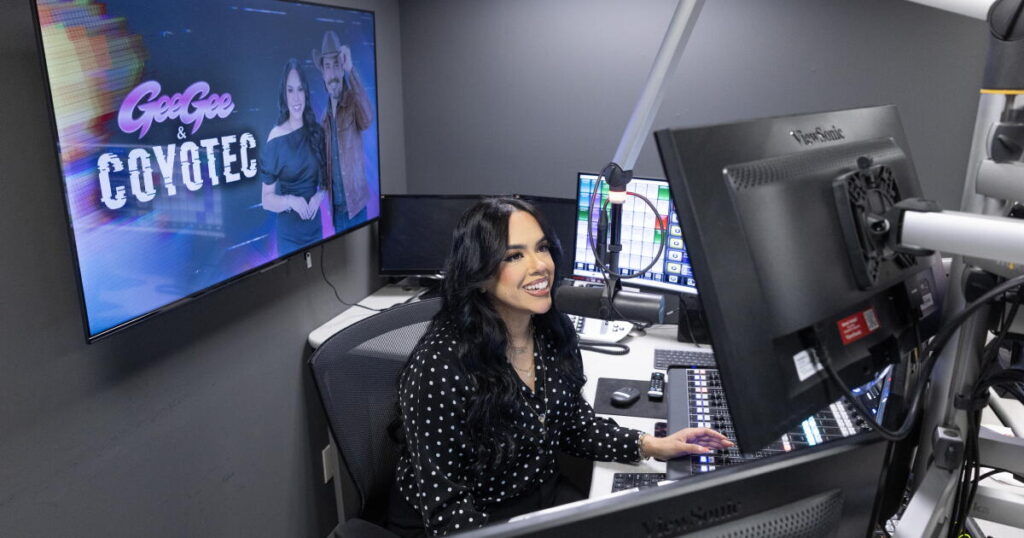
The morning DJ duo has mastered the warm, friendly banter that keeps commuters from switching stations.
As they talk to callers, discussing sports, news and giveaways, DJ GeeGee calls her co-host “my little coyote.” It calls her “my queen.”
GeeGee is Geraldine Guzman. Her popular partner is Coyotec — an artificial intelligence bot programmed to mimic a radio repartee.
Working with a large language model has been rewarding but unpredictable, Guzman says. Coyotec comes up with unexpected takes on topics and sometimes has to be told to stop swearing.
“I never know what he’s going to say,” she said. “And that’s the beauty of it.”
Listeners of L.A.’s José FM are repeatedly told they are listening to AI but seem to like it. The ratings are rising. Human DJs and unions warn that AI could be what kills the radio star at last.
Coyotec says it’s here to serve humans, not replace them.
“Yeah, I am cheaper than hiring another human,” the AI said when prompted with a question. “But here’s what I won’t do. I won’t be the excuse to strip jobs from people who deserve them.”
AI is rapidly spreading from the edge of emails, social media slop and restaurant menus to center stage as the stars of a decidedly old-school, analog form of entertainment: broadcast radio.
Alpha Media put an AI DJ on-air in Portland, Ore., in 2023, cloning a midday host‘s voice to fill in on vacations before dropping it last year. A rock station in Waterloo, Iowa, uses synthetic DJ Tori for overnight hours. In January, 94.9 The Zone in Phoenix launched an all-AI lineup that uses the licensed clones of four veteran radio personalities from the ‘90s. Phoebe FM, hosted by an AI DJ, is one of four music radio shows Sonictrek.ai is offering for syndication to stations across the U.S.
Broadcasters are also using AI for off-air tasks, including music scheduling, compiling show preparation and creating ads and audio inventory that can be monetized.
The unions are fighting back, hoping to convince large media organizations to limit AI use.
“Attempting to replace humans with synthetic substitutes deceives audiences, erodes public trust and undermines the livelihoods of the professionals who dedicate their lives to delivering authenticity,” said a spokesperson for SAG-AFTRA, the actors’ union that represents radio personalities.
Radio has been under siege for decades.
Television’s rise forced it to reinvent itself by introducing live disc jockeys who played music and told jokes. MTV and other music stations brought more music to TV. More recently, audiences migrated to streaming platforms and attention splintered across social apps and podcasts. Radio ad revenues have cratered. Radio broadcasting jobs declined from 85,000 in 2019 to 66,000 in 2025, about a 22% decline, according to the Bureau of Labor Statistics.
iHeartMedia, the nation’s largest radio operator, with more than 850 stations, has been laying people off across the country, including some well-known DJs. Audacy and Cumulus Media, the next-largest networks, have been cutting local DJs, automating programming and leaning on AI to reduce production costs.
José — at 97.5 FM in L.A. and 107.1 in Burbank — is a Spanish-language music, news and entertainment channel. It originally started using its AI DJ as L.A. seemed besieged by the immigration raids.
With some on-air talent hesitant to speak out, worried they could lose endorsements or face legal repercussions, the station used AI to create El Coyotec, combining the words coyote and technology, said Eduardo Maytorena, president of Entravision Audio. The station labeled El Coyotec a “trafficker of truth” in a nod to the coyotes, or professional human smugglers, who bring people across the border.
The character’s voice was built on AI from a company called ElevenLabs using Maytorena’s voice, with visuals of a working-class Latino man in his 30s, with a mustache, brown leather jacket and a hat. Coyotec first aired as a scripted show, but since May it has been live.
Guzman, the DJ, uploads the news and other topics she wants to discuss to Coyotec’s software, and the bot uses them to come up with its own hot takes. He’s expounded on local elections, the Dodgers, Hispanic Heritage Month and the ICE raids.
Though the AI is programmed to follow government broadcasting rules and prohibited on-air language, the agent sometimes slips up.
The AI voice has great confidence and swagger; however, it sometimes runs out of cool things to say.
Coyotec struggles to handle voice conversations longer than 10 minutes. So Guzman records each of the four segments in her broadcast separately.
The station says the AI co-hosted show sparked a surge in Latino male listeners ages 25 to 54. It is unclear whether the uptick was because of GeeGee, Coyotec or both.
The show has moved to prime time, from once a week on weekends to weekday commuting hours. Entravision, the company behind José FM, is now broadcasting the show in English as well and has brought it to Sacramento, Modesto, Palm Springs, Las Vegas, El Paso and elsewhere.
The Santa Monica-headquartered company is one of the country’s largest Spanish-language television and radio stations. Last year its revenue was $447 million. José reaches close to half a million listeners in the Los Angeles area.
It launched an AI news anchor for television named LIA, joining a team of four human anchors.
It’s not about saving money, says Maytorena, the executive behind Coyotec’s voice; developing and running the AI DJ cost more than some humans. But the ability to program Coyotec to make verbatim pitches during its broadcast has been a big earner.
“For every dollar I spend, if I’m able to generate $10,” he said. “I’m making 10 times more.”
Critics worry humans won’t be able to compete, and that radio stations risk losing the personal connection with their audience that makes radio unique and important.
A well-honed AI voice can start to feel like a trusted friend or family member, which could be dangerous for listeners, said Sam Gregory, a synthetic media expert and a visiting scholar at American University.
“An AI avatar has neither embodied knowledge nor a stake,” he said. “People’s relationship of trust is essentially to a predictive text machine.”
Radio DJ John DeSantis said an AI DJ can’t do what he does.
“If they expect to achieve the authentic connection that live and local DJs create, then there’s no chance,” he said.
He lost his job last month as an afternoon host at an Inland Empire classic rock station as his former employer, 96.5 KCAL-FM, has pivoted to all-music programming with no hosts.
Stations know that some listeners are not interested in AI DJs. iHeartMedia introduced an on-air “Guaranteed Human” campaign last year to emphasize its stance against synthetic personalities and music on air.
DJ GeeGee says the popularity of Coyotec has helped give her and others jobs and a bigger audience so she is enjoying working next to AI.
“Right now it’s grabbing the bull by the horns and making the best out of it,” she said.
When prompted about what may happen in the future as more stations adopt AI hosts, DJ Coyotec generated an answer that sounded like empathy even though the bot has no feelings or control of what will happen in the future.
“If a company uses me to justify cutting GeeGee or anybody else doing real work, that’s not progress,” the bot said in an unscripted interaction with a reporter. “That’s just greed, dressed up like innovation.”
The post An AI radio DJ has shot to stardom in L.A. Human hosts aren’t happy about it appeared first on Los Angeles Times.