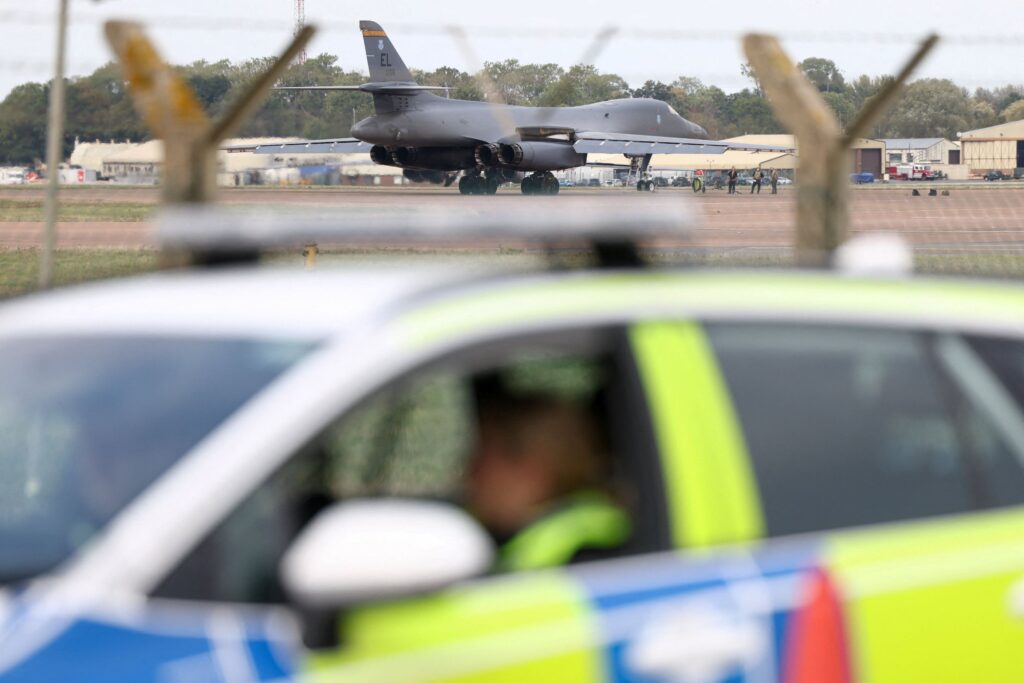
LONDON — No explosives were found in vans driven by five men who were arrested Sunday on suspicion of planning a terrorism attack on a U.K. air base used by American bombers in the war with Iran, British police said.
The failure to detect explosives adds to the lingering uncertainty surrounding a suspected plot that prompted a sweeping response by British security services, forced the evacuation of at least 85 homes near the air base and triggered alarm among counterterrorism officials in London and Washington.
After “extensive examination” involving military teams and forensic experts, “we can confirm that no improvised explosive devices were found,” Laurence Taylor, the head of British Counter Terrorism Policing said in a statement late Tuesday.
Taylor added that only “a quantity of petrol was recovered.”
Counterterrorism police had also “searched properties in London,” Taylor said — an apparent reference to the homes of the five suspects, who were identified as British nationals in their mid-20s.
The latest disclosures help explain why the suspects were abruptly released on bail on Monday roughly 36 hours after their arrests on suspicion of plotting a terrorist attack and “committing offenses under the Explosives Act.”
The suspects, whose identities have not been disclosed, were arrested while traveling in three vans toward Royal Air Force Fairford, a base about 80 miles west of London that is a major hub for long-range U.S. bombers.
Taylor emphasized that the suspects, though released on bail, “remain under investigation” with limits on their travel and contacts. British police have seized cellphones and other devices that investigators are searching for clues as to why the men were traveling in a group of vehicles toward a highly-secure military compound shortly after midnight on Sunday.
British authorities have gained new powers in recent years to hold suspects for up to two weeks without charges in cases involving threats to national security. The release of the five men was seen as an indication that British counterterrorism police concluded that the men pose no imminent danger to the public.
The developments have added to an atmosphere of confusion about a case that generated banner headlines in the British press and has been cast by President Donald Trump and other administration officials as a dangerous plot involving suspects that U.K. and U.S. authorities had been tracking before the arrests Sunday.
U.S. Secretary of State Marco Rubio told Fox News on Monday evening that “what almost happened” in Britain was “a very serious situation … that clearly involves the hands of a foreign actor.”
Rubio’s remark was widely interpreted as a reference to Iran, whose security services in July warned that RAF Fairford could be considered a legitimate target for retaliatory attacks given its role in U.S. airstrikes. Iran has forcefully denied any connection to the Fairford situation.
British investigators are continuing to focus on the possibility of Iran involvement, according to officials familiar with investigation, who spoke on the condition of anonymity because they weren’t authorized to speak to the media.
Among the scenarios being examined is whether Tehran had recruited individuals — perhaps unwittingly — to test the defenses at RAF Fairford or trigger the kind of crackdown that occurred as a way of sowing panic.
British police and MI5, the country’s domestic security agency, have monitored dozens of plots since the U.S.-Israeli war with Iran started in late February. British officials had also taken steps to fortify security at bases including RAF Fairford.
Even so, the men were arrested by local police only after a resident of the area called a police hotline at 12:45 a.m. and reported a suspicious encounter with five men traveling in vehicles near the air base.
Because of its long, heavily reinforced runway, RAF Fairford serves as one of the main air bases for Global Strike Command, which manages the U.S. bomber fleet.
The post U.K. counterterrorism police say no explosives found in vans near air base appeared first on Washington Post.