An Arizona tour company sued on Monday to stop the Trump administration from charging foreign tourists higher fees to visit some national parks and other public lands. The suit argues that such a pricing structure exceeded the authority of the Interior and Agriculture departments.
Since Jan. 1, foreign visitors to some of the nation’s most popular national parks have been required to pay a $100-per-person nonresident entry surcharge under an executive order President Trump signed last year. That comes on top of the standard entrance fee of up to $20 per person or $35 per vehicle.
Annual passes, which grant access to more than 2,000 federal recreation areas, cost $250 for nonresidents versus $80 for U.S. residents under the same rules, which the administration has referred to as “America First pricing.”
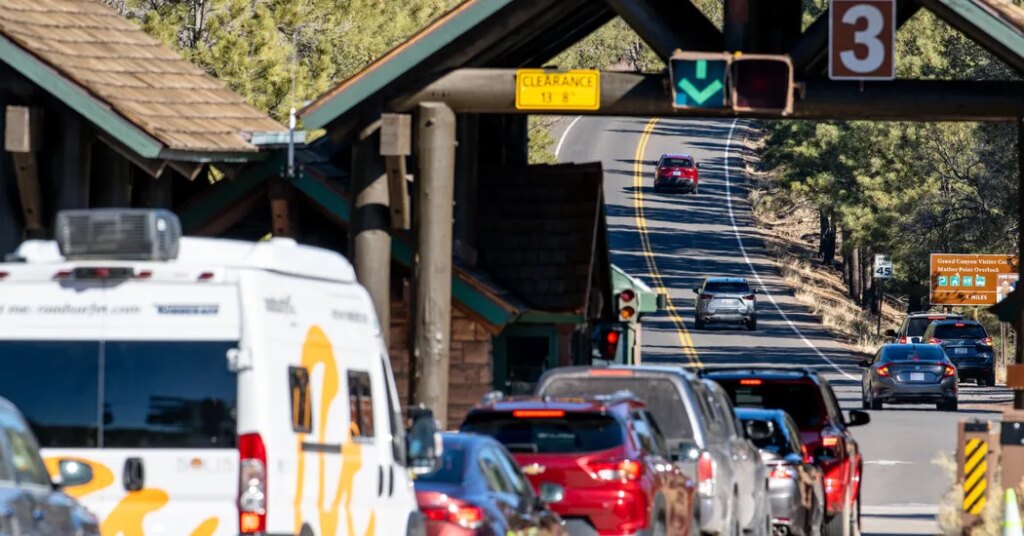
Across Arizona Tours, which brought the case in the U.S. District Court in Arizona, offers guiding services in Grand Canyon National Park, one of the affected sites. The company said in its complaint that it had “lost business from would-be tourists who are now opting against visiting the Grand Canyon” as a result of the extra fees. The suit argues that those fees can be imposed only by Congress.
The nonresident fees apply at 11 popular national parks, including Acadia, Rocky Mountain, Yellowstone, Yosemite and Zion, as well as Grand Canyon.
“To be sure, N.P.S. can charge an entrance fee,” said Luke Wake, a senior attorney at Pacific Legal Foundation, a public interest law firm that is representing Across Arizona Tours, in a telephone interview. “What they can’t do, what they have no authority for, is to have a higher entrance fee for nonresidents. There’s just nothing in the statute giving them that authority.”
In a statement, the Interior Department said, “Foreign tourists are paying higher entrance fees to help maintain our parks and improve visitor experiences.”
The Agriculture Department said in a separate statement, “This administration puts American families first by making sure access to our national treasures, like our forests, are affordable and accessible.”
The Federal Lands Recreation Enhancement Act, which governs fees on public lands, “would seem to constrain the Park Service from doing what it did here,” said Albert Lin, a co-director of the California Environmental Law and Policy Center and a former lawyer for the Justice Department’s Environment and Natural Resources Division, now known as the Energy and Natural Resources Division.
The law requires that fees be “commensurate with the benefits and services provided to the visitor,” he added. “It’s hard to imagine how the benefits and services differ based purely on residency versus nonresidency,” Mr. Lin said.
Still, he added, the law gives some leeway to the secretary of the interior to consider additional factors, offering a possible defense. “Whether that leeway includes the ability to simply base the fee on nonresident status is not clear,” Mr. Lin said.
Republican members of Congress proposed legislation in 2025 that would codify the nonresident fees into law, but the bill has not advanced.
Follow New York Times Travel on Instagram and sign up for our Travel Dispatch newsletter to get expert tips on traveling smarter and inspiration for your next vacation. Dreaming up a future getaway or just armchair traveling? Check out our 52 Places to Go in 2026.
The post Tour Company Sues to Undo Trump’s Nonresident Fees at National Parks appeared first on New York Times.