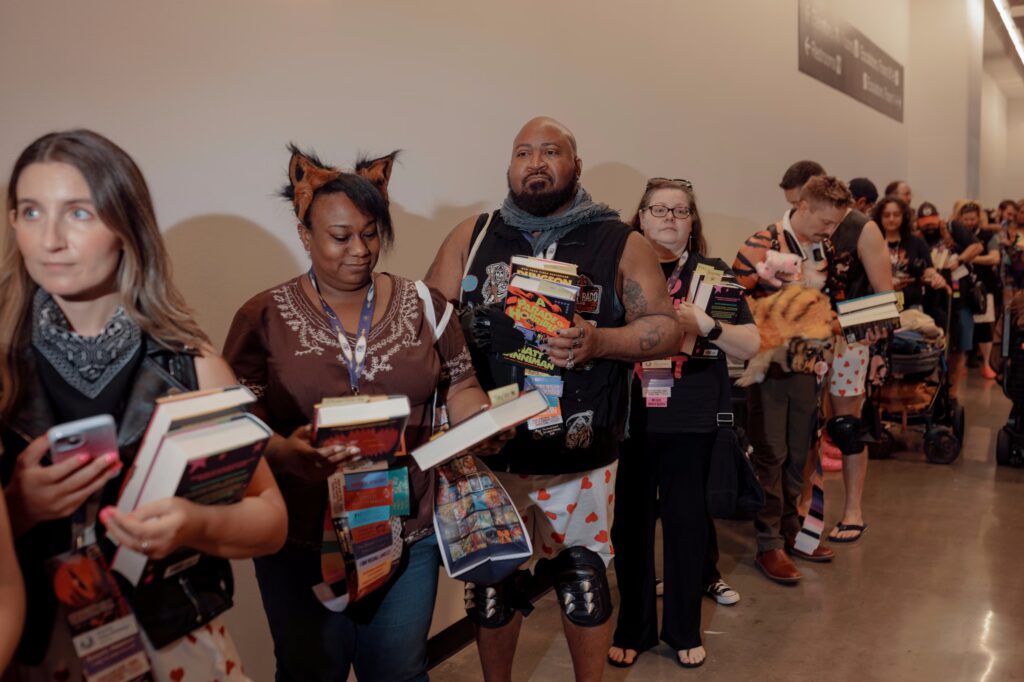
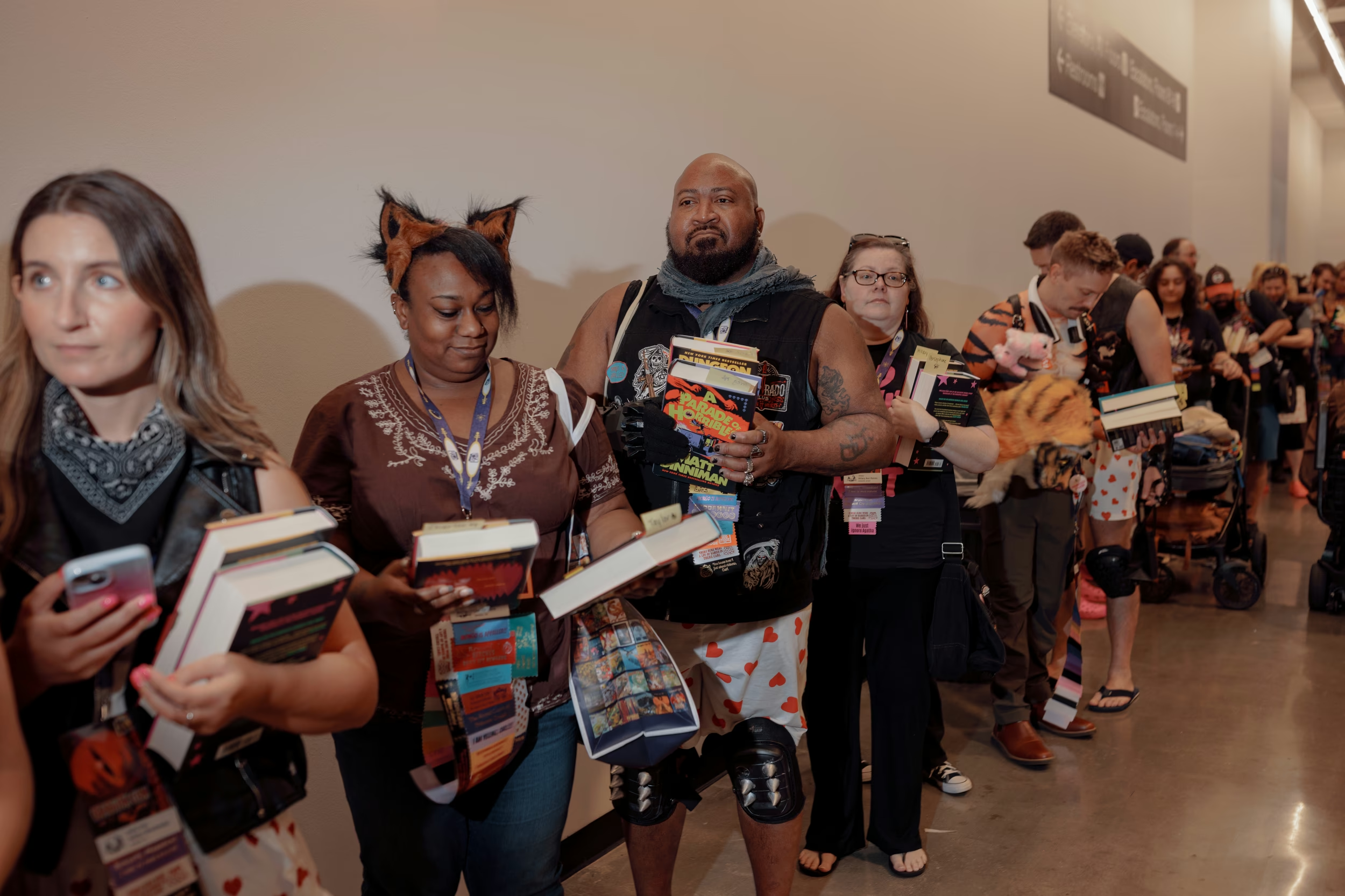
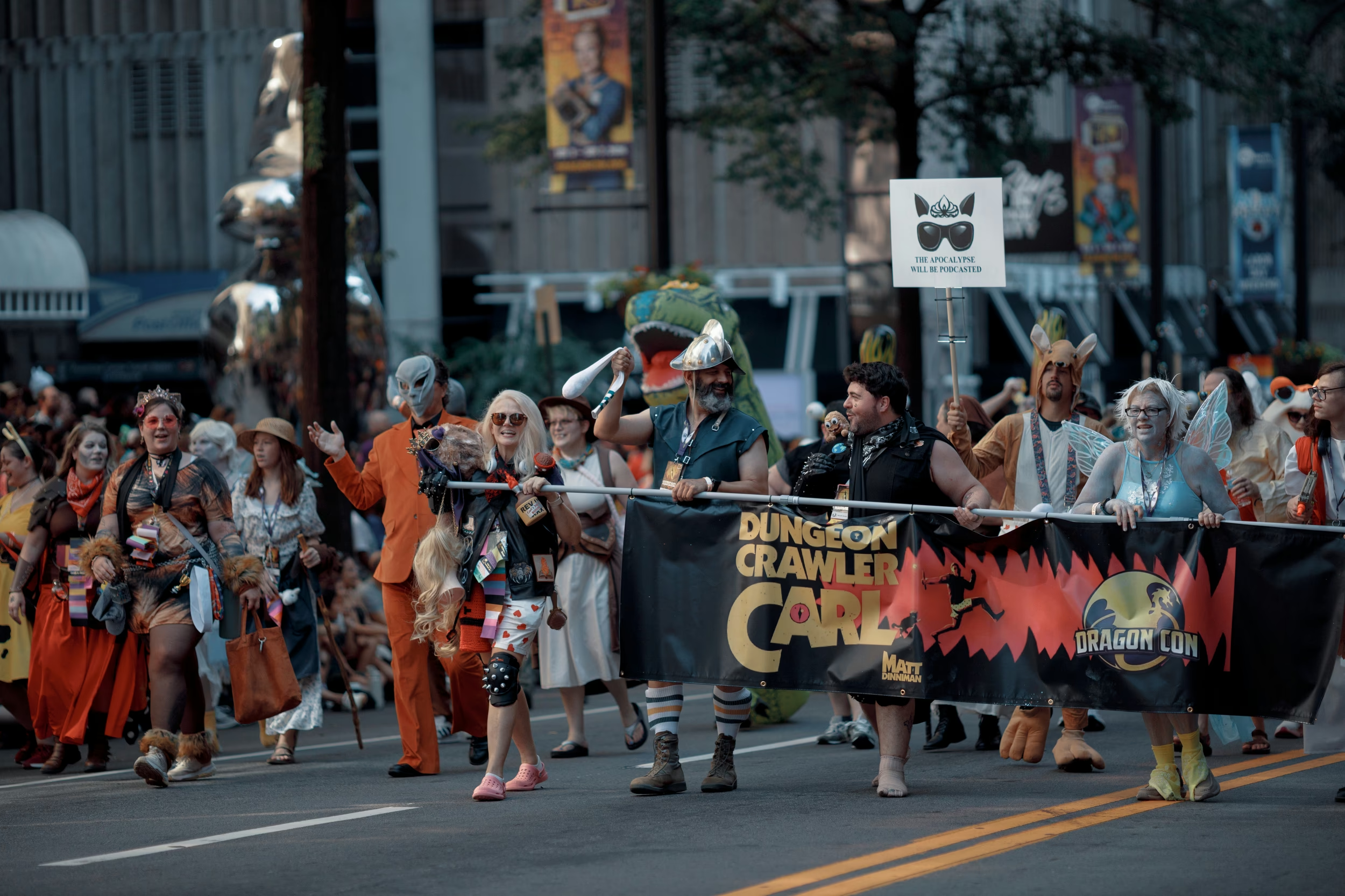
You couldn’t move without bumping into one of them: some man, woman, toddler, or puppet, dressed in a zippered vest and white, heart-patterned boxers. They stood out even among the 75,000 attendees of Dragon Con, the pop-culture convention described as the “Burning Man of nerds,” which each Labor Day weekend turns downtown Atlanta into a sea of spandex and body paint. The uniform had many variations: pink Crocs, rubber foot covers, black bandannas, spiked knee pads. I saw one person accessorized with a keffiyeh, another in a sagging kangaroo suit.
The ensembles paid tribute to the title character of Dungeon Crawler Carl, the blockbuster series by Matt Dinniman, in which aliens invade Earth, vaporize most of civilization, and force the survivors to compete in an intergalactic reality show. The books read as if the dystopia of The Hunger Games were adapted for the Twitch era, but with much more comic gore and a distinctly fratty sense of humor. The first seven volumes were self-published online, beginning in 2020, and rereleased in print by Penguin Random House in 2024; eight volumes have come out so far. The series has sold 17 million copies, and a TV show is on the way.
Dinniman has written the breakout hit of litRPG, a sci-fi subgenre that draws on the mechanics of role-playing video games, or RPGs. Typically, the plot concerns a hero stranded in a strange realm. He—most of the time, it’s a “he”—traverses this new world, accumulating experience that’s measured in points, adding assets to his inventory, and selecting new powers from a menu. If this seems hard to imagine unfolding in prose, think of The Lord of the Rings, Michael Chatfield, a litRPG author, told me. In the original novel, the wizard Gandalf is reborn, shedding his humble gray garments for a raiment of the brightest white. In the hypothetical litRPG version, “instead of just seeing that change between the color of robes, it’s ‘plus five to wisdom,’” Chatfield explained.
To some readers, this might seem like a rather clunky and clinical mode of character development. Dinniman himself told me that he knows a common reaction to Dungeon Crawler Carl is: “This is a stupid title, it’s a stupid premise, and it’s a boy book.” But, he added: “slowly, slowly, slowly, they hate-read it, until they love-read it.” He got me on the first part, because I found these books baffling. As Carl marched through battles and gameplay tutorials, the narrative careened between madcap action and maddening exposition; the prose bombarded me with information and sarcastic exclamation points. (Early on, the game announces to Carl, “New achievement! Oooh, Magic! You’re wearing magical gear for the first time! You’re a wizard, Crawler! Reward: You’ve received a Bronze Adventurer Box!” This contains an enchanted toe ring that “imbues wearer with +3 Strength and gives +3 to the skill Powerful Strike.”)
Yet something about Carl, and the litRPG style of storytelling, speaks to a huge, and growing, swath of the reading public. What struck me as a fundamentally stressful reading experience was, for many of the cosplayers I encountered at the convention, a source of cozy escapism. The success of Dungeon Crawler Carl may reflect the shake-up of the books business by self-published outsiders, and the mainstreaming of video-game culture. Gamer jargon has permeated everyday vocabulary; even the very offline know what it means to grind and speedrun and rage quit. The spread of litRPG suggests that those habits of mind go deeper than language, and are now shaping, for many readers, their sense of what makes a satisfying story.
When the Carls got together for a group photo on the sunbaked steps of the Hilton Atlanta, the crowd control required the use of seven megaphones and three rolls of yellow hazard tape. Regulars told me that even for Dragon Con, the turnout was eyepopping. In an elevator, I encountered a woman volunteering as a cosplay medic, aiding con-goers with their wardrobe malfunctions. She’d never seen so many people repping a single fandom, she told me, “and I’ve seen Game of Thrones, all the Deadpools.” This is the kind of cultural dominance typically enjoyed by video games and superhero franchises—not literature.
All over the convention, a mini platoon of entrepreneurs cashed in on Crawlermania. One candy-striped merch stand was piled with Crawler-themed drink cozies, phone grips, and lanyards. The proprietor, Kaitlin McConnell, had started out by making tchotchkes with a “general bookish theme,” she told me, but this weekend, she had gone all in on Carl, and more than tripled her sales so far. Meanwhile, in a dim venue about a mile south, a geeky burlesque troupe put on a very unauthorized Crawler show, with tickets starting at $25. A co-producer, who goes by Cherry BonBon and was dressed as an incubus, told me that the troupe had already booked a bachelor party in Florida.
Once the series started to take off, Carl’s popularity was accelerated by its rapid print-release schedule: “The books are so big, they’re out there so quickly, that they physically take space in the bookstore,” Seth Fishman, Dinniman’s agent, told me. (Three of the eight books are more than 700 pages long.) But the series’ virality can also be traced back to its online roots. In romance, a new generation of writers built their own digital followings by self-publishing on platforms such as Kindle Direct Publishing, before legacy imprints came knocking. LitRPG authors have followed a similar trajectory. Though traditional publishers are now moving quickly to snap up these series, for years they had no interest in the genre, Dinniman said: “Nobody would touch it.” He, like many others in the community, first found an audience on Royal Road, a site that hosts serialized fiction. (Quaintly, and perhaps crucially, the site bans erotic content; this rule differentiates Royal Road from other major writing platforms, where romance has reigned supreme.)
Like the beaks of Darwin’s finches, the features of these novels have been shaped by their habitat. LitRPG has an oddball melting-pot aesthetic that feels emblematic of the digital age. Dinniman, for his part, got into the genre after stumbling on a Russian series about a man serving a criminal sentence in a virtual world. Other litRPG novels riff on isekai, a Japanese genre in which characters embark on a string of adventures to return to their home world; still others borrow from xianxia, a type of Chinese martial-arts fantasy. Royal Road encourages authors to build up plots in short, punchy installments that end with a hook. Some Kindle Direct Publishing authors opt in to a program that pays them by the pages read, which encourages narrative sprawl and verbose world-building.
The most successful writers establish a close relationship with their readers, studying the comments section as they polish their work. They typically monetize on Patreon, sending their subscribers early drafts and other bonus content. Dinniman has even let his readers vote on future plot twists; he also posts regularly in the Dungeon Crawler Carl Subreddit, which he started himself on the advice of a friend. That audience, heavily composed of audiobook listeners, has also turned the narrators of these books into tastemaking micro celebrities; it’s not uncommon for litRPG authors to make more income from the audio versions of their work than from print and ebooks combined.
Jeff Hays, the wildly popular narrator of the Dungeon Crawler audiobooks, has his own theories about fans’ consumption patterns. “A very large percentage of the readers in litRPG were never recreational readers,” he told me. Because they may not have a habit of picking up a physical book in the first place, “going to a different medium, for them, is probably not a big deal.” Audio especially appeals to readers who want entertainment on a long shift, according to Chatfield, the litRPG author, such as “people doing trucking, or they’re working a factory line, or they’re in the trades.”
The litRPG readership is also dominated by men; some authors I spoke with said that men make up 70 percent of their audience—which would be striking, given the gender gap in reading, and particularly in reading fiction. The prospect of reaching a heretofore untapped market of male readers seems to tantalize the publishing industry, following years of literary trends largely driven by women. “I say this with love, but if you walk into a Barnes & Noble, it’s a tea party,” Steve Beaulieu, a co-founder of a prolific litRPG publisher, Aethon Press, told me. “There’s not a lot of men reading books today.”
I heard a lot of theories about why the genre has spoken so strongly to men: because litRPG tends to be process-oriented rather than focused on interpersonal drama; because much of it is built around progression fantasy, in which readers feel the vicarious gratification of a protagonist gaining more power and skill over time. The answer might be simpler: The video-game industry’s flagship franchises and live multiplayer experiences—the kind of games that are commonly associated with “gamer culture” and that inspired these books—have a mostly male audience.
But gaming, as a form of entertainment, is capacious. Games encompass the soothing experience of tending to a farm, and provide hectic, hyper-realistic re-creations of military missions. They accommodate people waiting for the bus and those holed up with their buddies for the weekend. LitRPG is starting to reflect that diversity: Novels have been published about founding a town and parenting during the apocalypse, and a startling number involve the ins and outs of running a magical café. Major publishers have snapped these titles up, partly aiming to attract more male customers, but partly betting that the genre has a much broader appeal—that just about everybody will enjoy the dopamine loops induced by seeing gameplay on the page.
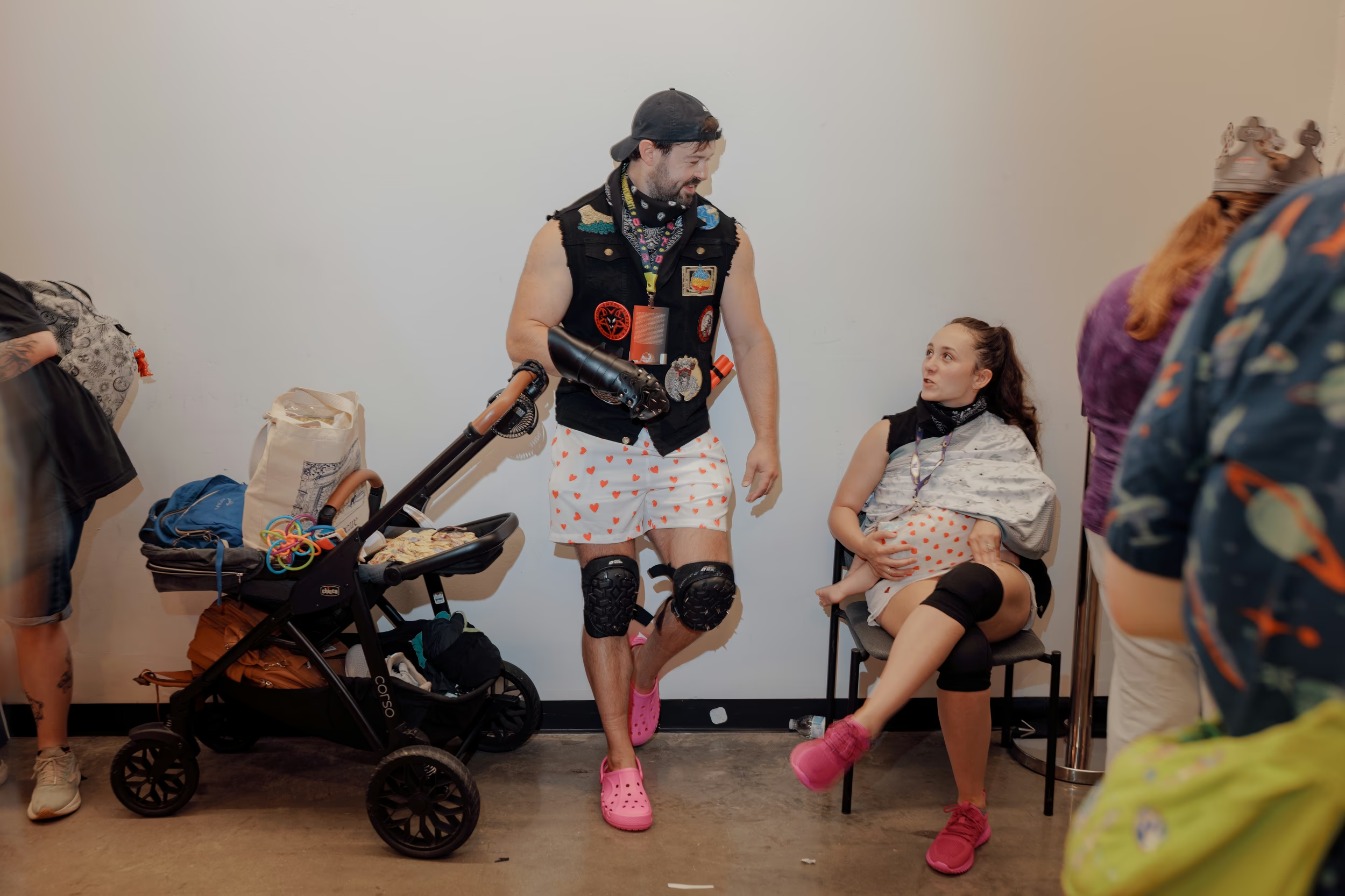
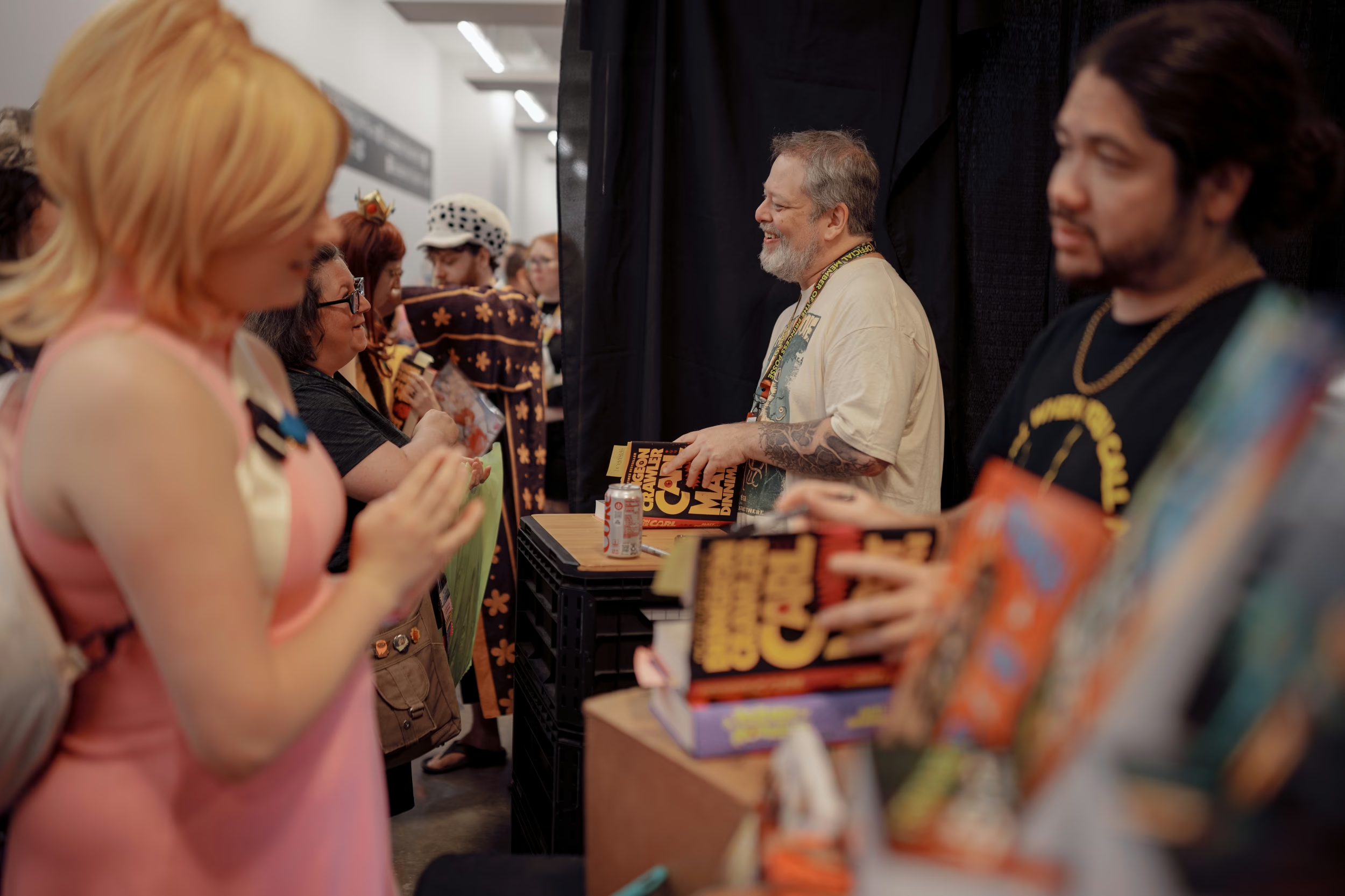
At Dragon Con, fans honor beloved rituals each year. The Douglas Adams readers boo lustily at the Vogon Poetry Slam. The Middle Earth diehards process through the hotel skybridges, singing Elvish hymns. The Buffy people gather for a screening of the show’s cult-favorite musical episode, “Once More, With Feeling,” accompanied by a live performance, à la Rocky Horror. But the Crawlers, a relatively young fandom, have thus far established few traditions. Their main means of showing devotion was to stand in line in the 97-degree heat, waiting anywhere that Dinniman was scheduled to appear—a panel on horror fiction, a late-night game of Dungeons and Dragons—and at some places where he wasn’t. “My friend told me where he likes to go drink, so I’m going to see if I can maybe find him later,” one woman told me, in a queue that wrapped around three sides of a city block.
For all that litRPG is defined by score keeping, the Dungeon Crawler novels seem to have won their passionate following through plot elements that are never assigned numerical value. Fans didn’t talk much about the epic showdowns that appear throughout the novels; instead, they mentioned scenes of emotional revelation, hinging on declarations of love between friends, that wouldn’t have felt out of place in an early season of Grey’s Anatomy. LitRPG, obsessed with self-optimization, can be a lonely genre. The Dungeon Crawler books offer a different fantasy: that even within a rigid system, the spark of sincere feeling can’t be fully extinguished—and that even in zero-sum environments, you can count on your pals. Dinniman’s series stands apart from most litRPG because its characters, far from reveling in game mechanics, express fury at them, determined to find loopholes and subvert the rules. Carl, who starts the series simply aiming to survive the reality show, becomes a more rebellious figure by the fourth book, vowing to destroy the game.
Still, what perplexed me about Dungeon Crawler Carl, and the genre at large, was that it only superficially mimics the pleasure of gaming. Video games give players a multisensory environment to explore and respond to; they offer a direct experience of power and agency in ways that literature can only evoke. When, for example, my avatar trawls the wastelands of Fallout 4, I feel the grim triumph of spotting the tools for my survival; in minutes, I’ve fashioned that junk into a turret that repels my enemies and keeps my ragtag settlement safe. That you have to take my word for how enjoyable this is sums up the inherent limitations of litRPG: There’s a gap between listening to a waiter recite tonight’s specials and sinking your teeth into a steak.
I kept asking the fans in line: Is it even fun? Reading all of this stuff, the accounting of items and upgrades, of skill trees and stat points? On-screen, you glance at the relevant figures for about a microsecond before resuming the action; a litRPG drags you through miles of description. Sarah Maloy, a marketing executive from Charlotte, North Carolina, shrugged me off. “It’s fun for me!” she said with a smile, as the line we were in lurched forward.
My weekend at Dragon Con made me realize that I was coming at the question from the wrong angle: Perhaps the appeal of litRPG isn’t in how it resembles games, but in how it resembles contemporary life, in which everything is scraped for data and opaquely systematized for mysterious purposes. Social media constantly reminds me of the various ways it measures my clout. Wearable devices promise to track my basal body temperature and heart rate, spitting out scores for daytime stress and cardiovascular age. I can position a night-vision camera over my infant’s crib to grade her “sleep efficiency.” These metrics are more or less optional, but that’s less true of the sticky mesh of algorithms that come with participating in the modern economy, or the prediction markets that have apparently metabolized all human activity, from the trivial to the world-historical, into the logic of odds and payouts.
The game mechanics that govern litRPG may be semi-arbitrary, but, more important, they’re legible. “So often in the real world, you don’t know whether life’s actually gotten better,” J. B. Garner, a longtime editor and writer in the genre, told me. “You did get a promotion, but was it really? How much more do you have to work for that small raise?” The prose provides consistent, reassuring updates about the hero’s journey: the experience points gained, the loot accumulated. The numbers always describe something meaningful and true. At least in this genre, the arc of quantification bends toward self-fulfillment. You know exactly what level you’ve reached.
The post The Next Generation of Choose Your Own Adventure appeared first on The Atlantic.