Thousands of refugees and other legal immigrants across the country are set to lose access to Medicaid starting Thursday as Republican-led cuts to the health insurance program for low-income people take effect.
Some of those immigrants who depend on Medicaid said in interviews that they were not sure how they would afford to treat their conditions, such as kidney failure, multiple sclerosis and bipolar disorder. Several said they applied for permanent residency more than a year ago, a status that would allow them to keep their coverage. But they said they have yet to hear back from U.S. Citizenship and Immigration Services amid slowdowns in green card processing.
States across the country have warned recently that the thousands who will lose coverage include refugees, people granted asylum, people granted parole and certain victims of domestic violence. The nonpartisan Congressional Budget Office estimated that the changes would lead to roughly 100,000 more people becoming uninsured. Immigrant advocates say many of those people would instead be forced to turn to emergency rooms for care.
The cuts represent a major shift for many legal immigrants who have had access to Medicaid for decades. The government has long recognized that refugees fleeing war, persecution and other dire situations often do not have many resources upon arrival, immigration policy experts said.
“Fundamentally, it’s a change in how we view people who come to the country and, specifically in this case, the humanitarian population,” said Valerie Lacarte, a senior policy analyst at the Migration Policy Institute, a nonpartisan think tank.
Medicaid, a program jointly funded by states and the federal government, provides free or low-cost health coverage to millions of poor families. The decision to make these immigrants ineligible for the program was approved by Congress last year as part of President Trump’s domestic policy bill, which enacted tax cuts and sweeping restrictions on immigrants’ use of safety net programs. Trump administration officials have targeted not only people in the country illegally but also immigrants who followed the steps to gain legal status.
Federal officials have said the cuts are necessary to reduce reliance on public benefits and prioritize American citizens. The domestic policy bill also imposed restrictions on legal immigrants’ use of food stamps, Medicare and the Children’s Health Insurance Program.
“Aliens in the United States should be self-sufficient and should not depend on U.S. taxpayer resources to meet their needs, and the availability of public benefits should not be an incentive for immigration to the United States,” the Department of Homeland Security said in a statement this week.
Lauren Bis, a White House spokeswoman, said in a statement that President Trump would “always put American citizens first.”
Some refugees said they had ailments that they informed the U.S. government about before they were granted status, while others developed them after arriving.
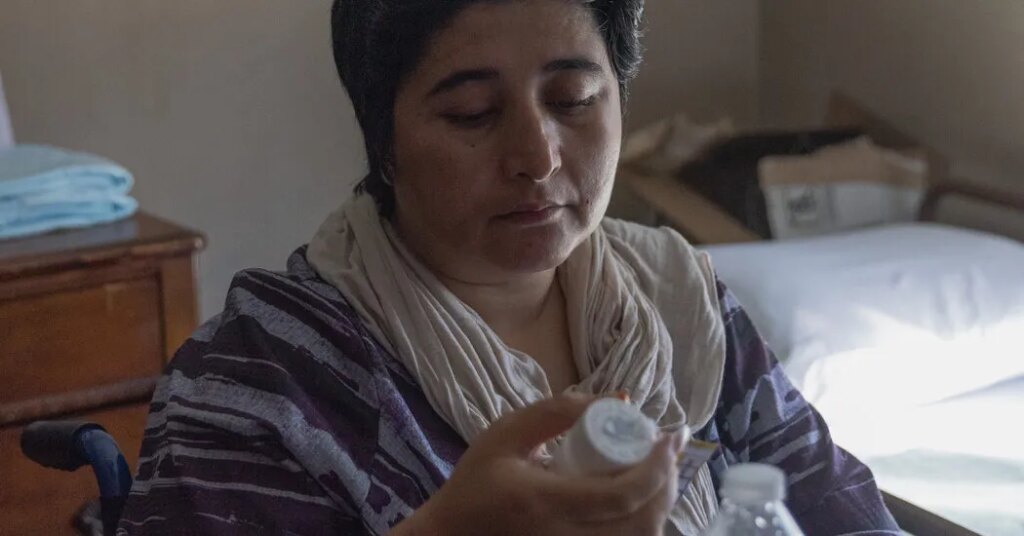
Farahzad Sediqi, 32, said she was set to lose Medicaid, which helps cover her treatment for multiple sclerosis, a disorder of the central nervous system that can cause paralysis and seizures. Because Ms. Sediqi is a paraplegic, nurses come to her house in Ohio daily to help her shower and change her clothes.
Ms. Sediqi fled Afghanistan and arrived in the United States as a refugee in May 2023, along with her brother and mother, Amina Safawi. Ms. Safawi, who also relies on Medicaid to treat back pain and diabetes, said she and her daughter each receive about $1,000 in federal disability payments each month. Ms. Safawi said her son works at Walmart, but their total income is only enough to cover rent and other basic necessities.
Ms. Safawi said she was unsure what would happen, as she cannot afford her daughter’s neurologist appointments, home care nurses or the treatment she needs to prevent seizures without insurance. Although they applied for green cards over a year ago, they are still waiting to hear back, she said.
“She’s my entire life and I can’t tolerate losing her,” Ms. Safawi said in Dari.
Danilo Zak, the policy director at Church World Service, a nonprofit group that aids refugees nationwide, said the organization was working with families to try to find alternatives to Medicaid but that options were limited. More immigrants will likely have to rely on emergency rooms and community health centers, he said.
“Access to basic health care and food assistance is part of those initial supports that are needed to get people to self-sufficiency,” Mr. Zak said.
Mr. Zak urged the federal government to speed up processing of green card applications, given that an approval could make them eligible for Medicaid again.
Although refugees can apply for permanent residency after living in the United States for a year, the Trump administration has slowed processing those applications, meaning many legal immigrants will be kicked off the program while they wait for their application decisions.
There are about 149,470 pending green card applications filed by refugees, according to data from U.S. Citizenship and Immigration Services. From October to the end of June, the agency completed reviewing only about 3,800 applications. It now takes about 18 months for the agency to process those applications, up from eight months at the end of 2024.
Esther Aguilar and her husband fled Nicaragua and later migrated to the United States as refugees in January 2024. Ms. Aguilar, a 39-year-old Ohio resident, said they submitted green card applications over a year ago, but they are waiting to hear back.
After arriving in the United States, Ms. Aguilar started swelling throughout her body and had difficulty breathing. Doctors later told her that her kidney was failing and she needed dialysis.
Ms. Aguilar said she now goes to a dialysis center three days a week. She recently joined a kidney transplant waiting list, she said, but her doctor told her that she will lose her spot on the list if she no longer has health insurance.
Ms. Aguilar said her medical expenses have been covered by Medicaid, including her nephrologist appointments, insulin and blood pressure medication. But she said she will not be able to afford treatment out of pocket.
Her husband makes $18 per hour working in construction and has asked his employer if he can get health insurance through his job. But they are not sure they will get coverage, and they depend on his wages to cover other basic expenses.
Ms. Aguilar said she feared she could die after losing Medicaid. “They are taking away my hope of moving forward,” she said in Spanish.
Cat Gossman, the health and wellness program manager at Community Refugee and Immigration Services, an Ohio nonprofit group, said she was reaching out to providers to ask about resources they might offer to lower-income individuals like Ms. Aguilar and Ms. Sediqi, but options were limited.
Drishti Pillai, the director of immigrant health policy at KFF, a health policy research group, said it was unclear if everyone subject to the change on Thursday would immediately lose coverage, given that it could take time for some states to reverify people’s immigration status. She added that pregnant women and immigrant children who are lawfully living in the country could continue to get coverage in many states.
The changes will likely result in more immigrants waiting until they become “horribly sick” before seeking treatment in emergency rooms, said Leighton Ku, the director of the Center for Health Policy Research at George Washington University. Hospitals are required to provide emergency care regardless of immigration status, which they can be reimbursed for through a provision known as emergency Medicaid.
“This will create additional strains for emergency rooms that could even have repercussions for citizens who are trying to get care,” Mr. Ku said.
Steven Camarota, the director of research at the Center for Immigration Studies, a think tank that favors lower immigration rates, praised the Trump administration’s efforts to curb immigrants’ use of welfare programs. But he said the move to revoke Medicaid for certain legal immigrants probably would not result in major savings for the federal government and added that he thought it would be more effective to focus on other efforts to reduce their use of public benefits.
“If you’re going to have humanitarian immigration, then it seems reasonable to say we’re going to give them this special eligibility,” Mr. Camarota said.
Ibrahim Daoud, a math teacher living in Southington, Conn., said he feared he could no longer afford the medication and psychiatrist appointments his sister needs to treat her bipolar disorder and schizoaffective disorder. He said her medications alone would cost more than $1,100 each month without Medicaid.
Mr. Daoud, 36, said they fled Syria amid its civil war and to find his sister better medical care in another country. The United States later accepted them as refugees, and they arrived nearly two years ago.
His sister, Ava Dawood, 29, said she worried that she would have trouble sleeping and more frequent thoughts of harming herself without medication. She also sees urologists to treat incontinence, the result of a fall she sustained from the fourth floor of a building in Syria.
Mr. Daoud said he did not want to abuse government benefits, but doctors have said his sister has limited ability to work because of her condition.
“I’m working here,” Mr. Daoud said. “I have no problem with that. But there are some people who really need help.”
Coral Murphy Marcos contributed reporting. Mehrnaz Ighani and Yasmin Alkashef contributed translation.
The post Legal Immigrants Lose Medicaid Coverage Under Trump’s Bill appeared first on New York Times.