KYIV — At least the residents of this battered capital city had a gorgeous autumn day to look forward to Wednesday. The forecasts promised clear skies and cool air as a respite from another night of sirens, booms and ballistic missile strikes.
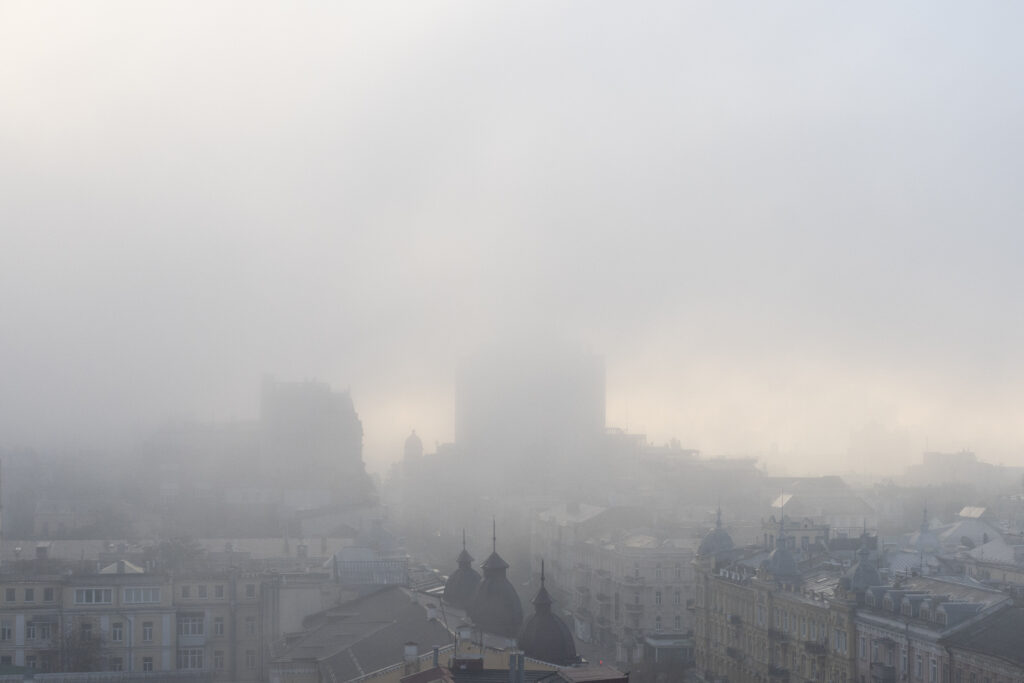
Instead, Kyiv woke up smothered in the fog of war. Actual fog.
An unexpected dense blanket of gray filled the city shortly after 7 a.m., blocking out the sun and cutting visibility to near zero. Drivers flipped on headlights. A woman on Khmelnytskoho Street held a scarf over her face.
It was, according to a government advisory sent out soon afterward, a side effect of Russian attacks.
“It is a consequence of the recent strikes,” the Ukrainian State Emergency Services posted on its Telegram channel to explain the rare meteorological occurrence. “Residual smoke and soot rose into the upper layers of the atmosphere, while an anticyclone is temporarily pushing them back toward the ground. There is almost no wind at the moment, so the air is not circulating.”
That smoke and soot come from relentless Russian ballistic missile and drone strikes on Kyiv and the surrounding region in recent weeks, including early Wednesday.
At least two people were killed and four injured in the city, and a child was killed in the wider region, according to Ukrainian media. Ukrainian air defenses said they brought down 160 targets, including five ballistic missiles.
Thick plumes of smoke are common after strikes, including recent hits on a warehouse near the central train station and a fire from a jet-powered drone that struck the National Academy of Sciences in central Kyiv on Monday.
The smoke of battle rises. On Wednesday, the atmosphere seemed to have had enough, sending the pollution back down for citizens to inhale anew.
For nearly five years, Kyiv residents have grown accustomed to explosions and blackouts. Wednesday brought a whiteout and bad air.
The government advised residents of some parts of the city to stay inside, shut the windows and run air purifiers if they had them. Drivers were told to use fog lights and keep their distance.
Some air-quality monitors spiked, including one on Kudriavska Street near the near the frequently bombed Lukianivka neighborhood, which registered 201, a level considered unhealthy. Other monitors showed lower levels of particulates.
Alina Skrylnyk was getting ready to leave for her job at a furniture store and wondering why it was so dim. She didn’t realize it was anything more than morning fog until official channels said to keep windows and doors shut.
Still, Skrylnyk said, she treated the weird air the way she does most air-raid sirens and the other effects of war — by ignoring it and going about her business.
“It’s just another day, what can you do about it,” Skrylnyk said.
Meteorologists and amateur weather-watchers on the internet debated what produced the unusual effect: whether the smoke created the fog, or simply joined it.
Calm, clear autumn nights under high pressure routinely produce fog on their own, but soot in the air gives moisture something to cling to.
What exactly is happening in the atmosphere remains unclear, in part because Ukrainian meteorologists can no longer send up weather balloons.
“Those observations have not been conducted here since 2022 because of the war, so we do not have a complete picture of what is happening through the vertical column of the atmosphere,” said Oksana Skliar of the Ukrainian Hydrometeorological Center.
By late morning, the mist had lifted and sunlight filled the city skyline. And then gunfire did as well.
Just before 11 a.m., rooftop batteries unleashed rifle and machine-gun fire at a drone. Then came another window-shaking boom. And another plume of smoke.
Serhiy Morgunov and Anastacia Galouchka in Kyiv contributed to this report.
The post Kyiv wakes up in fog of war as strikes set off unusual meteorological effect appeared first on Washington Post.