Most analysts think Democrats will win control of the House five weeks from now, but there is plenty of disagreement about how many seats they’ll have when all is said and done. The answer may be staring us right in the face.
This week, I set about reverse engineering the past three midterms using generic congressional ballot polling. I expected the analysis to be fruitful, but even I was surprised by just how predictive it turned out to be. Applying the same model to the election before us renders this verdict: a Democratic majority of at least 225 seats and as many as 232.
It’s widely recognized that voting in House races has become extremely partisan. For decades, split-ticket voting meant that many Republicans ended up representing districts carried by Democratic presidential candidates, and vice versa. Not so anymore. In 2024, according to Sabato’s Crystal Ball, just 16 districts were won by House candidates and presidential nominees from different parties, the same as in 2020. Indeed, the combined number of crossover seats over the past four House elections — 89 — is just three more than the number of crossover seats in the 2000 election alone.
Follow Henry Olsen
This means partisan support has become an almost-perfect predictor of the final House breakdown. There will be crossover seats, of course. Some Democrats will win Trump-carried seats this year, and a couple of Republicans will probably win Harris-captured districts. But the final tally for each party should closely follow the partisan breakdown.
To test this idea, I looked at the past three midterms. I took the final result on the RealClearPolitics average of generic congressional ballot polling — that’s the question that asks, without naming a specific candidate, whether a respondent would vote for a Democrat or a Republican for Congress — and compared it with the presidential margin of victory in the prior election.
I assumed that the winning party would be favored in every seat that its presidential nominee carried, as well as every seat that the other party’s nominee won by a margin lower than the generic ballot polling advantage. In other words, if a Republican presidential nominee won a district by five percentage points, and the generic congressional ballot showed Democrats ahead by six, then the Democrat should win that seat by one point.
That made it possible to predict the number of seats that each party would win in a perfectly partisan race. The results were astonishingly close to the actual outcomes.
In 2022, Republicans led in final RCP generic ballot polling average by 2.5 percentage points. Applying that to the 2020 presidential results by House district gave the GOP a partisan advantage in 219 seats. They won 222.
The results were similar in 2018 and 2014. The final RCP average in 2018 had Democrats up by 7.3 points, yielding a partisan advantage in 227 seats. They won 235. In 2014, the final average showed Republicans up by 2.4 points. That gave them an advantage in 236 seats. They won 247.
In each case, you will have noticed, the majority was a bit bigger than the generic ballot indicated. But the difference reflected the final, real-world vote. In 2018, Democrats actually won the overall vote by 8.3 percentage points, while in 2014 the GOP outperformed the final poll margin by a whopping 3.3 percentage points, winning by 5.7 points.
Applying the actual outcome in those years narrowed the gap between the prediction and the result. Had the 2014 polls been on the nose, the GOP would have been predicted to win 249 seats, only two more than they carried. In 2018, Democrats would have been predicted to carry 233 seats, only two fewer than they won.
Again, in each year, the losing party won some seats it was predicted to lose, while the winning party won some seats it “should” have lost. These discrepancies show that even in this hyperpartisan age, candidates still matter. They also show that regional disparities can affect races beyond the national partisan environment. In 2022, five of the GOP’s unexpected pickups were in New York, and another three were in California’s Central and Antelope Valley regions, places that demonstrated a consistent pro-Republican tilt that year.
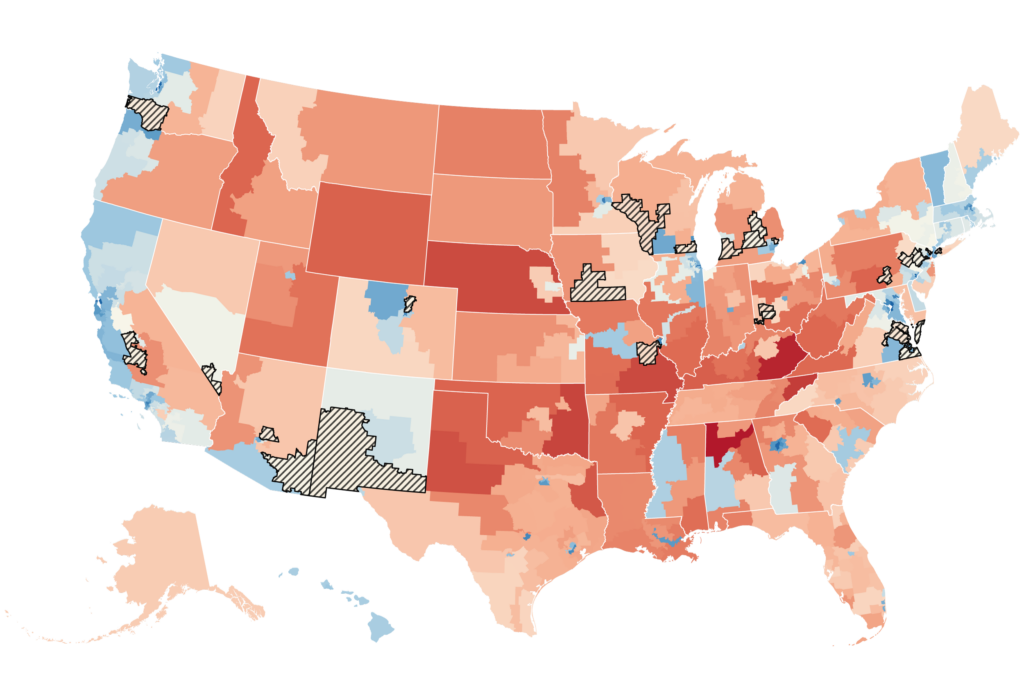
Applying the model today yields a prediction of 225 Democratic seats. The RCP generic ballot average on Wednesday morning put Democrats ahead by 8.3 points. Combine the districts that Kamala Harris won in 2024 (201) with the ones Donald Trump carried by 8.3 points or less (24). Since the winning party has generally outperformed its predicted level by about seven seats, that yields an upper bound of 232 Democratic wins.
A few caveats: Polls do change late in a campaign. (In the past three midterms, the final polling average varied from the one registered on Sept. 30 by between 0.2 and 1.6 percentage points.) A 1.6 point movement in either direction would only change the expected number of Democratic seats by a few. It would take a historically large late shift to make Republicans the favorites to keep House control.
Additionally, it should be noted that extreme pro-Republican gerrymandering means the final House makeup will not reflect the national vote proportionally. An 8.3 point win using a fair map would give Democrats a House majority comfortably in the 230s. We don’t have anything like that map now — to the detriment of our democracy.
As financial advertising warns: Past performance is not indicative of future results. So keep that in mind, too. But this simple model has proved accurate in the past, and I’ll be using it to guide my analysis for the final month of the campaign.
The post How many House seats will the Democrats win? The polls may already know. appeared first on Washington Post.