Standard passport annoyances — think printed forms, in-person appointments and unflattering photos — may become a relic as the U.S. State Department vows to make the process of getting the document easier.
Secretary of State Marco Rubio said this week that Americans will be able to apply for their first passport entirely online, starting in 2027.
While passport renewals are already available online, first-time applicants have always had to go in person, documents in hand.
“That is where the maze starts,” Rubio said at an event launching the government chatbot America.gov. “You have to know which form to print, you have to schedule an appointment, then you have to go wait in line.”
The State Department said in a statement that the ability for most Americans to apply online would reduce “the time, expense, and scheduling demands of an in-person visit to a passport agency or application acceptance facility.”
The department did not specify when the new application process would be available or provide details about the steps involved. But Rubio said the goal by the end of next year was “for the vast majority of Americans to be able to apply for a passport or a passport card on America.gov.”
Here are the updates he highlighted.
Online applications for first passports
Rubio described a process of navigating to the artificial intelligence-fueled America.gov and asking how to get your first passport. He said applicants would use the sign-in service Login.gov and see all the information the government has on file about them.
Details on how people would fill out required forms and submit any necessary documentation were not yet available.
Users would upload a photo (more on that below), pay and check out.
Online renewals were first announced under President Joe Biden in 2021, though the option was not rolled out widely until 2024.
Upload your own photo
Drab and somber drugstore photos are a passport stereotype — though there are also warnings about getting too glammed up for the picture. But passport holders can already submit digital photos when they renew online.
Under the new system, first-time applicants will also be able to submit a photo online.
“You probably can’t use those filters to make you look 50 years younger, but you can take a picture of yourself on the phone in the comfort of your own home, or you can upload one directly from your own device,” Rubio said. Per the State Department website, applicants definitely can’t use a filter.
He said users will be able to see their photo in the context of the finished passport and retake it until they like what they see.
New cover design
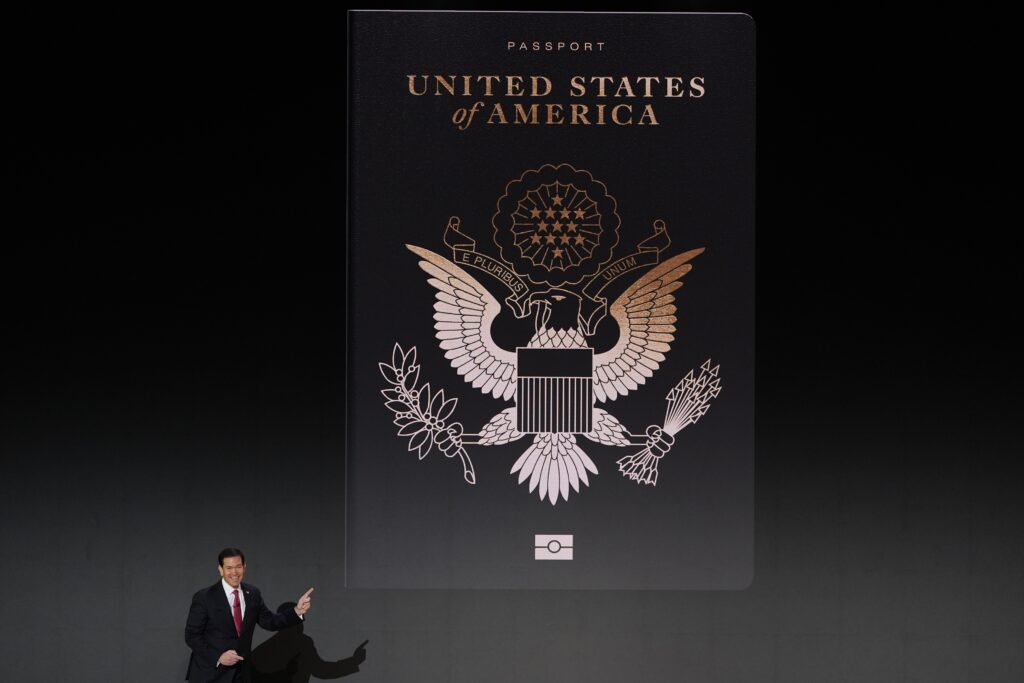
Rubio showed an updated design for what he described as the 2028 U.S. passport — not to be confused with the “Patriot Passport” commemorating the 250th anniversary of American independence and featuring a photo of President Donald Trump inside.
Rubio displayed a booklet with the word “passport” in small font above the country’s name, which is positioned on top of the passport instead of in the lower third. The country’s national emblem is larger in the new version and, he said to some laughter, “more gold.”
Soaring eagle
Rubio also showed images of an eagle on the right-hand side of pages that bear images from American history.
Flip the pages, and the eagle appears to fly.
“I can see Americans sitting at airports all over the world, like, ‘Why do people keep flipping through the page?’” Rubio said. “It’s either this or some Game Boy for your kids to keep them entertained. They can flip the eagle around.”
New packaging
Rubio showed an image of a beat-up U.S. Postal Service Priority Mail envelope that he said typifies the way passports show up. He showcased a new package, a thin white box emblazoned with the golden seal that opens a flap to reveal the passport.
The post 5 ways U.S. passports are changing appeared first on Washington Post.