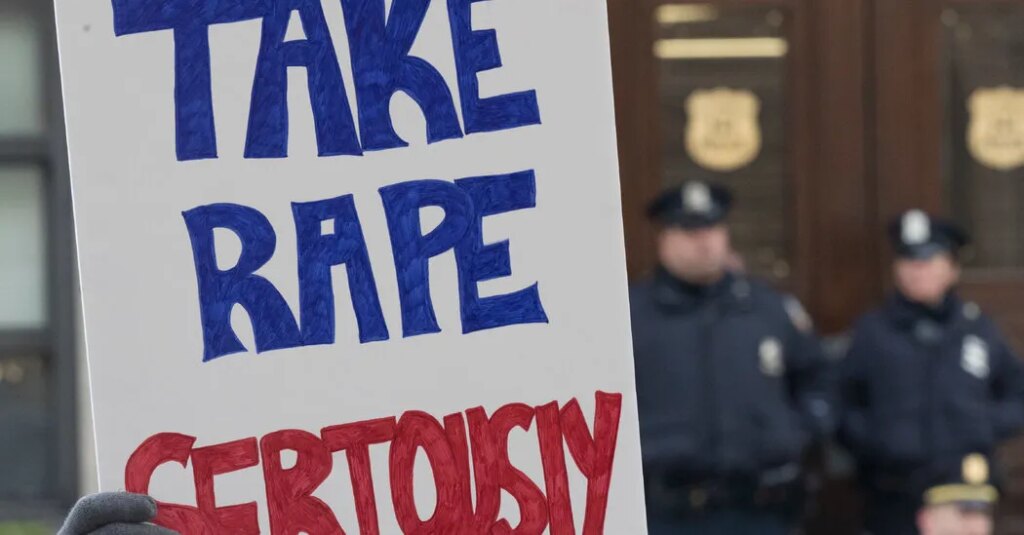
A New York prosecutor has blamed the state’s rape laws in part for his decision not to charge Cornell University students who were accused of sexually assaulting a 20-year-old woman in 2024.
Those laws make it much more difficult to charge people with rape if the accuser chose to become intoxicated, according to prosecutors and advocates for sexual assault victims.
For years, legislators have tried to change the law so that prosecutors could bring sexual assault charges in cases where a person had sex with someone who was clearly incapacitated and unable to control or understand their behavior.
The case of the young woman who said she was sexually assaulted by the students at their fraternity in Ithaca, N.Y., has renewed calls for that legislation to pass.
Here is what to know about the state’s rape laws.
What does the law say about voluntary intoxication?
In New York, accusers who chose to drink or take drugs have a high burden of proving they were unable to consent, according to prosecutors.
The way the law is written now, people who were voluntarily intoxicated cannot claim they were mentally incapacitated during an assault, unless they can show they were physically helpless. This means that they had to be unconscious or physically unable to communicate consent at the time of the act.
That definition leaves out people who were semiconscious, slurring their words or unable to stand or walk steadily before they were assaulted, according to prosecutors and supporters of sexual assault victims.
Proposed legislation would allow prosecutors to charge third-degree rape in cases where a person under the influence of drugs or alcohol was unable to control their behavior and was assaulted by someone who should have “reasonably” understood the victim’s condition.
At least 23 other states, including California and Virginia, already have similar laws.
How did the law affect the Cornell case?
Matthew Van Houten, the district attorney for Tompkins County, has said that when the woman first reported the assault in 2024, her claims did not support a criminal case.
The woman, who was an undergraduate student, took ketamine and drank tequila and beer; at one point, she consumed 10 drinks in a three-hour period, according to the lawsuit she has filed against the students, the fraternity, her sorority and the university.
The students pressured her into taking more ketamine and gave her so much alcohol she became unable to consent, the lawsuit states. They took her to a room and assaulted her for about seven hours. She tried to hide her naked body under the covers and push them away, but “she felt as if there was no way for her to escape this room full of predatory fraternity men,” the lawsuit says.
Since the lawsuit became public, Mr. Van Houten has been criticized for not charging the men when the woman first came forward in November 2024.
In an interview with The New York Times on Tuesday, Mr. Van Houten said that if the woman’s initial report had shown she was unconscious when she was assaulted, “these guys would be in prison right now.”
He said he is reviewing new evidence and will decide whether her case could now be taken to a grand jury.
Mr. Van Houten said if the law had been changed in 2024, it would have been easier to show that the accused students should have known that “the person was incapable of consenting because of their consumption of alcohol or drugs.”
“That’s not the law,” he said.
Why hasn’t the law been changed?
Defense lawyers have pushed back hard, saying proposed legislation would make it easier for prosecutors to charge people who had sex with someone they believed had given consent and later claimed they were too intoxicated to know what they were doing.
Some lawyers have described the legislation as “paternalistic” and say it would take away a woman’s agency and ability to stand by a decision to have sex even though she chose to get drunk or take drugs.
Assemblywoman Latrice M. Walker, a Democrat whose district includes the Brownsville neighborhood of Brooklyn and who has opposed changing the statute, has said she is worried about passing laws that would hurt a person’s right to due process.
The New York legislature has failed to pass the bill since 2019, when Assemblyman Jeffrey Dinowitz, a Democrat representing the Bronx, introduced the first version.
In June, Carl Heastie, a Bronx Democrat and the speaker of the State Assembly, declined to bring the latest version of the bill to the floor even though it had broad bipartisan support.
But on Wednesday, Mr. Heastie released a statement saying the Assembly had formed a working group to examine the state’s sexual assault statutes and consider “how best to move forward so that New York’s laws are as strong as possible.”
“The allegations being reported out of Cornell University are truly horrifying,” Mr. Heastie said. “We want to do everything we can to ensure victims of sexual assault see justice served.”
The working group includes Mr. Dinowitz and Ms. Walker.
Hurubie Meko contributed reporting.
The post What New York’s Rape Laws Mean for the Cornell Case appeared first on New York Times.