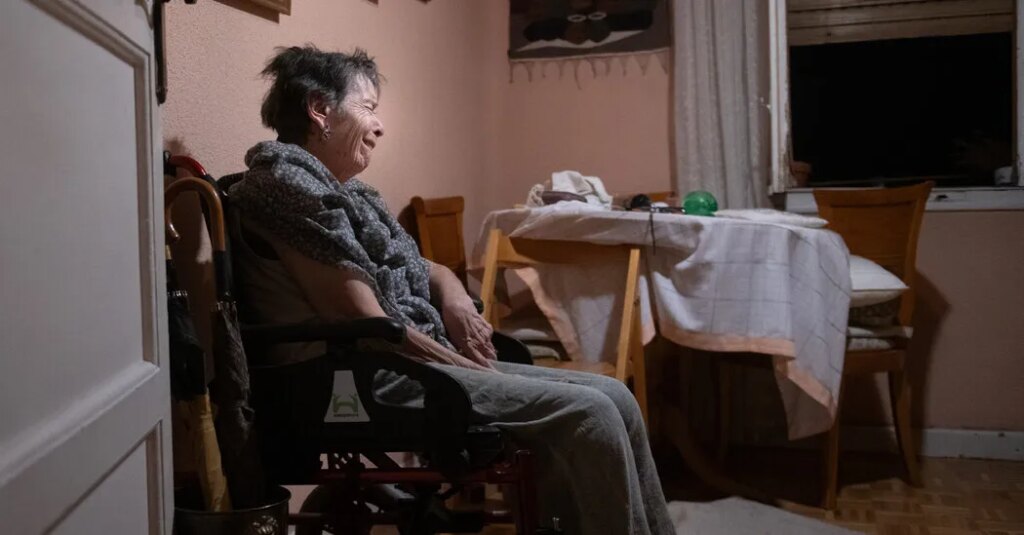
An 87-year-old woman in Spain whose eviction prompted large protests will be allowed to return home, her representatives said Tuesday, and the Spanish government announced proposals to protect renters that it hopes to pass through Parliament.
The woman, María del Carmen Abascal, known throughout Spain as Maricarmen, was evicted from her home in Madrid last week, angering many Spaniards and catapulting the country’s housing crisis to the center of political debate.
On Tuesday, Beatriz Duro, a lawyer for Ms. Abascal, and Urbagestión, the real estate company that owns her apartment, said that they had reached an agreement. Ms. Duro said the deal gave Ms. Abascal, who is currently in a Madrid hospital, an eight-year lease with a monthly rent equivalent to 30 percent of her pension, or about $460.
Madrid’s tenant union, which organized the protests, quickly celebrated.
“Together we are stronger than any politician, judge or speculator,” it wrote on social media late Monday.
Ms. Abascal’s eviction touched a nerve in a country increasingly frustrated with high housing costs and created intense pressure on the left-wing government of Prime Minister Pedro Sánchez, who had promised to make housing a priority.
On Tuesday, the government said it had reached a deal with its partners in a parliamentary coalition and introduced two proposals that will undergo a vote in Parliament on Friday.
The first, which has a better chance of passing, would ban evictions of vulnerable tenants like Ms. Abascal until 2030 and would generally extend eviction protections that had recently expired until that date.
Those protections, presented by Isabel Rodríguez, the housing minister, at a news conference on Tuesday, include an option for tenants to extend expired leases at the same rate by an additional two years. The proposal also contains measures to curb short-term rentals and the acquiring of properties by some real estate investors.
But this package does not contain a measure that tenant rights activists have called for: the automatic renewal of rental agreements, without a possibility for expiration or rent increases.
That proposal will stand on its own. The conservative opposition is likely to oppose it, but so is a party that is more sympathetic to the interests of landlords and that Mr. Sánchez’s minority government needs to pass legislation.
Over the past few days, activists furious over Ms. Abascal’s eviction and the lack of affordable housing have camped out in Madrid’s Puerta del Sol, a square popular with tourists that marks the geographic center of Spain.
“The situation is getting serious,” Dora García, a 55-year-old nurse, said in the square on Saturday night. Ms. García said she feared her landlord would increase her rent again after she was “pushed out” of her previous Madrid neighborhood.
“We the renters have the sword of Damocles hanging over us,” she said.
Spain faces a housing shortfall of about 755,000 homes, according to the Bank of Spain, which has predicted that could rise to a million homes by 2028.
Experts attribute the shortage to a complex range of factors.
Spain built too much in the 2000s because of a housing bubble. When the bubble popped during the financial crisis, prices cratered and the country became reluctant to build new housing. Then, to revive the market, Spain made it easier for landlords, companies and foreign buyers to buy in.
But in the last five years, Spain has boomed with an influx of wealthy foreign investors, about three million immigrants and a mass of tourists — projected to hit 100 million in 2026 — who often stay in short-term rentals that deplete the housing stock.
As a result, demand vastly outstrips supply in the urban centers where most people live, driving up prices and leaving an increasing number of Spaniards, especially young ones, behind. Their growing frustration exploded last week when the police broke down Ms. Abascal’s door and she left the apartment on a stretcher.
“What this highlights vividly is the extent of the housing crisis that has been going on for a long time now,” said Raymond Torres, an economist at Funcas, a think tank in Spain.
Private individuals own over 90 percent of Spain’s rental properties, according to the Bank of Spain. Still, many protesters blame real estate companies, which left-wing critics call “vulture funds,” for gutting housing stock and raising prices.
“We can’t live in our own apartment — we have to share with two other people,” Ana López, 29, said alongside her girlfriend next to the Puerta del Sol camp on Saturday night. “Speculators, vulture funds, tourists. What about us?”
In Spain, which prizes homeownership, about 20 percent of people rent while another roughly 7 percent live rent-free, often with relatives.
Bureaucratic and jurisdictional barriers have made building new housing difficult. Public housing makes up only 2 percent of Spain’s housing stock, as opposed to 10 percent throughout Europe, in part because Spain has previously allowed renters to buy public housing units at low prices.
The government on Tuesday sought to address some of those challenges. But Mr. Torres, the economist, said, “In the long run, there’s no solution other than to build 750,000 new houses.”
The post Evicted Woman Set to Return Home as Spain Announces Plans to Fix Housing Crisis appeared first on New York Times.