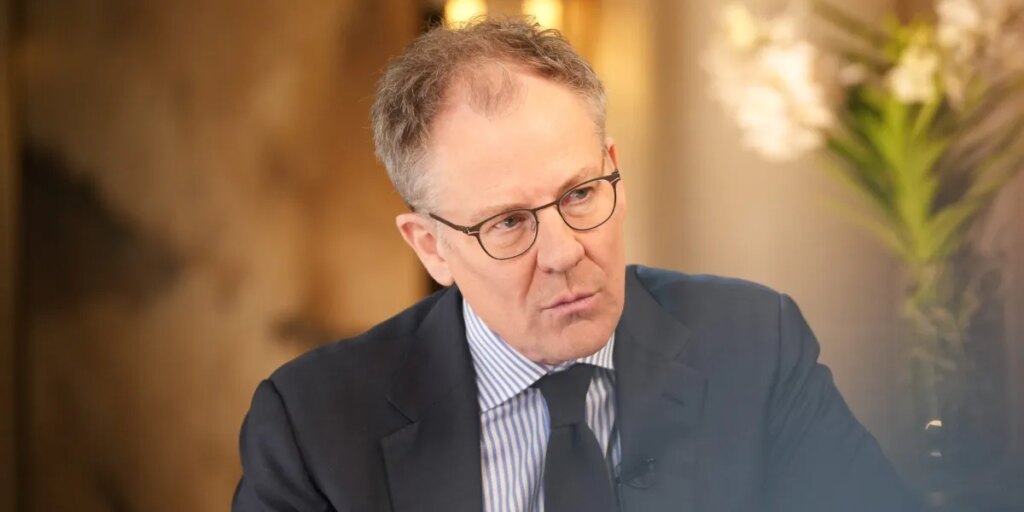
It was May 2023 when Bank of America’s Michael Hartnett took inspiration from the Wild West, coining the phrase “Magnificent 7” for a group of American companies that have proved to be the main driver of the stock market during an AI boom. And while the Mag 7—Apple, Amazon, Alphabet, Meta, Microsoft, Nvidia, and Tesla—remain dominant forces in the asset class, Hartnett now says that the very thing which once made them a portfolio “must” is now a vulnerability. Fiscal excess led investors to put their money toward something more sustainable, BofA’s chief investment strategist suggested in a recent episode of the Master Investor podcast. He said: “To a certain extent, the rise of the Mag 7 was because nobody wanted to hold government bonds.: ‘I don’t want the government balance sheet. They spend like drunken sailors. Why do I want to lend to them?… I’d rather put my money with companies that have tons of cash and … don’t spend any of it.’
“That was the Mag 7,” Hartnett said. However, AI hyperscalers have now begun spending—to a breathtaking degree. Global AI investment is expected to exceed $1 trillion in 2026, per Goldman Sachs’s latest calculations, with JPMorgan Chase CEO Jamie Dimon expecting hyperscaler AI spending will hit the $1 trillion mark next year.
But with bond yields rising at the longer end of the scale (10-year Treasuries sit at a near two-decade high, while 30-year Treasuries haven’t sat at their current levels of more than 5.5% since 2002), borrowing costs across the economy have increased.
The tech sector has run down its pile of cash and begun borrowing heavily in the corporate credit markets. Increasingly, that means the prospects of the Mag 7 are tied to the very asset class it was once used as a hedge against.
As Hartnett explains: “Let’s not forget that the Mag 7, the hyperscalers, whatever you want to call them, part of the reason to say they’re magnificent is because they made magnificent amounts of cash and didn’t spend any of it. That’s why they were magnificent.
“Now they’re spending a trillion plus a year on AI capex, and they’re negative cash flow to the tune of $200 billion. So … they have to be kind of subservient to the bond market. If the bond market pushes up yields or spreads too much, you’re not going to get the spending.”
The pain threshold
While Wall Street is divided on U.S. Treasury Secretary Scott Bessent’s recent bond buyback scheme, economists told Fortune that the action had taught investors an important lesson: The point at which the Treasury will step in to smooth volatility.
And while the 5% mark is a threshold that sticks in investors’ minds, it hasn’t automatically triggered action in the past. As Hartnett points out: “Half of what I do is listen to smart clients and half of what I do is just watch prices in the market. It’s not me thinking 5% is a magical level.”
The threshold means more to policymakers, Hartnett argues, because domestically, higher yields mean “the AI companies can’t borrow to do AI capex, and you really hurt the wealth effect that’s been so strong via the equity market.” Additionally, geopolitically, “There’s one objective, which is to beat China at AI, and they cannot allow a disorderly move in the bond market—and to a certain extent that’s why I feel that they’ll succeed because they’ll do anything they can to prevent that.”
“What they can’t necessarily … manipulate is if voters basically vote against AI. So the Wall Street threat is bonds. The Main Street threat is voters.”
The post The economist who coined the phrase ‘Magnificent 7’ says the very thing that made them extraordinary is under threat appeared first on Fortune.