Organizers of the 2028 Summer Olympics in Los Angeles have given vague and sometimes incomplete annual reports to the city on details of their preparations for what has been described as the largest athletic event in the nation’s history, records show.
A review by The Times of five years of annual reports from LA28 shows that the organization appears at times to have curtailed the reporting requirements that are spelled out in its 2021 contract with Los Angeles.
The private nonprofit organization’s yearly reports haven’t outlined progress on roughly two dozen venues around Greater Los Angeles. Nor have they included details about contracts LA28 signed with companies providing such services as security and preproduction work for the opening and closing ceremonies.
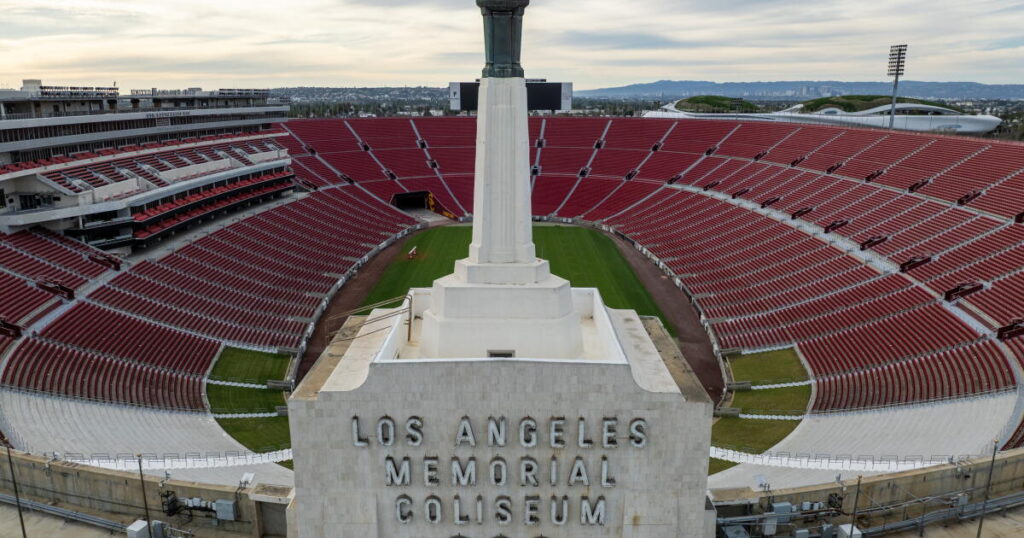
The incomplete updates leave the city’s taxpayers with less information than promised on matters such as who is winning business — and the attendant jobs and profits — from contracts that soared to $687 million in value last year. They also don’t have as clear a picture on things like the progress on plans to install a running track at the Los Angeles Memorial Coliseum and swimming pools inside SoFi Stadium in Inglewood.
L.A. City Controller Kenneth Mejia demanded last month that LA28, the private nonprofit producing the Games, release a much more detailed accounting of its activities than it has in yearly reports to City Hall. He has asked for bank statements, more detailed revenue and expenditure accounting and other documents.
Mejia said he is aware of LA28’s assurances that robust ticket and sponsorship sales will ensure a healthy bottom line. LA28 has estimated the Summer Games will generate $2.6 billion in revenue from domestic sponsorships and $2.5 billion from ticket sales.
Even so, Mejia wants more information to be sure that those reports are accurate, especially because the city previously agreed to help cover any deficit should the Games lose money.
“L.A. taxpayers need to know that LA28 is doing well. They want to make sure that those numbers are legit, which is why we’re requesting more information,” Mejia said in an interview. “Because if LA28 does not do well, then we as taxpayers, as the fiscal backstop, we’re on the hook.”
The controller asked LA28 to make the additional disclosures by Monday. But the organization has given no indication that it intends to provide additional information.
LA28 said it already provided the records required in the contract, noting that its previous annual reports had been accepted by the city. The group suggested some of the information that didn’t appear in annual reports, such as copies of insurance policies, had been provided to the city “directly.”
“We look forward to continuing to meet our obligations,” Jacie Prieto Lopez, an LA28 spokesperson, said in a statement.
Mejia has been virtually alone in calling for more information from the Olympic organizers. Mayor Karen Bass and City Council members have accepted LA28’s annual reports since 2021, asking some questions but not publicly pressing for all the details that The Times and Mejia have requested.
The dispute over LA28 disclosures has its roots in a contract signed in 2021 by then-Mayor Eric Garcetti and LA28 Chairman Casey Wasserman, which was designed “to provide a critical framework for how the [organizing committee] and the City will work together.” The so-called Games Agreement laid out a “shared set of values” and called for an operating budget that would be “prudent, realistic, and designed to protect taxpayers by mitigating financial risk.”
In a section called Transparency, the agreement mandated annual reports to the city that are supposed to include a range of disclosures. Among the requirements:
• A list of all contracts of more than $1 million inked by LA28, including “the name, type, amount, term and purpose” of the agreements.
• Copies of all purchased insurance policies to the city, including the “coverage amounts contemplated” and the timing of their procurement.
• An “update on venue infrastructure and improvements, including, but not limited to, all related schedules and budgets.”
The kind of information provided by LA28 in those three areas has changed over the five years it has reported to the city.
In the first years of its annual reports, LA28 reported its $1-million-and-up contractors by name and the value of their deals. Among those listed were AECOM, the global infrastructure company, which received more than $6.7 million from 2021 to 2023 for technical consulting and planning.
Similarly, LA28 reported contracts with Deloitte for consulting, Gavin de Becker and Associates for security and Two Circles Inc. for “ticketing functional area support.”
As the 2028 Summer Games have grown closer, contracts signed by LA28 grew in 2024 to a total of $36.2 million and in 2025 to $687 million. But annual reports for those two years told less, no longer naming the contractors and the amount paid to each. Instead, LA28 released only broad categories of the work completed — such as “engineering consulting services,” “mascot design and production” and “office buildout.”
Bass and some City Council members have been pressing the Olympic organizers to direct more of their spending to companies based in L.A, arguing that the principal host city and financial guarantor of the Games deserves special consideration. Without names of the companies hired, it’s harder to track where more than $687 million in business has gone.
LA28 didn’t respond to a request for comment from the The Times about the failure to publicly disclose the contract details. Leaders of LA28 rejected the idea that their annual reports have been incomplete, however, and repeatedly have said the organization continues to hit or exceed its projections.
In their routine review of the 2025 annual report, two top advisors to the city’s elected leaders described the reporting on contracts as “limited.” Matt Szabo, the city administrative officer, said that he and Sharon Tso, the chief legislative analyst, have asked LA28 to provide a list of the $1 million-plus contractors in writing, “as required by the Games Agreement.”
Tso and Szabo wrote in their review last week that LA28 had not listed the detailed information, contending “that publishing specific contractors and contracting details within the annual report is financially detrimental and a risk to its future competitive contracts partnership and sponsorship activities.”
Instead, LA28 had shared the detailed contract information only with the top advisors and the mayor’s office, Szabo said.
Mejia said the identity of the contractors and how much they are being paid should be disclosed to the public. “There are concerns about who they are paying. Who is it going to? Is it a local business or is it going outside of L.A.?” Mejia said. “We want to know those contract details.”
On the subject of insurance, LA28 provided the amounts of some coverage in reports in 2021, 2022 and 2023, while reports for 2024 and 2025 provided no coverage amounts.
The 2024 report notes that rates for some insurance had increased. It described broad areas of coverage, such as cyber and media liability and event cancellation. It also said the organizing committee formed its own company, Amphoreis Agonos, “to provide tailored risk management solutions and insurance coverage specific to LA28’s operational needs.”
LA28 told The Times it had “provided copies of the required insurance policies to the City directly.” And Szabo reported to the City Council last year that his office had determined that LA28 had complied with “insurance and risk management requirements.”
When it comes to preparation of venues, LA28 has estimated it will spend $1.4 billion to create 49 competition locations, spread across Southern California and Oklahoma City. The organization named AECOM as the lead consultant for construction.
But in its 99-page annual report for 2025, LA28 offered just a single paragraph on venue preparation. It didn’t provide any of the schedules or budgets required in the contract with the city. Mejia demanded those details for each venue, and updates on any changes from past plans.
While not included in the annual report, LA28 has separately filed a venue plan with the city. In 2024, for example, the organizing group updated the plan, saying that the changes would result in a total of $150 million in combined cost savings and revenue increases.
An LA28 spokesperson said “venue-related planning continues to be coordinated with City partners as appropriate.”
Wasserman and other organizers have said they expect the Games to at least break even, or to produce a surplus. Those profits have been promised to go, in large part, to support youth sports programs in Southern California for years to come.
Unions and other activists had pressed for more commitments from the Olympic organizers at the time of the 2021 contract signing. But Wasserman disagreed.
“It can’t be an agreement that locks in every detail because the one thing we need is flexibility,” the LA28 chairman said at the time. “Seven years is a long time and the world can change a lot.”
In his August letter to LA28, Mejia asked for several other disclosures: financial statements that compare revenue and spending forecasts to actual performance; bank statements on the contingency fund LA28 must maintain to cover potential losses, annual financial forecasts and a more granular breakdown of broad budget categories now labeled only “other revenues” and “other expenses.”
The Games Agreement directs LA28 to work with the mayor, city attorney, city administrative officer and chief legislative analyst on matters related to the Olympics. The agreement doesn’t mention the controller’s office.
But Mejia said in his letter to LA28 that the City Charter gives him the power to “provide critical oversight, accountability, and financial transparency of and for the City of Los Angeles.”
“Never before in this City’s history has a private organization been backstopped by the city of Los Angeles to carry out an endeavor of this size and scale,” Mejia wrote to LA28.
Mejia wasn’t prepared to lay out his next steps if LA28 doesn’t comply with his demands.
“We’ll circle back and look at our charter-mandated authorities and powers and we’ll let you all know from there,” Mejia said. “But, for now, we’re just going to wait to see what happens.”
The post L.A. Olympics organizers limit some financial disclosures, a Times review shows appeared first on Los Angeles Times.