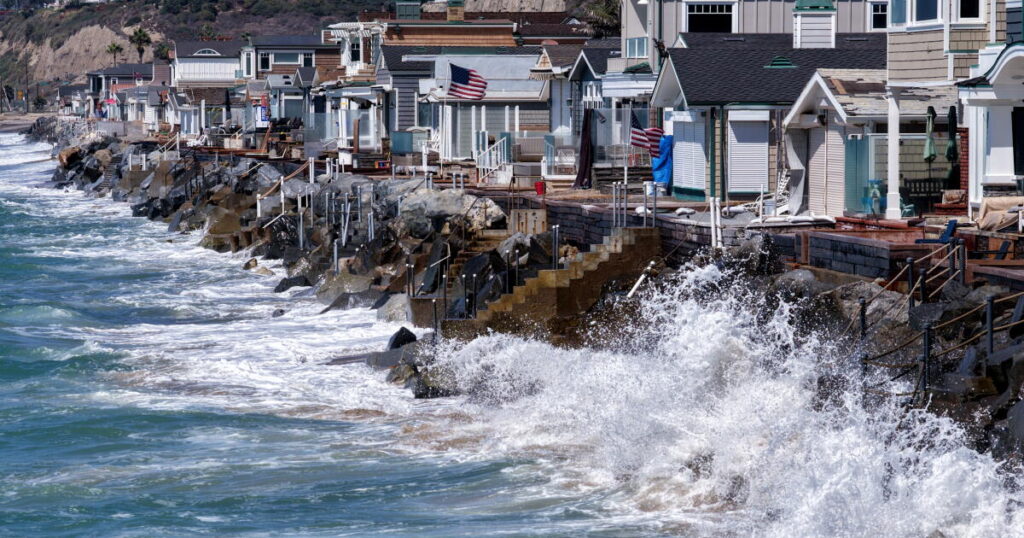
With California’s coast getting pounded by strong waves amid a strengthening El Niño, residents and government leaders are turning to big rocks and seawalls to protect homes and keep a railroad from falling into the sea.
But there is growing concern this defensive strategy will end up harming California’s famed sandy beaches.
“It’s kind of a double-edged sword, where it may have some short-term benefits, but long-term, there’s a lot of work showing that some of those protection measures can have negative effects — both at the site, and immediately adjacent to the site,” said Jonathan Warrick, a research geologist with the U.S. Geological Survey.
The tension of short-term coastal protections versus long-term ramifications has played out along the coast for years, as rising sea levels pose a growing threat to communities. But with a potentially historic “super” El Niño in the forecast this winter, the debate is coming to a head.
Rocks and seawalls might wind up saving coastal infrastructure this year, experts say. But the impacts on the coastline could linger far beyond a season of storms.
Coastal armor
California’s coast is dotted with man-made barricades — rocks, seawalls, concrete, wood — aimed at keeping the elements at bay.
Such tactics, called hardening the coastline, are becoming increasingly urgent as the El Niño-roiled Pacific lashes the coast with fury, spawning erosion that’s unprecedented in recent times.
In Dana Point, coastal homeowners on Beach Road — part of the Capistrano Bay Community Services District — have been racing to install protection like a boulder barrier, according to a statement from the city. KTLA-TV recently broadcast video of workers pouring concrete near the shoreline to protect beachside homes from high surf.
A key coastal-hugging railroad line in the area — part of a route that carries $1 billion in freight a year — has for years been at risk of falling into the ocean. Despite completion of a project to place large boulders, called riprap, between the train tracks and the sea in 2025, sediment next to the train tracks was seen this month falling into the ocean below.
A sandy squeeze
All these coastal-hardening efforts may have protective properties for man-made structures in the short term, but they are also hastening the disappearance of California’s beaches as those sandy stretches are increasingly squeezed between a rising ocean and seawalls. The U.S. Geological Survey in 2017 warned that California could lose up to two-thirds of its beaches by the end of this century if the sea level rises 3 to 6 feet.
A sandy coastline can survive rising sea levels by retreating inland. But creating a seawall or some other barrier draws a firm line on the shore — the ocean on one side, the armored coast on the other, with no more space for the sand.
“Sea walls and revetments and rock riprap can temporarily protect homes and public infrastructure like the train tracks, but they ultimately destroy the beach,” said Chad Nelsen, chief executive of the Surfrider Foundation, a coastal and ocean conservation organization.
“We’re making a trade-off between protecting the property and infrastructure for the public’s beach.”
Priorities and price tags
Those studying the coastline have known for years the day would come when the tension between California’s beloved public beaches and those responsible for coastal property would become impossible to ignore.
Some cities had to face this dilemma sooner than others. In the coastal city of Pacifica, near San Francisco, a beach that existed in the 1970s has given way to a mostly armored coastline. And that still hasn’t prevented cliffs from eroding so much that teetering apartments had to be torn down.
One partial solution for some areas is to import sand to replenish eroding beaches, but that can carry a hefty price tag.
“One of the questions is, if we’re going to spend state and federal money to replenish the beaches, is that fair that the homeowners get free public protection in front of their homes at all of our costs?” Nelsen said. “At some point, it’ll be probably cheaper to try to buy out the homes than to put sand on the beach forever, because these beach nourishment projects, beach replenishment projects, they’re tens of millions of dollars.”
In Dana Point, the California Coastal Commission has approved 24 emergency permits on Beach Road just this month, primarily for the construction of a new rock revetment across two dozen homes, according to agency spokesperson Joshua Smith.
“The Coastal Commission has for years repeatedly engaged the community and the city on medium- to longer-term strategies for preventing flood damage in this area,” Smith said. Installing a cobblestone berm, elevating homes and adding sand to the beach have all been suggested.
But, he noted, “while seawalls can provide temporary relief for homes, they can also increase erosion and destroy the public beaches that help protect those same structures.”
The commission noted that all 201 parcels on Beach Road are at high risk of flooding, according to a flood insurance rate map from the Federal Emergency Management Agency.
“Many damaged structures had aging, unpermitted wooden seawalls that were not designed for the level of fierce wave action and severe beach erosion that we saw,” the commission said.
Shoreline hazards have been known to the area since the 1960s, the commission said, but homes built in the area weren’t initially designed to withstand them. After the California Coastal Act was enacted in the 1970s, new and redeveloped homes have been required to be built to withstand erosion and flooding by elevating them and “discouraging seaward encroachment,” the commission said.
The controversy over seawalls extends to the dilemma of the critical coastal rail route connecting Orange County to San Diego County through San Clemente. Since 2021, the route has faced “coastal erosion, bluff movement, landslides, high tides, storms and powerful ocean swells” — collectively adding up to nearly a full year in disrupted service, according to the Orange County Transportation Authority.
The agency says it has been working on solutions to protect the rail line for the next three decades, while a separate effort led by the state will look at solutions beyond that time frame.
Some concepts include sand placement and, depending on location, more heavily engineered interventions such as seawalls or rock.
“More than $300 million in state, federal and local funding has been secured for those priority rail protection efforts. Sand placement is also a significant component of this effort,” the authority said.
Orange County Supervisor Katrina Foley, who sits on the authority’s board, acknowledged that rocks aren’t an ideal solution, but they are often the only option when emergencies arise.
“We know the rocks that they have to keep adding out there are exacerbating the sand erosion, but we have to do that to protect the rails,” she said.
Foley said big sand projects often take years for approvals, permitting and necessary coordination, often with federal partners, but she is hoping to find ways to expedite that. After declaring a local emergency this month, Orange County officials pushed forward a project to move 200,000 cubic yards of sand from the mouth of the Santa Ana River to the Newport Beach shoreline, where severe coastal erosion has been exposing dangerous, historic structures.
The group Save Our Beaches San Clemente, however, says adding more rocks on the coast to protect the railroad is unacceptable. And others say the authority should have looked at relocating the rail line a long time ago.
Everyone has “seen OCTA bringing more rocks to our beaches as a response,” the organization wrote in a Facebook post earlier this month. “They are delivering a solution that further destroys our beaches.”
Storming the coast
Recent hits to beaches were a result of strong swells from hurricanes in the eastern Pacific Ocean, Warrick said, as well as abnormally high tides. Also a factor, scientists say, is the roughly 1-foot increase in sea levels along the California coast over the last 125 years — a result of human-caused global warming.
But there are more specific reasons why certain homes along the Southern California coast were hit particularly hard in recent weeks.
The Capistrano Beach region, Warrick said, has already been dealing with a deficit of sand.
“Those beaches have been narrow for years, and unless there’s more sand in that system — whether that’s provided by some sort of dredging project, or by nature, you know, in the way she provides sediment during big floods from rivers — that place will continue to have severe challenges as similar storms come through,” he said.
While some emergency response initiatives are still underway, others have already proved not up to the task.
In Long Beach, crews built berms out of sand, hoping that waves would crash upon them and spare homes. Instead, massive swells swallowed the berms and slammed through a seawall earlier this month, damaging a number of homes on the Long Beach peninsula.
Much of Long Beach is sheltered from big waves by a 1940s-era breakwater, which protects naval operations, the ports of Los Angeles and Long Beach, the oil islands and the Carnival Cruise terminal.
But the way the breakwater was built puts the peninsula “in a particularly unique position where it’s more vulnerable to erosion,” Warrick said.
“That big, long breakwater only allows waves to approach from the south, pretty much,” he said, which pushes sand west. So the eastern end of the peninsula, “unless you put more sediment there, it gets stripped … and that’s where we’re seeing all the problems with erosion.”
Some nature-based strategies to deal with rising seas include moving things such as a parking lot farther inland, as well as install rivermouth cobble and plant dunes to help retain a sandy beach along the shoreline. That was done at Surfers Point in Ventura, Nelsen said, and he’s pushing for a similar approach at San Onofre State Beach.
Those solutions, however, are less controversial when you’re talking about a parking lot, as opposed to people’s homes.
One thorny issue has been how to deal with threatened wastewater infrastructure on San Francisco’s coast, along Ocean Beach. Officials want to build a buried seawall to shield those installations from erosion. But critics warn that the proposed wall — said to be one of the largest in state history — “will almost certainly result in the loss of the beach” south of Sloat Street.
They suggest the city relocate wastewater infrastructure that is too close to the ocean.
Times staff writers Rosanna Xia, Grace Toohey and Hannah Fry contributed to this report.
The post California’s plan to save coastal homes from El Niño could end up killing beaches appeared first on Los Angeles Times.