Ronald G. Shafer is the author of “A Half-Naked George Washington and Other True Tales From History,” a collection of Washington Post Retropolis articles.
The huge structure would tower over the Potomac River as a bold symbol of American history.
No, it’s not the 250-foot triumphal arch topped by a golden statue of Lady Liberty with big wings that President Donald Trump wants to build — without congressional approval — between Arlington National Cemetery and the Memorial Bridge. Not the behemoth Trump also envisions as a “Military Complex,” housing drones and sniper ammunition, claiming online that “there will be no facility like this anywhere in the World.”
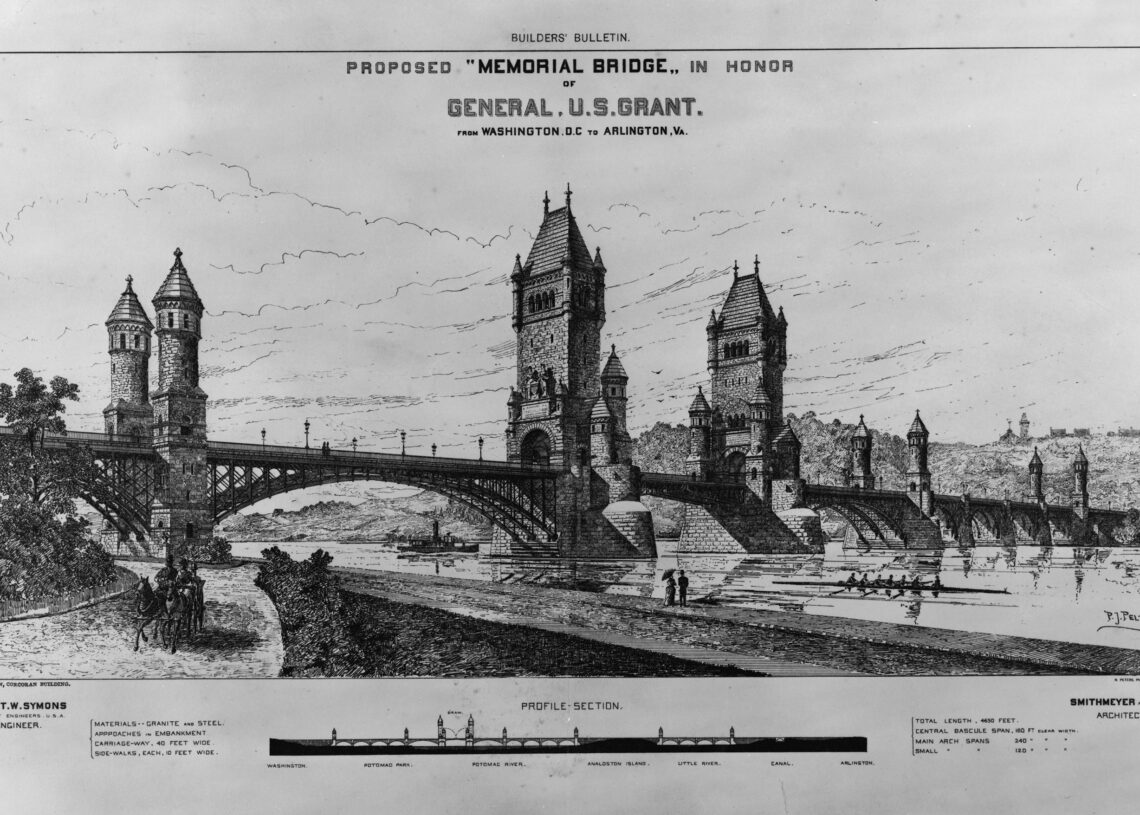
Rather, it was the medieval-style Memorial Bridge that was proposed to Congress in 1887, with two fortress-style towers and several shorter castle-like gun turrets. “No such elaborate and imposing structure of the bridge kind has ever been built; or even contemplated before in the United States,” the Baltimore Sun reported then. The steel and granite bridge between Washington D.C. and Virginia was proposed to be nearly a mile long, its carriageway 40 feet wide, the sidewalks 10 feet. There would be a drawbridge in the middle.
On Feb. 13, 1887, The Washington Post printed a drawing of the bridge in a front-page story about the design, which had been proposed by Capt. T.W. Symons of the War Department’s Engineer Corps and architect by Paul J. Pelz. It was to be dedicated to the late Gen. (and former president) Ulysess S. Grant.
“I have thought, ever since the memorial Bridge was first suggested, that it would be the most appropriate monument that could be erected to Gen. Grant,” Symons told The Post reporter then, “and it is particularly fitting that such a bridge, from the north to the south, should lead from the Capital to the entrance of the great National Cemetery.”
The concept drew support. The Washington Critic newspaper — which had previously scorned a proposed “Arch of Triumph” as a “trace of Old World imperialism” — said of the Memorial Bridge, “One can imagine the imposing effect of such a magnificent structure spanning the Potomac.”
A New York Tribune reporter wrote: “In this city, where memorials have generally taken the form of statues — indeed there is scarcely a street in Washington the distant view of which does not disclose a man on a ‘critter’ — a bridge erected to the memory of the great general would be a new departure. It would be . . . unlike the hideous Washington Monument, something useful as well as beautiful.” An English architect named Silvanus Trevail offered his own view in a letter to the Post: “Not only will it be, if carried out, one of the connecting links between North and South, but also between the great Anglo-Saxon Republic and the Mother Country, in the fact that the design is almost a counterpart (with a few slight modifications of detail) of the Tower Bridge now being erected across the Thames below London bridge, the plans of which having been extensively published, no doubt reached the architects of the Potomac design.”
But the proposal stalled in Congress, for three reasons. One was its massive fortress style. “The weak point of the design is these towers, which are without beauty” and show “a great lack of taste,” the New York Times said.
Second, there was the cost of at least $1 million, equal to $35 million today. And it would benefit the “carriage class,” who could drive their horse-drawn conveyances over the bridge while poor people had to walk.
Third and most important, Southerners who idolized Confederate Gen. Robert E. Lee resented such a prominent memorial to Grant. The Post came up with a compromise. “A correspondent suggests that the new bridge to be thrown across the Potomac ‘be called the Grant and Lee Memorial Bridge, in memory of the two most illustrious characters that performed upon the stage of the late unpleasantness.’” Congress stuck with Grant.
But the proposal remained stalled, and eventually died. New ideas were pitched but went nowhere.
That changed on Armistice Day, Nov. 11, 1921. President Warren G. Harding was being driven to Arlington Cemetery to dedicate the new Tomb of the Unknown Soldier of World War I. Thousands of other people were driving there as well. One car ran out of gas on the old 14th Street bridge, setting off a world-class traffic jam. It “caused the automobile bearing the President of the United States to leave the main road and cut across the field three times,” the Washington Evening Star reported. Harding was furious. In 1922 he announced plans to build a new bridge leading to Arlington Cemetery.
On Jan. 16, 1932, President Herbert Hoover walked across the recently completed Arlington Memorial Bridge for its dedication. “The presidential party then took to their automobiles again, after glancing at the quartet of giant eagles that sit atop the great pylons looking down,” the Washington Sunday Star reported. The next day, the span opened to public traffic, with a speed limit of 22 miles per hour.
The new bridge was low and sleek in the simple neoclassical style recommended by the 1902 McMillan Plan for developing the District of Columbia. That report specifically rejected the earlier plan for its “central ornamental towers, which would conflict with the proposed Lincoln memorial, and which are not considered as in themselves desirable features for the central portion of a bridge structure.”
The Arc de Trump flouts the McMillan Plan’s assertion that preserving the view from Arlington Cemetery is vital: “In particular, the noble slopes toward the river should be rigorously protected against the invasion of monuments which utterly annihilate the sense of beauty and repose. This is one of the most beautiful spots in the vicinity of Washington; it should not be defaced or touched in any way, and a law or rule should at once be passed forbidding the placing of any monument on this hill.”
The post 2026 triumphal arch, meet 1887 bridge appeared first on Washington Post.