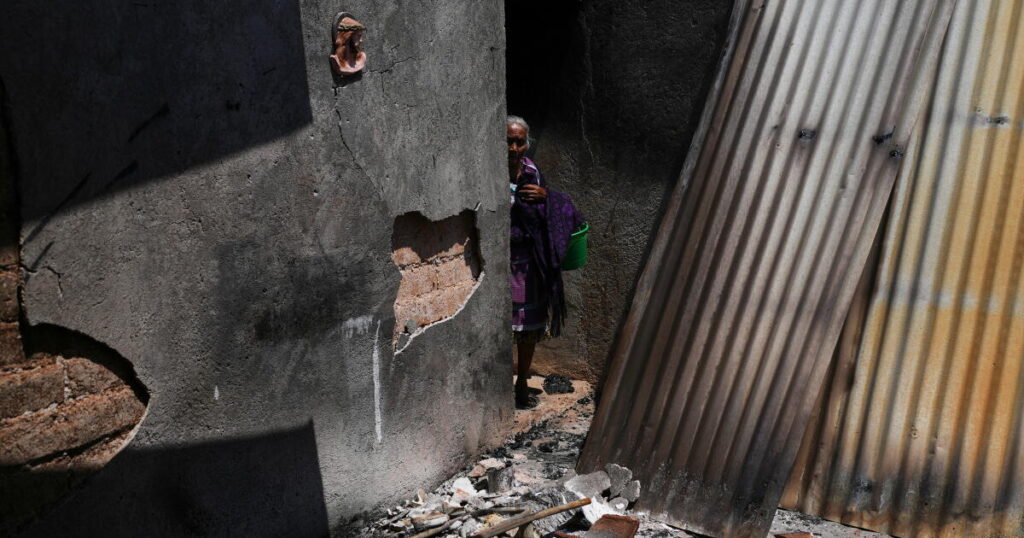
MEXICO CITY — Violence has forcibly displaced people from more than 500,000 households across Mexico in the last five years, according to new figures released by Mexico’s national statistics agency, the first numbers that speak to the depth of what many have described as an invisible internal displacement crisis.
Until now, Mexico’s government did not share comprehensive data on people who have been forced to flee their homes because of violence in many parts of Mexico, leaving civil society groups piecing together information to get a wider view of the problem.
The figures published by Mexico’s National Institute of Statistics and Geography, or INEGI — an autonomous government agency that has at times been at odds with Mexico’s ruling party — offer the first wider snapshot of the crisis.
Between October 2020 and October 2025, people in 510,000 households across Mexico were forced to flee to another part of the country. That could range from a single person to an entire family. The displacement affected 1.6 million people, including those forced to flee and those left behind to cope with the consequences of the crisis.
The figures show the problem has reached every corner of Mexico, but the states with the highest rates of displacement from cartel violence were Zacatecas, Morelos, Michoacan, Queretaro and Colima.
Other autonomous agencies, civil society groups and Mexican state governments have published data on internal displacement, but their findings often have been limited in scope.
Tracking internal displacement can be tricky because many people leave their homes in fear without the intention of being found or reporting their case, or hope to later return to their homes if they determine it’s safe.
David Mora, Mexico analyst for International Crisis Group, described the new data as a “major breakthrough” that will pave the way for authorities and civil society to address the long-term humanitarian consequences of the crisis. Those who are forced to flee criminal violence have almost no resources to turn to when they disappear into the fabric of Mexico and often have to start from scratch.
“For years, civil society and victims of forced displacement have been sounding the alarm on the issue and the federal government has not paid attention,” Mora said Friday. “So this coming from the independent INEGI, it’s a breakthrough. It’s huge that they’re trying to put a number on it, which is just the first step.”
The INEGI figures don’t include people displaced before 2020, meaning the number of displaced people across the country is likely much higher. Cartel violence has raged in key areas of Mexico since the beginning of the drug war around 2006 under the administration of former Mexican President Felipe Calderón. The data focus specifically on internally displaced people and don’t capture people who fled to the U.S.
Mexican President Claudia Sheinbaum has said little about the issue, focusing instead on the government’s efforts to reduce homicide numbers and crack down on criminal groups. She also is facing pressure from the Trump administration to show progress on security.
She has addressed specific cases of families being displaced from bursts of cartel violence, noting that authorities were working on finding a way for them to return home, but largely has not spoken about forced displacement as a widespread phenomenon.
At her morning news briefing Wednesday, Sheinbaum questioned the figures and said she had asked INEGI to provide further details about the data, including the questions and methodology used to reach those numbers.
Janetsky writes for the Associated Press.
The post Violence displaced members of more than 500,000 Mexican households in the last five years appeared first on Los Angeles Times.