UNITED NATIONS — Early this month, hundreds of diplomats huddled in a cavernous U.N. conference room in Switzerland, working toward a muscular treaty to regulate the use of lethal autonomous weapons — the first agreement governing the use of killer artificial intelligence arms. On the last day of negotiations, the talks turned aggressive.
Over the next roughly 15 hours, U.S. and Russian diplomats hammered away at the document, removing a range of provisions designed to safeguard the use of artificial intelligence in weapons, according to three people familiar with the negotiations, who spoke on the condition of anonymity to discuss sensitive closed-door proceedings, and documents reviewed by The Washington Post.
They stripped language requiring the systems to operate in a “predictable” and “reliable” manner, the people said, and removed a clause mandating that ethical considerations be taken into account when using AI weaponry. The U.S. and Russian teams also removed a provision requiring that humans review military targets developed by AI before a strike, they added.
In a closed-door session, with U.N. cameras turned off and civil society observers removed, Washington and Moscow deployed their army of about 10 lawyers each — nearly twice the diplomatic presence of other delegations — to make changes that moved so quickly that the smaller delegations were left dizzied, the three people said.
“It was death by a thousand paper cuts,” said one of the people.
The U.S. State Department, the Russian Foreign Ministry and the United Nations did not return requests for comment.
The erosion of the agreement, the details of which are previously unreported, shows how the United States and Russia have worked to weaken global rules to regulate lethal AI weaponry, as the Pentagon moves to rapidly infuse the burgeoning technology into its battlefield strategy.
The talks are happening amid a fierce public debate over the existential risks of advanced AI, as tech executives urge world leaders to collaborate to impose limits on the technology. The U.N. has for years tried to regulate AI weaponry with limited progress, and the latest directive is the furthest the effort has advanced.
Washington’s attempts to neutralize global rules on AI weaponry also provide insight into how it may approach regulating the U.S. military’s use of the technology. U.S. officials are currently revising the military’s own lethal autonomous weapons directive, released in 2023.
Verity Coyle, the deputy director for arms in the crisis, conflict and arms division at Human Rights Watch, said weak rules governing lethal AI weaponry could have significant consequences.
“It could mean machines can make life‑and‑death decisions without human control,” she said. “The practical impact is stark: more civilian harm, less accountability and a faster slide into riskier, automated warfare.”
Across the world, the use of artificial intelligence in war has moved from scenarios that are largely theoretical to actual battlefield use. The U.S. military used Anthropic’s chatbot to identify nearly 1,000 targets to strike in the first 24 hours of the war with Iran, according to The Post. Israel has heavily relied on AI for its military operations in Gaza, The Post reported.
Over the past few months, AI companies have disclosed that their bots have autonomously hacked the servers of other organizations — including U.S. government websites — and that nefarious actors in places such as Yemen and Iran have used chatbots to try to make weapons or target the U.S. military, sparking fears that the technology could become uncontrollable.
This month, an Anthropic researcher quit the company and warned the public that AI could end the human race, setting off a furious debate in Washington over how to regulate it before it poses an existential threat to humanity.
Amid this flurry of consternation, tech executives and global leaders have urgently called for AI regulation. At a meeting of the U.N. Security Council this week, OpenAI chief executive Sam Altman and Anthropic leader Dario Amodei called for nations to collaborate to create a model of global AI governance.
Regulation “must be shaped through democratic processes, by governments accountable to the people they serve,” Altman said. “At the international level, that means cooperation.”
But domestic attempts to regulate have reached a roadblock, with the Trump administration arguing that any rules on AI will stymie innovation.
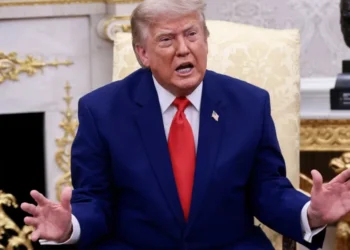
“The United States also totally rejects any attempt to construct a globalist scheme to control for the artificial intelligence being spoken of so much now — hereinafter officially called ‘super intelligence,’” President Donald Trump said at the United Nations on Tuesday.
The lethal autonomous weapons negotiations in the U.N. are currently nonbinding, though the talks could open the door to a landmark treaty that is legally binding if member nations agree. It presents the most advanced global effort to regulate how AI weapons are used in the battlefield.
But at the talks in Geneva in early September, it was apparent that the U.S. and Russia were going to be a major roadblock to progress, the three people said.
The U.S. team is led by State Department diplomats, Pentagon officials and legal experts, Coyle of Human Rights Watch said. “It’s a well‑resourced team, and they come prepared to defend U.S. military autonomy,” she said.
Nicole van Rooijen, the executive director of the global nongovernmental coalition Stop Killer Robots, said Washington and Moscow aren’t in favor of legally binding rules on autonomous weapons and have outsize influence on how negotiations will end.
The autonomous weapons talks require dozens of nations to reach consensus on what rules will be enacted, she added. The U.S. and Russia do not champion multilateralism — which requires countries to work together to reach agreements — and can use “political capital to exert pressure on other states,” she said.
“They have the power to block any significant progress that is made by the vast majority of states who do want to move forward on a binding treaty,” she added.
In November, nations will come together in Geneva to discuss whether talks can turn into an official mandate or potentially a legally binding treaty.
In the U.S., a parallel discussion is happening as the Pentagon works to rewrite its own directive on the use of autonomous weapons. In June, Trump issued a national security memorandum requiring that the directive be updated within 90 days. As of late September, the U.S. government has not released a new version.
Established in 2023 during the Biden administration, the directive contained several clauses that echo those eliminated from the U.N. document, including requiring that human judgment be deployed to check autonomous and semiautonomous weapons systems. It also mandated that those who operate AI weapons systems abide by the laws of war and applicable treaties.
Richard Lennane, the disarmament adviser for the legal team for the International Committee for the Red Cross, said global treaties can be impactful in controlling the use of harmful weapons, citing the effect that directives on chemical and biological weapons, antipersonnel land mines and cluster munitions have had on limiting use.
“It’s not about punishment, it’s about setting norms and influencing behavior,” Lennane said. “We believe that a treaty regulating autonomous weapons could be similarly effective.”
Coyle, however, noted that the U.S. and Russia have the diplomatic muscle, legal teams and political incentives to keep any global rules on autonomous weapons weak, and she said the actions to water down regulation on AI arms follow a well-trodden playbook.
“When the U.S. wants to preserve military or technological advantage, it pushes voluntary guidelines instead of binding rules,” Cole said. “We’ve seen the same playbook in cyber, space and other arms‑control debates. Autonomous weapons are no exception.”
The post U.S., Russia stripped human oversight from global AI weapons pact appeared first on Washington Post.