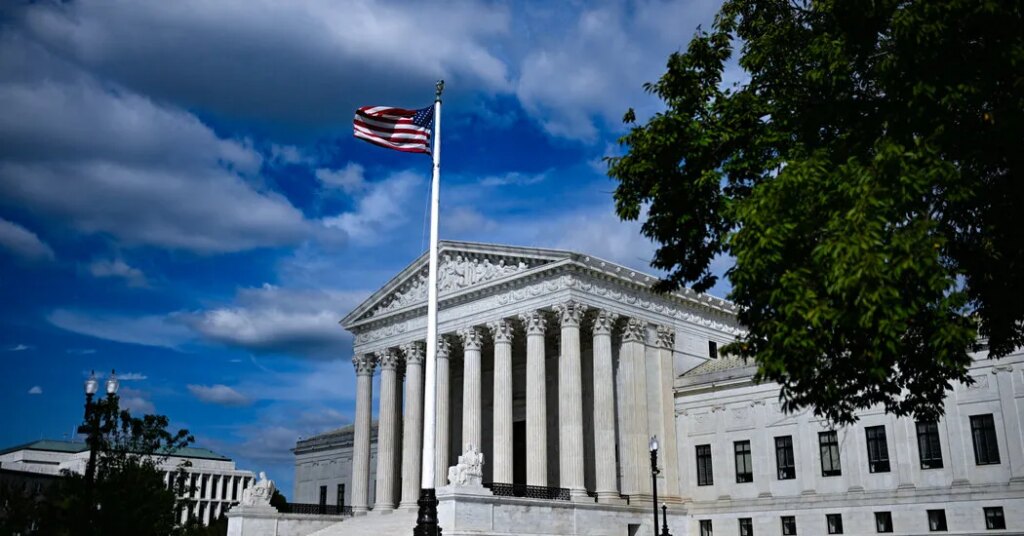
Friday’s Supreme Court ruling clearing the way for states to use a sweeping online system to identify ineligible voters is a victory for the Trump administration, which has routinely promoted unfounded claims of widespread illegal voting by noncitizens. But the impact of the decision on the November midterm elections is likely to be limited, according to election law experts.
That is largely because federal law establishes a 90-day “quiet period” before elections, in which wide-scale changes to state voter rolls cannot be made. The provision is meant to avoid last-minute chaos in elections, and is likely to prevent major changes ahead of the Nov. 3 midterms, experts said.
“I think this is going to have very little impact on the midterms,” said Derek T. Muller, a law professor and election law expert at the University of Notre Dame. “There’s very little runway for states to do very much before the election.”
David Becker, the executive director of the Center for Election Innovation & Research in Washington, concurred with that view.
“This decision will not have any significant impact on the 2026 election,” said Mr. Becker, whose nonpartisan group focuses on election security issues.
Still, in the coming weeks, Mr. Muller said, some states might use the federal database when they have “individualized suspicion” of certain voters, even though they cannot seek to use the system to try to purge voters on a broad scale.
“They’ll be using it in ways to evaluate whether or not, on an individualized basis, people are not citizens,” he said.
Friday’s unsigned emergency order allows states to use the database, known as Systematic Alien Verification for Entitlements, or SAVE, which had historically been used to determine the immigration status for people seeking certain benefits and licenses, in efforts to purge ineligible people from voter rolls. But states are not required to use the database, which expanded its scope under the Trump administration last year.
The Supreme Court’s three liberal judges dissented on Friday. Justice Ketanji Brown Jackson wrote that “if there is a bright side to today’s opinion,” it was that it “will likely have minimal short-term impact.”
But, she added, “the harm caused by burdening or disenfranchising even a few lawful voters outweighs the nonexistent harm that the government experiences when it is prevented from taking an action that it likely lacks the authority to take.”
Documented cases of noncitizen voting, which is illegal, are exceedingly rare. But President Trump and his allies, as part of a broader effort to sow doubts about elections, have claimed, without evidence, that the problem is widespread.
In an executive order last year, Mr. Trump directed several agencies to pool their records into the SAVE system, encouraging state and local officials to use it to verify the citizenship and immigration status of registered voters.
On Friday, several state officials said the ruling would not change their approach.
Ashley Hunt Esquivel, a spokeswoman for Paul Pate, the Iowa secretary of state, said that Iowa was already using SAVE and would not be affected.
“This ruling does not impact our processes in Iowa because of our participation in a previous lawsuit alongside a few other states,” she wrote in an email.
In Minnesota, Steve Simon, the secretary of state, said in a statement that the ruling would have no effect on the state’s elections — in part because the use of the program is not permitted under state law.
“Minnesotans should rest easy knowing that their right to vote won’t be impeded by this faulty project,” he said.
Angela Benander, a spokeswoman for Michigan’s secretary of state, Jocelyn Benson, said that Michigan had already been using SAVE in a limited capacity and that it would continue to do so.
“We wouldn’t cancel a voter’s registration on its own because the SAVE system indicates that they have noncitizen status,” she said. “It’s a clue, but it’s not the end of the investigation.”
Use of the SAVE system has drawn criticism for at times producing erroneous information.
Some states, including Michigan and Georgia, have used the system as a part of their multi-step voter verification process, but do not rely on it entirely. It has produced inaccuracies, flagging U.S. citizens in some instances.
For example, last October, the Texas secretary of state’s office said that it had “identified 2,724 potential noncitizens who are registered to vote in Texas” after “running the entire Texas voter list with more than 18 million voters through the SAVE database.”
But county officials soon began finding that many of the names of people that the system flagged were, in fact, citizens. Nearly a year later, the Texas secretary of state’s office said that it had further reviewed the data and found that at least 578 of those who were initially flagged — roughly 20 percent — were citizens.
The secretary of state’s office referred 117 names to the state attorney general for further investigation of potential cases of noncitizen voting.
In Missouri, 70 county clerks signed a letter in December 2025 that was sent to state House and Senate leadership that described the system as flawed, saying it regularly included “individuals we know to be U.S. citizens — our neighbors, colleagues and even voters we have personally registered at naturalization ceremonies.”
St. Louis County, Mo., found that around 35 percent of roughly 690 people initially flagged by the SAVE tool had been registered at naturalization ceremonies, Rick Stream, the Republican election director for the county, said earlier this year.
Richard Hasen, a law professor and election law expert at the University of California, Los Angeles, wrote in a blog post on Friday that both the majority decision of the Supreme Court and the dissenting opinion were in agreement that the case would have “limited impact” on the midterms.
Mr. Hasen noted, though, that a few “bold states” might try to implement “mass purges of purported noncitizens,” in a test of whether the Supreme Court might allow them to do so.
The post Supreme Court Ruling Could Have Limited Impact on Voter Screening in Midterms appeared first on New York Times.