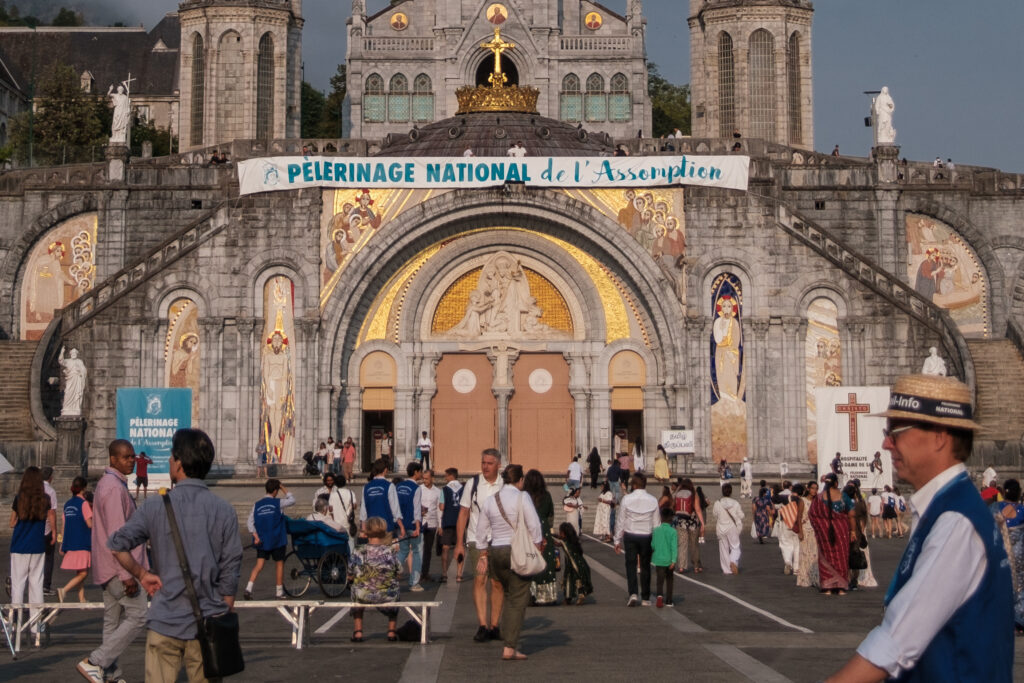
PARIS — The gold-flecked mosaics adorning the Basilica of Our Lady of the Rosary were installed in 2008 for the 150th anniversary of what the Catholic Church recognizes as miraculous apparitions of the Virgin Mary in Lourdes — one of the faith’s most sacred pilgrimage sites.
But when Pope Leo XIV visits on Saturday, the mosaics will be conspicuously covered. Their creator, Slovenian priest-artist Marko Rupnik, has been accused by at least 20 women — including current and former Catholic nuns — of sexual, physical and psychological abuse.
Rupnik, 71, is one the most prominent living Catholic artists, and the mosaics in Lourdes are among his many works housed in more than 200 churches across the globe. He was openly celebrated and championed by past popes.
But as Leo visits France, a secretive trial of Rupnik is unfolding in Vatican City and the case is raising difficult questions, including whether to condemn the art as well as the artist in a faith whose masters include convicted murderers like Carravaggio, the 16th-century Italian painter.
“It’s a very difficult problem because often people say, ‘if we destroy the art of all problematic artists, we will have to destroy many things throughout history,’” Bishop Jean-Marc Micas, who leads the Diocese of Tarbes and Lourdes, told The Washington Post.
Out of respect for abuse victims who make pilgrimages to Lourdes, Micas began covering some of Rupnik’s mosaics in 2025, before opting to cover all of them ahead of Leo’s visit.
Micas said his decision was consisted with one by the pope, who, he said, directed the Vatican last year to cease using images of Rupnik’s artwork in official communications.
So far, the Vatican has not issued broader guidance to churches holding Rupnik’s work, and most have left the art untouched.
“My answer is that I will solve a problem here in Lourdes, where people do not come to visit the mosaics of Rupnik, but to look for consolation from the Virgin Mary,” said Micas, who is weighing their permanent removal. “For me, nothing, including the mosaics, should be an obstacle to that.”
The Rupnik case highlights how sexual abuse scandals continue to plague the world’s largest Christian faith, posing a challenge for Leo who, even in Lourdes — one of Catholicism’s most revered holy sites — must confront the fallout.
In Lourdes, Leo is set to meet with a group of abuse victims as the issue threatens to overshadow his visit to the sacred sanctuary, a famed pilgrimage site drawing millions of devout elderly and Catholics in search of healing — including abuse survivors.
The location is famous for a series of 18 visions of the Virgin Mary by a 19th-century miller’s daughter, Bernadette Soubirous.
In Lourdes, Leo is slated to deliver a keynote speech on the sanctity of human life.
In June, an independent commission released details of large-scale abuse at Notre-Dame de Bétharram, a boarding school near Lourdes. The commission cited decades of “systemic” violence committed by clergy and lay staff between 1957 and 2004.
Last year, Hélène Perlant, 53, the eldest daughter of former prime minister François Bayrou, shocked France by publicly disclosing she was among the victims.
More broadly, Leo is visiting France five years after an explosive 2021 report found nearly 330,000 children in the country had been sexually abused over a 70-year period by Catholic priests or other church figures.
About 2,000 people have filed claims for reparations, with victims thus far receiving an average award from the church of about 37,000 euros ($42,000).
Some victims are criticizing Leo for meeting only a small and highly curated group of victims while in Lourdes. The critics insist he should also have made a contrite visit to the site of the boarding school, approximately 40 minutes away by car.
“This is a lost opportunity,” said Alain Esquerre, a victim of physical abuse at the Bétharram school and spokesperson for a victims collective. “They are only letting him speak to people who will not embarrass him and not ask him to acknowledge the extent of the problem and express shame. They are protecting the pope, not the victims.”
Leo has denounced sexual abuse as a “scourge” on the church, but victims’ groups are still awaiting further signs of how he plans to deal with the issue.
The Rupnik case is viewed as a key test.
“We haven’t seen or heard much from Leo yet on this topic, but we are anticipating, and hoping, he finally takes action in the Rupnik case,” said Anne Barrett Doyle, co-director of BishopAccountability.org, a watchdog group that tracks abuse cases in the church. “He knows the public will be watching.”
For decades, Rupnik reigned as a darling of the church.
His doe-eyed, placid figures created in oversize, irregularly cut and vibrantly colored tesserae were praised by senior clerics and adored by popes. His art adorns not only the Basilica of Our Lady of the Rosary, but Vatican City’s Apostolic Palace, the Sanctuary of Our Lady of Fatima in Portugal and Almudena Cathedral in Madrid.
The first allegations against Rupnik emerged in Italian blogs and religious sites in 2022, with the initial accusations played down by the Jesuit order to which he belonged. In 2023, however, the Jesuits dismissed him.
At a 2024 news conference, two of his accusers — Gloria Branciani and Mirjam Kovac, both former nuns — alleged that Rupnik sexually abused them, including by compelling them to have a threesome in northern Italy. They said he described the number three as being “like the [Holy] Trinity.”
Rupnik has never commented publicly on the allegations. Neither he nor representatives of the Aletti Center — the religious art foundation he helped found in Rome — responded to phone calls or a letter left at their office.
The Vatican declined to comment on the Rupnik case, citing the ongoing trial. But previously, it disclosed that Rupnik had been investigated since at least 2018.
Critics have accused the late Pope Francis — who kept work by Rupnik in his private apartment in Vatican City — of acting too generously toward him because they were both Jesuits.
In an unusual move, Rupnik was excommunicated briefly in 2020, only to have the decision lifted shortly after. Critics argue such action could not have happened without Francis’s consent.
In 2023, the Vatican divulged a private meeting Francis had with a close Rupnik collaborator, Maria Campatelli, who wrote a letter defending the artist from “a media campaign based on defamatory and unproven accusations.”
Laura Sgrò, an attorney representing five alleged victims of Rupnik, said in an interview that she has tried in vain since 2024 to have her clients participate in the Holy See’s case against the artist.
“No one has ever responded to me — not my written motions, registered mail, phone calls,” Sgrò said.
A group of Rupnik victims last week sent an open letter to Leo ahead of his trip to Lourdes, scathingly criticizing the secrecy of the ongoing Vatican trial.
They described the case as emblematic of the church’s uneven response and its knee-jerk instinct to conceal even decades after the first revelations of abuse by clergy.
They alleged that instead of being heard, Rupnik’s accusers have been vilified and condemned as “harlots” for reporting the abuse.
“This loud and prolonged silence is experienced by us victims as an additional and ongoing form of violence, which adds — with the weight of a boulder — to the violence we have already suffered,” Rupnik’s accusers wrote.
They concluded that, “it is futile to report abuse to ecclesiastical authorities, because nothing happens, no one is held accountable, and victims never receive justice.”
Victims’ groups have applauded the decision to cover Rupnik’s artwork in Lourdes, though some say a plaque or other informational guide should be added so worshipers can better understand the reason.
The Knights of Columbus of Washington, D.C. also opted to cover mosaics by Rupnik in the Saint John Paul II Shrine.
The Vatican however, has not issued a blanket directive on Rupnik’s work, and most churches have taken no action.
One sanctuary in Brazil this month moved forward with the inauguration of a new Rupnik mosaic — the last of four at the site.
“The Holy See is handling the Rupnik case, and the Holy See is the only entity with the tools to provide guidance on how to behave,” said Stefano Campanella, a spokesman for the Sanctuary of Saint Pio of Pietrelcina in San Giovanni Rotondo, Italy. “So far, no indications have arrived.”
At the sanctuary, Rupnik’s artwork still hangs unobstructed where Pope Benedict XVI blessed it in 2009.
At the end of a guided tour led personally by Rupnik, Benedict said: “Not only are they very beautiful, but they are also a lesson in theology.”
Experts say the question of what to do with Rupnik’s work is a familiar one for a church with a patchwork past. Caravaggio was convicted of killing a young man in a street brawl in the 17th century, and yet his art was — and still is — celebrated.
“I am drawing a parallel to Caravaggio, because there is a question here of a man and his work,” said Luca Ribichini, a professor of architecture at Rome’s Sapienza University. “And in some way, we should try and separate the two things.”
Pitrelli reported from Rome.
The post At sacred Lourdes, Pope Leo confronts a new reminder of the church’s sins appeared first on Washington Post.