In a time of massive accumulations of money and power by ultra-wealthy Americans, many on the left are convinced it’s time to soak the rich.
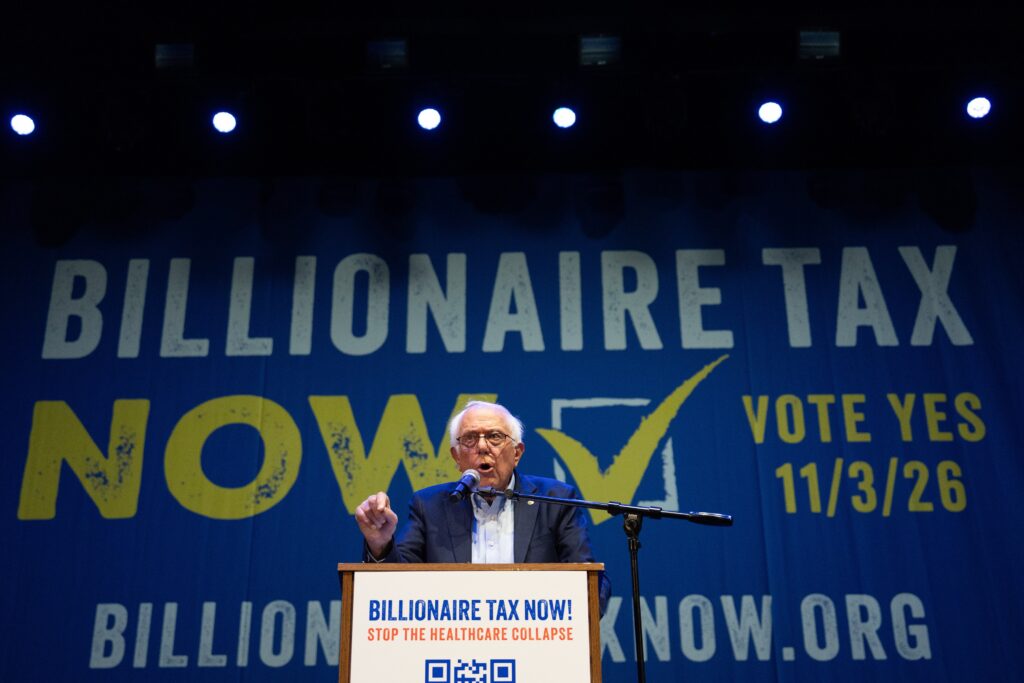
The latest test case is in California, where voters will decide in November whether to take one of every 20 dollars from the fortunes of moguls like Facebook founder Mark Zuckerberg and LinkedIn co-founder Reid Hoffman.
The campaign for California’s wealth tax proposal, known as Prop 40, is being watched nationwide for reasons behind its success or failure, as democratic socialists and others find increasing traction with ideas for reducing wealth inequality.
Much of the inspiration behind these ideas can be traced to a chart first disseminated by two young economists 25 years ago this month.
Over the years since, as Emmanuel Saez and his colleague Thomas Piketty have kept updating the numbers, the effort felt less and less like a purely academic exercise, Saez says. The unfairness he saw in a line representing the very rich’s share of income, shooting skyward, made him angry, he says.
The chart shows how much of America’s total income goes to the richest families. In the mid-1970s, the top 1 percent took in about 9 percent of all income, the economists found. By 2001 when they distributed the chart in a working paper, that share had grown to more than 18 percent. And it has continued to rise.
“I do feel, like my fellow humans you know, that the way resources are distributed across society is an important issue,” Saez, a soft-spoken, French-accented professor now at the University of California at Berkeley, said in an interview.
Saez is also one of the architects of Prop 40, which would impose a one-time 5 percent tax on the net worth of some 250 state residents each worth more than $1 billion.
The proposal faces opposition bankrolled largely by a handful of Silicon Valley billionaires. And even many traditional Democratic allies such as teachers and other labor groups have lined up against it, concerned that proceeds from the tax are slated mostly for health care, leaving little for other priorities.
Others say the proposal will backfire by driving billionaires and their fortunes away, which would cut into California’s revenue in the long run. One billionaire who has already fled the state, tech investor and White House official David Sacks, has taken to calling the measure an “asset seizure.”
The polls are mixed: one poll conducted this month showed just over half of California’s likely voters backing Prop 40, another showed fewer than halfof likely voters supported it.
Whatever happens, the push by many Democrats for wealth taxes in other states and nationwide is unlikely to go away, as the ultra-rich amass resources faster than everyone else. Exhibit A for that trend is the set of charts that Saez and Piketty have spent a quarter century updating.
“We got attention first from the press,” Saez said, “and then from a number of policymakers on the left saying, ‘We should do something about it.’”
In 2009, the American Economic Association awarded Saez its top honor for economists under 40. The next year, he received a MacArthur “genius grant.”
Piketty went on to write “Capital in the Twenty-First Century,” a 2014 bestseller on wealth and inequality that made him one of the field’s best-known voices.
Their claim of rising income inequality has been challenged by critics who raise several objections, including that tax returns leave out too much of what people actually receive.
“Important sources of income are missing in tax data, including government transfer payments and nontaxable employer-provided benefits,” wrote two government economists, Gerald Auten at the Treasury Department’s Office of Tax Analysis and David Splinter at the Joint Committee on Taxation, in a peer-reviewed 2024 study of inequality trends.
But reports by the nonpartisan Congressional Budget Office lend support to Saez and Piketty’s assertion of rising top incomes. The CBO found this year that, even when counting federal taxes and government aid, the top 1 percent’s share of household income nearly doubled from 7.4 percent in 1979 to 14.4 percent in 2022.
Saez argues that the tax system, as built, cannot reach the most extreme wealth because those fortunes grow mostly through rising stock prices, not salaries, and unrealized gains go untaxed. “Billionaires can accumulate their enormous wealth by paying very low taxes relative to those gains,” he said.
Saez helped Sen. Elizabeth Warren (D-Massachusetts) craft a wealth tax proposal during her 2020 presidential run. Others interested in implementing wealth taxes also have sought his help, including the California health care union behind Prop 40.
The measure’s opponents include California’s Democratic governor, Gavin Newsom, who says it will put his state at a disadvantage and favors a national wealth tax instead.
Conservative critics go further, arguing that heavily taxing rich people chokes growth by discouraging them from taking the entrepreneurial risks needed to launch successful businesses.
Saez says history shows that taxing the rich doesn’t stop growth. The United States had its best stretch of economic growth from the New Deal in the 1930s to the 1970s, he said, when top income tax rates reached 70 percent and higher.
“The U.S. provides a clear demonstration that you can have a dynamic economy that works for everybody,” he said, “while having very substantial taxation at the top.”
The post The chart that inspired California’s billionaire tax campaign appeared first on Washington Post.