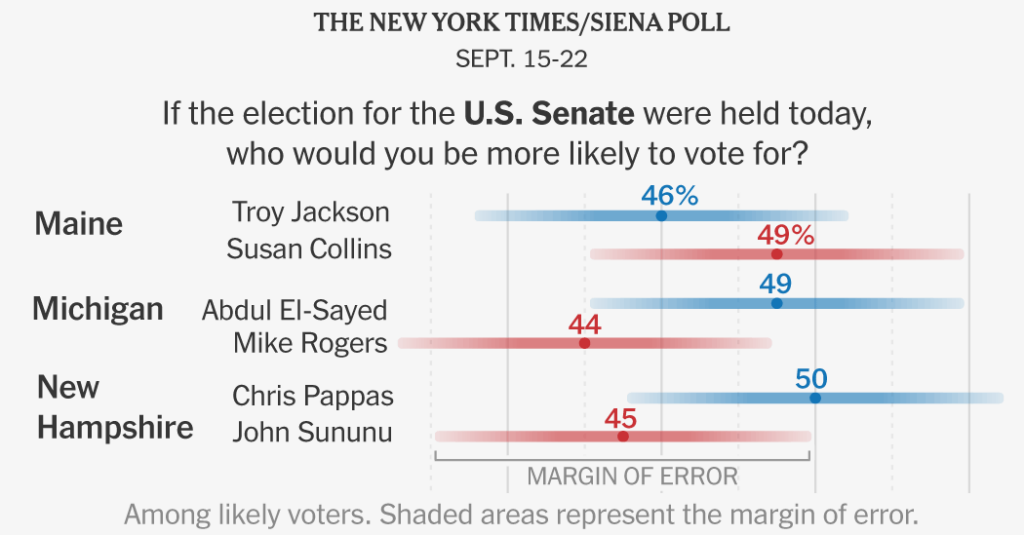
Democrats appear to be holding off Republican attempts to flip Senate seats in Michigan and New Hampshire but are struggling in their efforts to oust a Republican in Maine, according to New York Times/Siena University polls of three battlegrounds.
In Michigan, the party’s nominee, Dr. Abdul El-Sayed, has consolidated Democratic support despite worries about party unity after a divisive primary race. He leads his Republican opponent, former Representative Mike Rogers, by five percentage points.
In New Hampshire, the Democratic nominee, Representative Chris Pappas, is running five points ahead of his Republican rival, former Senator John E. Sununu. The result could dampen Republican hopes that the state might be more competitive than expected.
But in Maine, Senator Susan Collins, who has been seen as her party’s most vulnerable incumbent, holds an edge of three points over Troy Jackson, her Democratic challenger. Her showing, which comes after a sudden switch of the Democratic nominee, could fuel Democratic worries that they will again lose to Ms. Collins in the light-blue state.
[Follow all of the latest polls heading into November’s elections.]
The results underscore the uncertainty both parties are confronting in a series of tight Senate contests. While Republicans are navigating an increasingly grim national political environment, Democrats face a challenge in winning races against well-established G.O.P. politicians with long histories of serving their states.
To win control of the Senate, Democrats must flip four Republican-held seats, including some in states President Trump won by double digits, and keep all of their own. Maine was widely considered Democrats’ best chance of defeating an incumbent Republican, but their prospects were scrambled after the summer implosion of Graham Platner’s campaign and Mr. Jackson’s quick ascent.
The survey is the worst result for Mr. Jackson in any public poll since he earned the nomination in July.
The poll was conducted almost entirely before ProPublica published a report on Tuesday detailing how the F.B.I. in 2025 shut down an inquiry into allegations that a top ally of Ms. Collins’s had participated in a scheme to funnel illegal campaign contributions from a defense contractor. A Collins spokeswoman vigorously denied the allegations.
The poll found that independent voters, a crucial group, were deeply divided over whom to support in the three states. In both Michigan and Maine, independents were nearly evenly split between Democrats and Republicans. In New Hampshire, the group leaned toward supporting Mr. Pappas, the Democrat, by 10 points.
In all three states, the Democratic candidates are being lifted by a broad dislike of Mr. Trump and his policies. A majority of voters disapproved of his handling of a series of top issues, including immigration, tariffs, the war with Iran, the cost of living and gas prices. Nearly two-thirds of voters described the president as generally focused on the wrong issues.
“I hate to be so partisan, but my feelings right now are there are no Republicans that are willing to stand up to Trump,” said Scott Grady, an independent from Hillsborough, N.H., who is supporting Mr. Pappas. “That’s forcing me to not even look at the Republican side of the ticket and just want to vote straight Democratic.”
Yet across all three states, the Republican nominees for Senate outperformed Mr. Trump’s 35 percent approval rating, sometimes by double digits. Their stronger standing signals that some G.O.P. candidates might be able to overcome the drag that the unpopular president is causing on his party.
While a majority of voters in these states view the Republican Party as too far to the right, most voters do not see the G.O.P. candidates in their states as too extreme.
And in all three states, support for the individual Democratic candidates falls short of a general desire for the party to win power in Congress. Overall, 54 percent of voters said they would prefer Democrats to control the Senate, a greater share than the percentage supporting any of the three candidates.
In Maine, 12 percent of voters who said they preferred Democrats to control the Senate also said they planned to support Ms. Collins — a split that helped explain her lead.
Views of Ms. Collins have warmed slightly since June, when she was narrowly underwater with voters in the last Times/Siena poll of Maine. Now a majority — 51 percent — view her positively, including nearly half of independent voters.
Ms. Collins is also seen by a majority of Maine voters as more likely than Mr. Jackson to be an effective senator and as having better character. By contrast, Mr. Jackson is viewed more unfavorably than favorably.
The survey shows that voters tend to agree with what Ms. Collins has pitched as her strongest selling point: that she delivers for the state. By a wide margin, voters were more likely to see her as better at bringing money and resources to Maine as they were to say the same of Mr. Jackson.
Ms. Collins still faces headwinds in the state, though. A majority of Mainers, including a majority of independents and 12 percent of Republicans, said they preferred a candidate who would provide a check on Mr. Trump.
Claude Junkins, a Republican in Holden, Maine, said he planned to support Ms. Collins despite her support of Mr. Trump.
“Sometimes she does go with some of Trump’s crazy ideas, and you’ve got to wonder sometimes what she’s thinking,” said Mr. Junkins, 70, a retired facilities director.
But he added: “She works for Maine. If it’s got anything to do with Maine, she’s going to fight for us.”
In Michigan, support for Dr. El-Sayed appears to be fueled by the popularity of his economic message and his vocal support for single-payer health care. He is more trusted to handle the cost of living by nine points, the only Democrat who is more trusted on the issue across the three states. And despite a bitter primary, a whopping 95 percent of Democrats are now supporting his candidacy.
Dr. El-Sayed is also winning 8 percent of voters who supported Mr. Trump in the 2024 election, more than either of the other two Democrats in the survey.
Abel Kang, a social worker from Grand Rapids, said he knew very little about Mr. Rogers other than his support of Mr. Trump. Mr. Kang said he planned to support Dr. El-Sayed largely because of economic issues and his support of single-payer health care.
“He is talking about free health care,” said Mr. Kang, 47, an independent. “Personally, I think that is a necessity. It’s a basic human need.”
In all three Senate races, economic worries far outpace concerns about foreign policy — either the war with Iran or the situation in Israel and Gaza. Thirty-six percent said economic concerns, including jobs, inflation and the cost of living, were the most important issue deciding their vote, while only eight percent named foreign policy.
Concerns about foreign policy were more pronounced in New Hampshire and Michigan, where debates over Israel have raged in both the Democratic primary and the general election.
Voters in Michigan were divided over which candidate they trusted to best handle foreign wars: 46 percent preferred Dr. El-Sayed, while 43 percent preferred Mr. Rogers.
“I trust him zero percent,” Sandra Campbell, a self-described moderate conservative from Macomb county, said of Dr. El-Sayed. “I think that he would lean more toward foreign policy that would be anti-American.”
In recent weeks, Republicans have grown more hopeful of pulling off an upset in New Hampshire, which is seen as competitive despite not electing a Republican to the Senate since 2010. But the poll indicates that Mr. Pappas has a comfortable lead.
Still, even in New Hampshire, views of the Democratic Party brand remain dim, with majorities saying Democrats are divided and generally focused on the wrong issues.
Across all three states, 44 percent of Democrats said they identified as “democratic socialist,” while 50 percent said they did not. Just 21 percent of Democrats viewed socialism unfavorably.
“The Democrats need to get a message,” said Laura Platt-Lunardo, an independent from Exeter, N.H., who is supporting Mr. Pappas. “And they need to get some core things down, like this is what we’re actually going to do and this is how we’re going to do it.”
The post Democrats Show Strength in Michigan Senate Race but Trail in Maine, Polls Find appeared first on New York Times.